
Scattered quietly across the Purdue campus stand a handful of trees that look no different from any of their neighbors. Yet each one carries an extraordinary secret in its rings: it began life not in an Indiana greenhouse, but in orbit around the Earth. Known affectionately as the “space trees” or “shuttle gums,” these sweet gums and a lone sycamore grew from seeds that traveled aboard NASA’s Space Shuttle, germinated in the weightlessness of low-Earth orbit, and were carried back home by two Purdue alumni who became astronauts. They are among the most remarkable—and most overlooked—specimens in the Arboretum’s living collection.
The Space Trees at a Glance
- What they are
- Sweet gum and sycamore trees grown from seeds germinated in space
- On campus
- Several sweet gums and one sycamore
- The missions
- Shuttle Discovery, STS-41-D (1984); Shuttle Atlantis, STS-27 (1988)
- Astronauts
- Charles Walker and Jerry Ross, both Purdue graduates
- Nicknames
- “Space trees”, “shuttlegums” and “space sycamore”
The Shuttlegums: Charles Walker and Shuttle Discovery
Most of Purdue’s space trees are sweet gums, and they trace back to 1984 and to Purdue alumnus Charles Walker, a 1971 graduate. In August of that year, Walker flew aboard STS-41-D—the very first mission for both Walker himself and for the brand-new Space Shuttle Discovery. During the flight, the crew germinated 200 sweet gum tree seeds in orbit.
The young trees spent five years at an arboretum in St. Louis before Walker donated several of them to Purdue in 1992. Purdue’s Grounds staff, who nurtured the seedlings in the University nursery, dubbed them “the shuttlegums”—and once the trees were large enough to survive outdoors, they transplanted them into generally inconspicuous spots around campus. To the everyday passerby they look like ordinary sweet gums, which is precisely what makes them such a delightful discovery. As Purdue arborist Tim Detzner put it, Walker “thought it would be an interesting contribution for Purdue to have.”
The last of the donated shuttlegums to find a home on campus was transplanted into Pickett Park on October 12, 1999, as part of a park renovation given by the Purdue Class of 1999. A plaque at its base dedicates it as a living memorial to Purdue’s aerospace tradition.
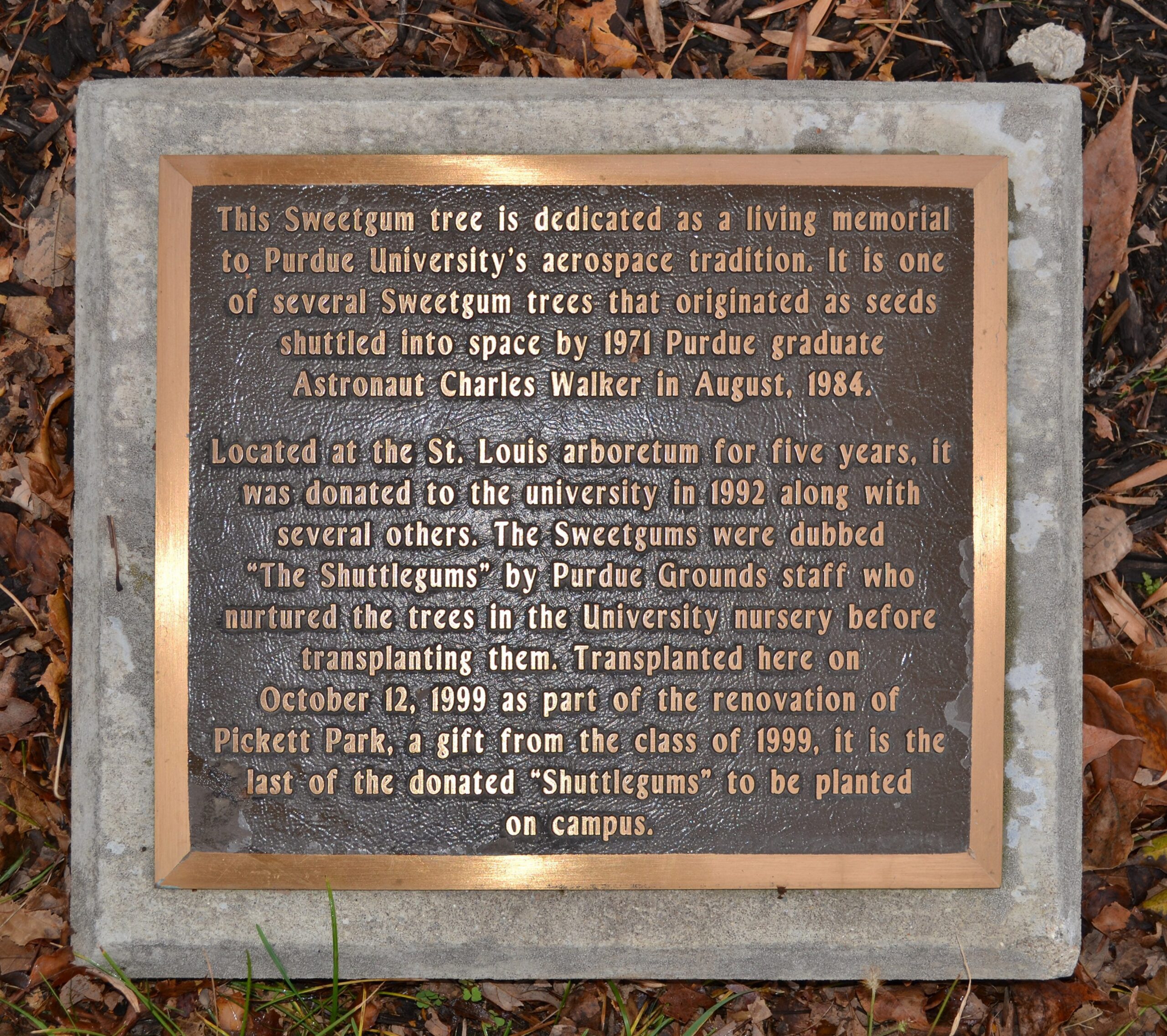
The Shuttle Gum Plaque at Pickett Park
“This Sweetgum tree is dedicated as a living memorial to Purdue University’s aerospace tradition. It is one of several Sweetgum trees that originated as seeds shuttled into space by 1971 Purdue graduate Astronaut Charles Walker in August, 1984. Located at the St. Louis arboretum for five years, it was donated to the university in 1992 along with several others. The Sweetgums were dubbed ‘The Shuttlegums’ by Purdue Grounds staff who nurtured the trees in the University nursery before transplanting them. Transplanted here on October 12, 1999 as part of the renovation of Pickett Park, a gift from the class of 1999. It is the last of the donated ‘Shuttlegums’ to be planted on campus.”
The Sycamore: Jerry Ross and Shuttle Atlantis
Four years after Walker’s flight, a second Purdue astronaut added a single, special tree to the collection. Jerry Ross—who earned his bachelor’s degree in mechanical engineering from Purdue in 1970 and his master’s in 1972—flew as Mission Specialist 2 aboard the Space Shuttle Atlantis on STS-27, a four-day mission that ran from December 2–6, 1988. On that flight Ross carried seed packets of sycamores, sweet gums, and tulip poplars to be germinated in space, as part of a project to give back to Indiana’s 4-H community. From those seeds grew the tree now celebrated as Purdue’s “Space Sycamore.”
When Ross returned to Earth, Purdue forestry professor Walter Beineke grew the sycamore seed into a seedling in the university’s greenhouses. After about a year and a half, the young tree was ready, and in the spring of 1990 it was planted on the south side of the Lilly Hall of Life Sciences to mark an anniversary of Purdue Extension. Ross went on to a legendary career: he shares the record for the most launches into orbit with seven Space Shuttle missions, performed nine spacewalks, retired in 2012, earned 15 NASA medals, and was inducted into the Astronaut Hall of Fame in 2014.
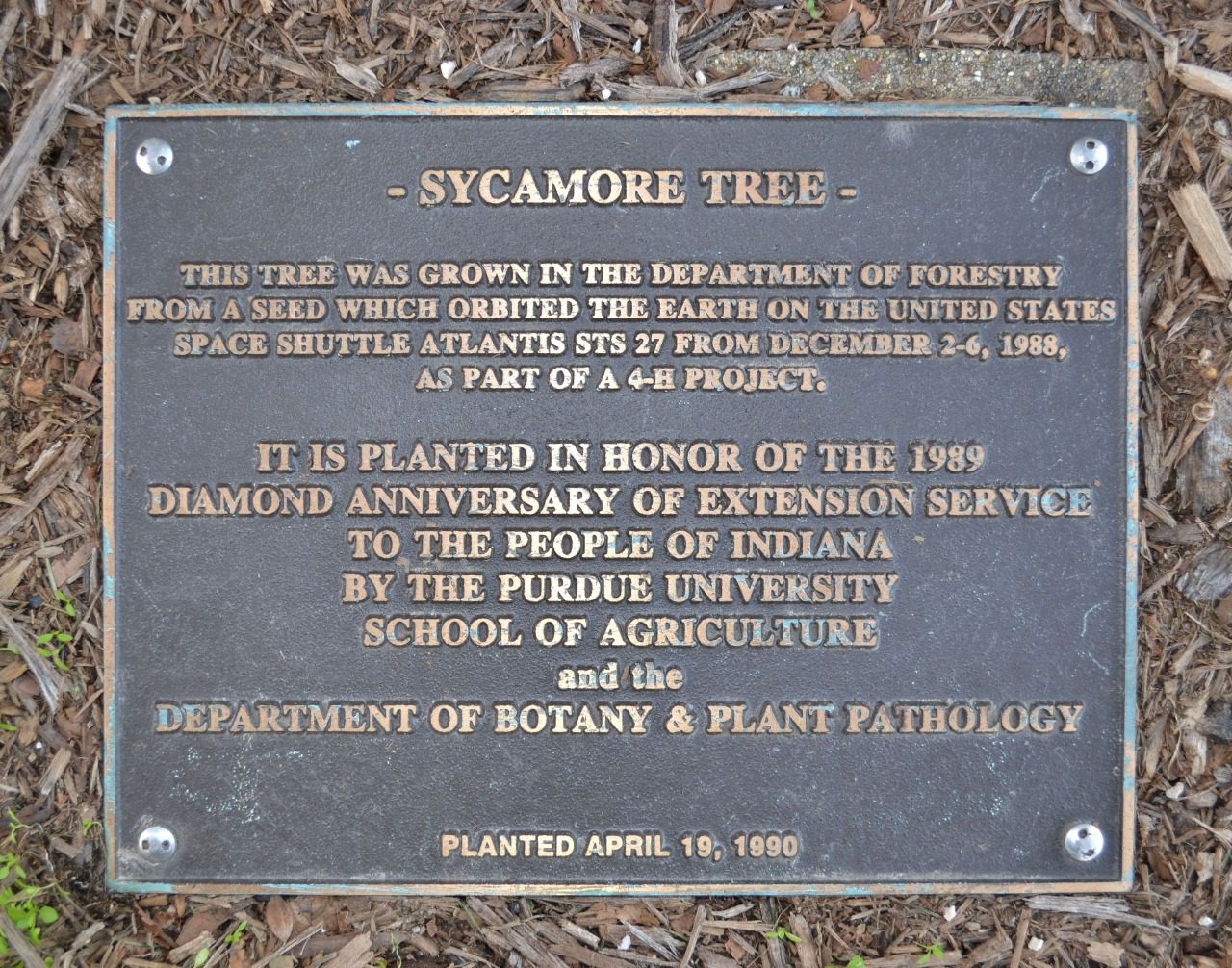
The Space Sycamore Planted at Lilly Hall
– Sycamore tree –
This tree was grown in the Department of Forestry from a seed which orbited the Earth on the United States Space Shuttle Atlantis STS 27 from December 2–6, 1988, as part of a 4-H project.
It is planted in honor of the 1989 Diamond Anniversary of Extension Service to the people of Indiana by the Purdue University School of Agriculture and the Department of Botany & Plant Pathology.
Planted April 19, 1990
Meet the Astronauts
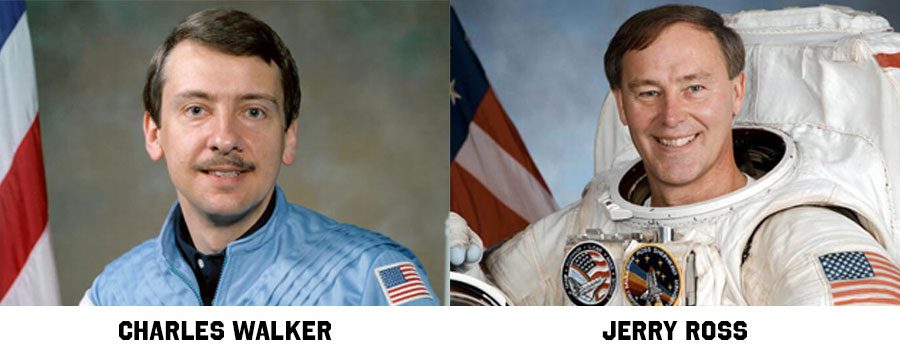
Charles Walker — Purdue Class of 1971. Flew on STS-41-D (August 1984), the maiden voyage of Shuttle Discovery; his crew germinated 200 sweet gum seeds, several of which became Purdue’s shuttlegums.
Jerry Ross — Purdue Class of 1970 (B.S.) and 1972 (M.S.), mechanical engineering. Seven shuttle flights, nine spacewalks, Astronaut Hall of Fame (2014). Carried sycamore, sweet gum, and tulip poplar seeds on STS-27 (1988).
Finding the Space Trees on Campus
The space trees are spread across campus in unassuming locations. Most have a small plaque at their base explaining their history and significance, but otherwise look no different from the surrounding trees.
[pu_arb_map accessions=”ORIG_0793*A” name_numbers=”21410″]
A Living Legacy
For visitors to the Purdue Arboretum, the space trees offer something rare: a chance to stand beneath living organisms that have literally been to space and back. They are, in the words of dendrology laboratory manager Sally Weeks, “an oddity for Purdue’s campus” that “add a little bit of status for us, being from a space program.” More than three decades after they were planted, they continue to quietly connect the campus landscape to the university’s storied place in the history of flight.
So the next time you pass a sweet gum in Pickett Park, or pause beneath the sycamore at Lilly Hall, look for the small plaque at its base. That unassuming tree once floated in the darkness above the Earth—a reminder, as one early chronicler wrote, of “just how close space is.”
Sources
- Mayer, Wendy. “Space Sycamores: A Legacy of Hope, Friendship.” Purdue University College of Agriculture, Department of Forestry & Natural Resources, June 1, 2021. Read the article
- Goodrich, Allie. “Purdue campus houses trees germinated in space.” Purdue Exponent, February 18, 2011. Read the article
- “Trees…. From Space?” Purdue Traditions (blog), May 1, 2015. Read the article
- “Uncovering Hidden Purdue.” Journal & Courier (jconline.com), September 6, 2017. Read the article