
A handful of trees in the Arboretum began life not in a nursery, but in orbit. Here is how they got there—and how they came home to Purdue.
Walk almost anywhere on the Purdue campus and you will pass trees without giving them a second thought. A few of them, though, are worth stopping for. Tucked among their ordinary-looking neighbors is a small group of sweet gums and a single sycamore whose stories begin more than a hundred miles above the ground. Their seeds were carried into orbit aboard NASA’s Space Shuttle, sprouted in weightlessness, and were brought back to Earth by two Purdue graduates who had become astronauts. Grounds crews long ago nicknamed them the “shuttlegums,” and to this day they remain some of the most surprising residents of the Arboretum’s living collection.
You would never guess their origin by looking at them, which is part of the fun. This page is your field guide to the space trees: where their seeds traveled, who brought them home, and where you can go to stand beneath a tree that has literally been to space and back.
The Space Trees at a Glance
What they are: Sweet gums and one sycamore, grown from seeds that germinated in orbit
Where to find them: Scattered across the Purdue campus (see the map below)
The flights: Space Shuttle Discovery, mission STS-41-D (1984); Space Shuttle Atlantis, mission STS-27 (1988)
The Boilermakers behind them: Astronauts Charles Walker and Jerry Ross, both Purdue graduates
The nickname: The “shuttlegums,” coined by Purdue Grounds staff
The Shuttlegums: A Sweet Gum Story
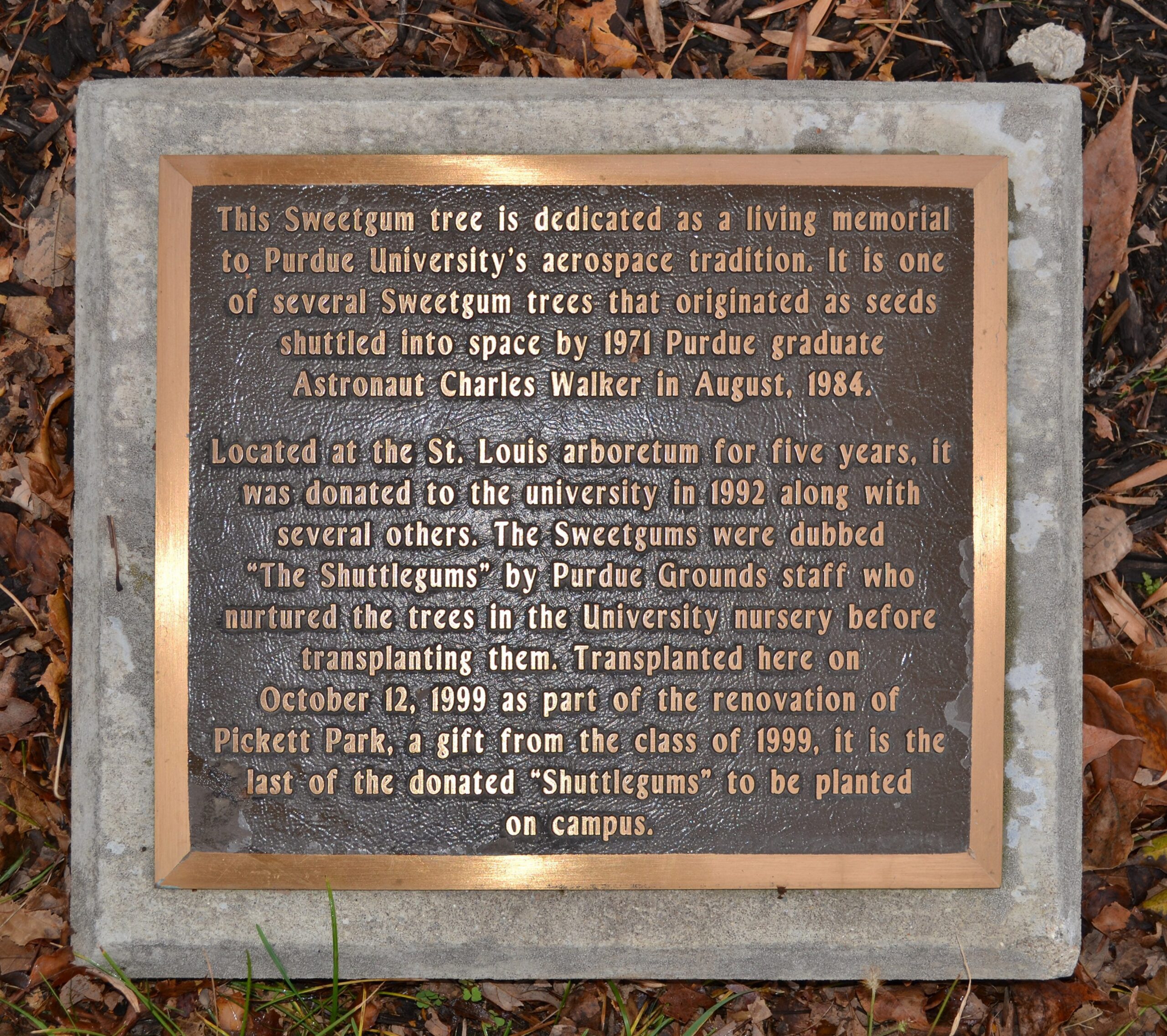
The Shuttle Gum Plaque at Pickett Park
“This Sweetgum tree is dedicated as a living memorial to Purdue University’s aerospace tradition. It is one of several Sweetgum trees that originated as seeds shuttled into space by 1971 Purdue graduate Astronaut Charles Walker in August, 1984. Located at the St. Louis arboretum for five years, it was donated to the university in 1992 along with several others. The Sweetgums were dubbed ‘The Shuttlegums’ by Purdue Grounds staff who nurtured the trees in the University nursery before transplanting them. Transplanted here on October 12, 1999 as part of the renovation of Pickett Park, a gift from the class of 1999. It is the last of the donated ‘Shuttlegums’ to be planted on campus.”
Most of the space trees you will find on campus are sweet gums, and they owe their existence to Charles Walker, who earned his Purdue degree in 1971. In August 1984 he launched aboard STS-41-D, a mission that doubled as the very first flight of the Space Shuttle Discovery and Walker’s own first trip to space. Somewhere in the crew’s busy schedule, 200 sweet gum seeds were coaxed into sprouting in the strange, floating environment of low-Earth orbit.
The seedlings did not come straight to West Lafayette. For about five years they grew at an arboretum in St. Louis, and it was not until 1992 that Walker gave several of them to his alma mater. Once they arrived, Purdue’s Grounds crew took the young trees under their care in the University nursery, affectionately calling them the “shuttlegums.” As each tree grew sturdy enough to handle an Indiana winter outdoors, it was moved to a permanent home somewhere on campus—usually a quiet, everyday spot where a passerby would never suspect anything unusual. In the words of Purdue arborist Tim Detzner, Walker simply thought the trees would make an interesting gift for the university to keep.
The final shuttlegum to be planted came to rest in Pickett Park on October 12, 1999, set into the ground during a park makeover funded by the Purdue Class of 1999. A small plaque marks it as a living tribute to the university’s long history in aviation and space.
The Space Sycamore: A Seed With a Mission
The Arboretum’s lone space sycamore has a different pedigree. It goes back to Jerry Ross, who collected two mechanical engineering degrees from Purdue—a bachelor’s in 1970 and a master’s in 1972—before flying for NASA. In December 1988 he served as a mission specialist aboard the Space Shuttle Atlantis on STS-27, a short four-day flight that ran from the 2nd through the 6th. Among the items Ross carried were packets of sycamore, sweet gum, and tulip poplar seeds, meant to be sprouted in orbit as part of a project connected to Indiana’s 4-H youth program. One of those sycamore seeds became the tree Purdue now proudly calls its “Space Sycamore.”
Turning a space-flown seed into a plantable tree took patience. A Purdue forestry professor, Walter Beineke, raised the seedling in the university’s greenhouses for roughly a year and a half. By the spring of 1990 it was ready for the ground, and it was planted on the south side of the Lilly Hall of Life Sciences to help mark a milestone anniversary of Purdue Extension. Ross, for his part, went on to one of the most decorated careers in spaceflight history: seven shuttle missions (a record for launches that he shares), nine spacewalks, fifteen NASA medals, and, in 2014, induction into the Astronaut Hall of Fame. He retired from NASA in 2012.
Meet the Astronauts
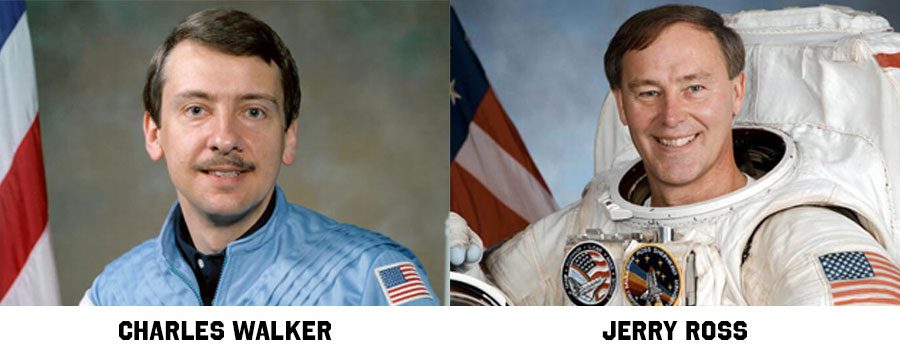
Charles Walker — Purdue Class of 1971. Flew on STS-41-D (August 1984), the maiden voyage of Shuttle Discovery; his crew germinated 200 sweet gum seeds, several of which became Purdue’s shuttlegums.
Jerry Ross — Purdue Class of 1970 (B.S.) and 1972 (M.S.), mechanical engineering. Seven shuttle flights, nine spacewalks, Astronaut Hall of Fame (2014). Carried sycamore, sweet gum, and tulip poplar seeds on STS-27 (1988).
Finding the Space Trees on Campus
Part of the charm of the space trees is that they hide in plain sight. Some of them carry a modest plaque at their base telling their story, but otherwise they look like any other sweet gum or sycamore you might stroll past. The Space Sycamore at Lilly Hall is also included on Purdue’s self-guided Space Walks gold tour, making it an easy addition to a campus visit. Use the map below to track the trees down and see for yourself.
🗺️ Map of the Campus Space Trees
[ MAP PLACEHOLDER — insert interactive campus map of the Space Tree locations here. ]
Why These Trees Matter
There is something quietly wonderful about walking up to a tree and realizing it has traveled farther than most ever will. That is the gift the space trees offer to anyone who visits the Arboretum. Sally Weeks, a former dendrology lab manager in Purdue’s Department of Forestry and Natural Resources, has described them as an oddity that lends the campus a little extra distinction, given their ties to the space program—and it is hard to disagree. Decades after their seeds drifted in orbit, these unassuming trees still link the everyday campus landscape to Purdue’s remarkable record in the history of flight.
So the next time you find yourself near Pickett Park or passing Lilly Hall, slow down and look for the plaque at the base of a nearby tree. You may be standing beside a living thing that once floated in the dark, weightless quiet above our planet—proof that space is never quite as far away as it seems.
Sources
- Mayer, Wendy. “Space Sycamores: A Legacy of Hope, Friendship.” Purdue University College of Agriculture, Department of Forestry & Natural Resources, June 1, 2021. Read the article
- Goodrich, Allie. “Purdue campus houses trees germinated in space.” Purdue Exponent, February 18, 2011. Read the article
- “Trees…. From Space?” Purdue Traditions (blog), May 1, 2015. Read the article
- “Uncovering Hidden Purdue.” Journal & Courier (jconline.com), September 6, 2017. Read the article