
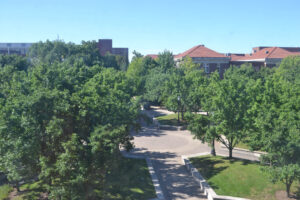
Academy Park is a landscaped pedestrian green space in the heart of the Purdue University campus, replacing a series of streets and parking lots. The five-acre tract includes sidewalks connecting the buildings surrounding the mall, bicycle and some automobile parking, and seating areas for students and staff. The seating areas are enhanced by a diverse planting of trees, which provides a pedestrian-scaled space.
Academy Park honors the quest for knowledge by Purdue faculty and the origin of that tradition in ancient Greece.
Academy Park is inspired by The Academy, founded by Plato in the fourth century B.C. to carry on the intellectual tradition of his mentor, Socrates. Here Plato also taught Aristotle. The Academy was a place where ideas were exchanged and discussed, where teaching, learning, and thinking were done. The traditions and intellectual discourse of ancient Greece form the foundation of Western thought, including the principles of political and intellectual freedom. At the heart of the philosophy of Socrates, Plato, and Aristotle was the notion that the education of citizens was imperative for the functioning of society. The words of each adorn the limestone-and-granite obelisk in Academy Park. The words on the obelisk of another Greek philosopher, Diogenes, perhaps tell best the good that faculty do and the reason Academy Park honors them: “The foundation of any state is the education of its youth.”
On warm days, students are arrayed on the park’s grassy slopes. Professors stand above or below the class – or lounge off to the side in a way that makes it hard to tell who is teaching whom.
Since its opening in 1997, the space has been used as an informal outdoor classroom, a stage for live performances, and a forum for student presentations.
Academy Park can be reserved through Purdue’s Space Management and Academic Scheduling department.