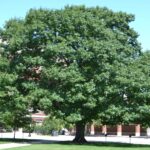
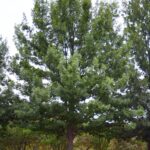
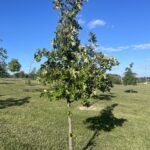
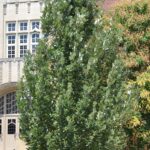
Tree Indiana Native Quercus rubra [Red Oak] One of the best and most reliable of oaks as a shade or street tree. More vigorous and fast-growing than most oaks. Good street tree since it performs reasonably well in small soil volumes (although it tends to branch close to ground). Oak wilt disease has been troublesome in certain areas of the Midwest. Hybridizes easily with other oaks (be careful of source).
Tree Indiana Native Quercus shumardii [Shumard Oak] The Shumard Oak is a handsome tree that is drought and air pollution tolerant, and but can also be used in rain gardens. Transplanting and establishment can be difficult.
Tree Quercus sp. [Oak] Oak species consist of 2 groups - Red/Black and White. This genus can be used all over the United States, and can thrive in various environments. It adds lots of shade to a landscape.
Tree Indiana Native Quercus stellata [Post Oak] A tough find in Indiana and mostly encountered in the wild throughout the southern states, the native Post Oak can be found in oak-hickory forests of southern Indiana. Open grown trees have a dense, round-topped crown with spreading branches for shade. Bark is similar to the White Oak, gray-brown in color with flat ridges, somewhat scaly, eventually ridged and furrowed. Fall color can vary, ranging from deep red to a golden brown.
Tree Indiana Native Quercus velutina [Black Oak] Quercus velutina is a large, deciduous oak with an irregular canopy. It is closely related to Q. rubra (Red Oak), which it is known to hybridize with. The interesting bark of the Q. velutina is nearly black and furrowed. Transplanting is made difficult by the long tap root. Not generally sold commercially.
Tree Quercus × warei 'Long' [sold as Regal Prince®] [Regal Prince Oak] The Regal Prince Oak is notable for its resistance to powdery mildew and borers, strong vertical, columnar form, and tolerance to wind and ice. Holds its dense, fastigiate form into old age.
Liana (Climbing Vine) InvasiveThis plant is considered invasive Reynoutria compacta [Japanese Knotweed] Handsome groundcover with summer color. Adaptable to poor, dry soils. Just a root cutting stuck in poor soil will lead to an aggressive spreading groundcover. Spreads by underground stems; can be very invasive. Fall color not attractive (best to mow it down in the fall).
Shrub/Tree InvasiveThis plant is considered invasive Rhamnus cathartica [Common Buckthorn] Tolerates most sites. Dioecious. Very invasive, by the seeds that birds love to eat; probably best to refrain from planting this species in the landscape. Susceptible to rusts (Puccinia coronata), that also attacks oats (in oat growing areas, buckthorn eradication is recommended). The bark, leaves, and fruit were once used in purgatives, thus one of this plant's common names, "Purging Buckthorn".