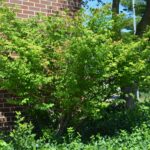
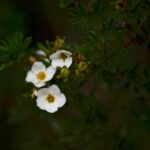
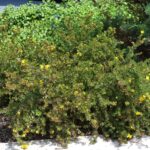
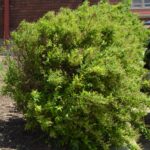
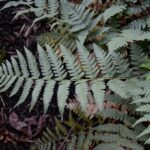
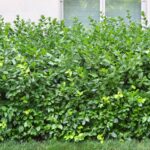
Shrub Indiana Native Dasiphora fruticosa [Bush Cinquefoil] Extreme hardiness and long season of bloom make this a favorite in severe climates. Low stature and tolerance of poor, dry soils give it added usefulness in other areas also. Can develop a ragged, unkept habit over time. Remove 1/3 of canes each year (3-year pruning cycle), and consider renewal pruning to a very low framework every 3-5 years if needed.
Shrub Dasiphora fruticosa 'Abbotswood' [White Bush Cinquefoil] 'Abbotswood' has beautiful, large, white flowers and an especially long blooming period. Extreme hardiness and long season of bloom make Potentilla fruticosa a favorite in severe climates. Low stature and tolerance of poor, dry soils give it added usefulness in other areas also. Can develop a ragged, unkept habit over time. Remove 1/3 of canes each year (3-year pruning cycle), and consider renewal pruning to a very low framework every 3-5 years if needed.
Shrub Dasiphora fruticosa 'Yellow Bird' [Yellow Bird Bush Cinquefoil] 'Yellow Bird' has large, single to semi-double yellow flowers. Extreme hardiness and long season of bloom make Potentilla fruitcosa a favorite in severe climates. Low stature and tolerance of poor, dry soils give it added usefulness in other areas also. Can develop a ragged, unkept habit over time. Remove 1/3 of canes each year (3-year pruning cycle), and consider renewal pruning to a very low framework every 3-5 years if needed.
Shrub Deutzia gracilis [Slender Deutzia] Nice in flower as they can cover the plant, hardiest of all deutzias, and relatively pest free. Once flower show is over, plants can look bedraggled. Branches often killed by cold temperatures in Northern range (or just die back), and then it's often best to cut it back to 6". Renewal pruning every few years can maintain vigor and form. Prune to maintain form by removing old stems, and do so after flowering to encourage…
Shrub Indiana Native Dirca palustris [Leatherwood] Dirca palustris is a small, dense, quite rounded, Indiana native shrub with excellent yellow fall coloration. Although it is generally uncommon in the wild, Leatherwood can be found growing naturally and thriving along the ravines of Turkey Run State Park in Marshall, IN. This plant requires rich, moist, acidic soils and should be protected from intense sun. Leatherwood fruits, bark, and roots are poisonous.
Fern Dryopteris marginalis [Marginal wood fern] This fern is easily grown in average, well drained soils in partial to full shade. It prefers moist, rich, acidic soils with protection from the wind.
Shrub InvasiveThis plant is considered invasive Euonymus alatus 'Compactus' [Dwarf Winged Euonymus] The dense and lower-growing 'Compactus' is one of the most common Winged Euonymus cultivars. Widely tolerant of most soil and microclimatic conditions, but develops good fall foliage color only when exposed to considerable direct sun. Tolerates heavy pruning. Can be troubled by scale insects, although not so frequently as the evergreen euonymus. Fruits are toxic. Avoid very dry or wet sites. Can be invasive, seeding into woodlots.
Shrub Euonymus fortunei 'Vegetus' [Vegetus Wintercreeper Euonymus] This cultivar has a more shrub-like habit than the species type, but can be moderately effective as a groundcover or wall climber. Also much heavier fruiting than the straight species; the fruiting display can be quite attractive, if fruits are borne in high enough numbers. Very susceptible to Euonymus Scale.
Shrub Exochorda racemosa [Common Pearlbush] The Common Pearlbush is lovely in the spring time with its abundance of beautiful, white flowers, but is unfortunately a rather non-descript shrub during the rest of the year. It is a tough plant, able to withstand both heat and drought. The common name refers to the round, pearl-like white flower buds.