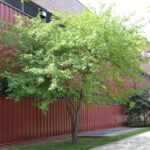
Tree Nyssa sylvatica 'Hayman Red' [sold as Red Rage®] [Red Rage Black Gum] 'Haymanred', the broadly pyramidal cultivar of the Indiana native Black Gum, is know for its rich and vibrant fall color, lustrous dark green leaves and resistance to leaf spot. Selected from southern Indiana and introduced by Mike Hayman, it is one of the best cultivars of black gum. Can be difficult to transplant due to its taproot, use container-grown plants or plants dug with a soil ball. Can be used in areas with wet soils.
Tree Indiana Native Nyssa sylvatica 'Wildfire' [Wildfire Blackgum] Especially useful in wet soils. One of the most beautiful trees, with habit comparable to Quercus palustris, but usually more irregular, and with a greater number of more slender main limbs. Silvery-grey, picturesque branching; strong horizontal accent. Difficult to transplant due to taproot; use container-grown plants when possible, or at least plants dug with a soil ball. Shelter from wind. In the North, select native northern stock as the species has a wide geographic range.…
Tree Indiana Native Ostrya virginiana [American Hophornbeam] A good, trouble-free small shade tree worthy of greater use. Very graceful with many drooping branches that create a rounded habit. Best on drier slopes, and is usually found in native ecosystems. Slow growing, and difficult to transplant. Does not tolerate periodic flooding (as does Carpinus caroliniana) or salt.
Tree Indiana Native Oxydendrum arboreum [Sourwood] This plant gets it common and scientific name from its sour-tasting leaves. The genus name is derived from the Greek word "oxys", meaning sour, and "dendron", meaning tree. Honey produced from the pollen of Sourwood flowers is considered valuable. The attractive, slightly fragrant flowers are often prolifically produced, especially in full sun, and are effective for up to four weeks. Like all Ericaceous plants, Oxydendrum arboreum requires rich, organic, moist, well-drained, and acidic soil. This…
Herbaceous Panicum virgatum 'Thundercloud' [Thundercloud Switch Grass] This tall hedge grass can grow up to 8 feet tall, making it a great option to buffer views or frame spaces. Open panicles frame the crown creating a soft fluffy top that contrast the dark green switchgrass blades.
Tree Parkinsonia × [Hybrid Palo Verde] Semi-evergreen leaves, and smooth line green trunks and branches year round. Palo Verde means "green stick" in Spanish, and the green bark carries on photosynthesis. Survives in the desert on natural rainfall once established. Few problems. Needs some minor clean up maintenance of flowers and leaves. Prune when young to develop multi-stems and show off the beautiful bark. 'Desert Museum' is a V-shaped thornless hybrid having genetic characteristics indicating complex hybridization between three species, Parkinsonia…
Tree Parrotia persica [Persian Parrotia] One of the best trees for foliage and bark effect. Very adaptable, tolerating drought, various soils, heat, cold, etc. Prefers full sun but tolerates light shade. Sites with strong winter winds will surely cause tip dieback in Northern Indiana.
Shrub Philadelphus coronarius [Sweet Mockorange] Well adapted to different light (even shade) and soil conditions, especially to dry situations. Relatively trouble-free, and one of the most fragrant of the mockoranges. None of the mockoranges have much landscape interest after the season of bloom. Becomes leggy if not pruned. Pruning should be done after flowering (flower buds form on previous years wood), and to maintain fullness of form.
Shrub Physocarpus opulifolius 'Monlo' [sold as Diabolo®] [Diablo Eastern Ninebark] Renew by cutting to the ground in late winter. Very course in texture in the winter with its multi-layered exfoliating bark (which gives it the common name of "ninebark"). 'Monlo', generally sold under the name Diablo, has reddish-purple leaves that sometimes fade to green in hotter climates.