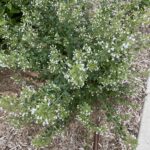
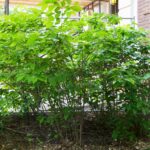
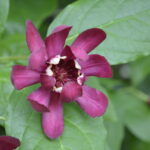
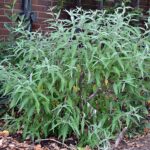
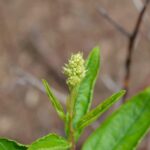
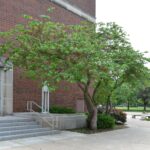
Shrub Buxus sinica var. insularis [Korean Littleleaf Boxwood] The Korean Littleleaf Boxwood grows best when placed in areas of moderate shade that are away from strong winter sun and wind. It has shallow roots and prefers moist, cool soils. This shrub flowers in April; flowers can attract bees due to the fragrance but are not showy.
Shrub Buxus sinica var. insularis 'Wintergreen' [Wintergreen Korean Littleleaf Boxwood] The Wintergreen Korean Littleleaf Boxwood is quite hardy (to zone 4) and grows best when placed in areas of moderate shade that are away from strong winter sun and wind. It has shallow roots and prefers moist, cool soils. This shrub flowers in April; flowers can attract bees due to the fragrance but are not showy.
Shrub Buxus sp. [Boxwood] Boxwoods do best when planted away from strong winter sun and wind and prefers moderate shade. Winter desiccation injury (browning) in full sun is a real concern, but this plant often recovers in spring with new growth. The Boxwood's shallow roots prefer moistness and coolness.
Herbaceous Calamintha nepeta 'Montrose White' [Montrose White Calamint] Easily grown in slightly acidic, dry to medium moisture, well drained soils in full sun. It does however tolerate drought although it prefers evenly moist soils. After the plant has flowered cut back the plants to remove unsightly foliage and/or to simply prevent any unwanted self-seeding.
Shrub Calycanthus floridus [Common Sweetshrub] The Common Sweetshrub was one of the first native plants in the US used as an ornamental. Widely adapted to soil and sun or shade. Certain selections can permeate an area with fragrance. Can be forced for indoor fragrance. Not all plants have equally fragrant flowers; don't use seed propagated plants for that reason. Seeds are poisonous, causing convulsions, myocardial depression, and hypotension.
Shrub Calycanthus floridus 'Aphrodite' [Aphrodite Sweetshrub] 'Aphrodite' has an upright form with deep red flowers. The flowers are fragrant and large and bloom throughout the summer season. Large bright green leaves, can grow to be bigger than a human hand.
Shrub Caryopteris × clandonensis [Bluebeard] Is often killed to ground in winter, returning to flower in the same year. Functions much like an herbaceous perennial, primarily for flowering interest, blooming on new growth. This hybrid is much hardier than C. incana and much more showy than C. mongholica. Prefers full sun but tolerates partial shade. Attractive plant to bees, butterflies, and hummingbirds. Occasionally kills out completely at the northern edge of its useful range, with tops regularly killed back to…
Shrub Caryopteris × clandonensis 'Blue Mist' [Blue Mist Bluebeard] This cultivar blooms in clusters during late summer with vibrant blue flowers. Is often killed to ground in winter, returning to flower in the same year. Functions much like an herbaceous perennial, primarily for flowering interest, blooming on new growth. This hybrid is much hardier than C. incana and much more showy than C. mongholica. Attractive to bees, butterflies, and hummingbirds. Occasionally kills out completely at the northern edge of its useful range, with tops…
Shrub Indiana Native Ceanothus americanus [New Jersey Tea] New Jersey Tea is a native prairie plant that has thick, deep-reaching, red roots (which can even grow up to 8" in diameter), making it very drought tolerant, but also difficult to transplant. This small, compact shrub is able to fix atmospheric nitrogen and is quite adaptable, not only tolerating drought, but different soil types as well. It is even capable of growing in sandy and rocky soils. The leaves of New Jersey Tea were…
Tree Indiana Native Cercis canadensis [Eastern Redbud] A fine small tree that grows wild in many parts of Indiana. Relatively trouble-free and drought-resistant. Requires some protection from the sun in hotter climates, however flowering decreases with deep shade. Canker, leaf spot, and verticillium wilt can be problematic for older trees, or trees weakened by other environmental stresses. Due to genetic variability, be sure of seed source. Long tap root means that older plants transplant poorly.