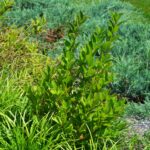
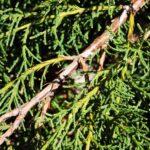
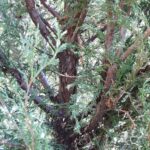
Shrub Itea virginica 'Henry’s Garnet' [Henry's Garnet Virginia Sweetspire] 'Henry's Garnet' is an excellent cultivar that has larger flowers and more exceptional red and purple fall color when compared to the straight species. Resistant to flea beetle and leaf spot. Quite drought and pH tolerant although best situated in moist areas with some acidity. Flowers best in full sun, but is shade tolerant. Pruning sometimes needed to maintain form, primarily for removal of wayward branches. Avoid pruning in late fall or winter as flowers…
Shrub Juniperus horizontalis 'Youngstown' [Youngstown Andorra Juniper] Youngstown Andorra Juniper is a cultivar of the creeping Juniper. It has a mounding form and dense branches that give the evergreen its uniform shape. Youngstown offers season round interest with its silver-green foliage that turns bronze in the winter.
Shrub Juniperus × pfitzeriana 'Aurea Improved' [sold as Gold Coast®] [Gold Coast Pfitzer Juniper] This variant is compact and spreading with lacy, golden needles that hold their color through the winter. Widely adaptable to soils and climates. Tolerates alkaline soils, heat, and drought. Members of this species are used from New England to Minnesota to Louisiana. Phomopsis and Kabatina blights can be a serious problem in some areas, especially for small plants.
Shrub/Tree Juniperus scopulorum 'Skyrocket' [Skyrocket Rocky Mountain Juniper] 'Skyrocket' has an extremely narrow, fastigiate form and silvery blue-green foliage. Widely adapted to soils and climates. Does well in alkaline soils, but not wet soils. Alternate host for cedar-apple rust disease. Plant other juniper species in areas having many apples, hawthorns, etc. Susceptible to bagworms.
Shrub/Tree Juniperus scopulorum 'Welchii' [Welch Rocky Mountain Juniper] 'Welchii' is compact and comlumnar with blue-green foliage that is silver when emerging. Widely adapted to soils and climates. Does well in alkaline soils, but not wet soils. Alternate host for cedar-apple rust disease. Plant other juniper species in areas having many apples, hawthorns, etc. Susceptible to bagworms.
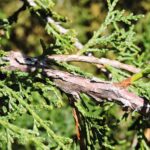
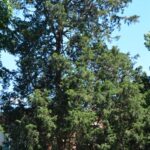
Tree Indiana Native Juniperus virginiana [Eastern Redcedar] Widely adapted to soils and climates, as evidenced by the species' wide geographic range. Does well in alkaline soils, but not wet soils. Alternate host for cedar-apple rust disease. Plant other juniper species in areas having many apples, hawthorns, etc. Susceptible to bagworms.
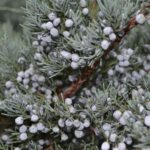
Tree Juniperus virginiana 'Canaertii' [Canaert Eastern Redcedar] 'Canaertii' is a picturesque, pyramidal female cultivar that produces a profusion of bloomy blue berries (cones). Widely adapted to soils and climates. Does well in alkaline soils, but not wet soils. Alternate host for cedar-apple rust disease, and 'Canaertii' is especially susceptible. Plant other juniper species in areas having many apples, hawthorns, etc. Susceptible to bagworms.
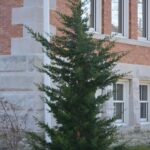
Tree Juniperus virginiana 'Cupressifolia' [Hillspire Eastern Redcedar] 'Cupressifolia' is a pyramidal female cultivar with bright yellow-green, cypress-like foliage. Widely adapted to soils and climates. Does well in alkaline soils, but not wet soils. Alternate host for cedar-apple rust disease. Plant other juniper species in areas having many apples, hawthorns, etc. Susceptible to bagworms.
Tree Juniperus virginiana 'Glauca' [Silver Eastern Redcedar] 'Glauca' is a columnar cultivar with glaucous blue needles that are most prominent in the spring, transitioning to blue-green later on in the summer. Widely adapted to soils and climates. Does well in alkaline soils, but not wet soils. Alternate host for cedar-apple rust disease. Plant other juniper species in areas having many apples, hawthorns, etc. Susceptible to bagworms.