
Dicotyledon

Purdue Arboretum Learning System

This glossary definition is part of the Purdue Arboretum learning resource database, providing educational information on campus flora, morphology, and botanical terminology.

Synonyms: Dicot, Dicots, Dicotyledons

Dicotyledon
A dicotyledon (commonly known as a dicot) is a flowering plant that begins life with two seed leaves, called cotyledons. Dicots typically have broad leaves with branching veins, flower parts in multiples of four or five, and a taproot system. Many trees, shrubs, wildflowers, and garden plants are dicots, including oaks, maples, roses, and sunflowers. Did You Know? Most of the trees found in arboretums are dicots. Their branching leaf veins and flowers with four or five petals can help visitors distinguish them from monocots such as grasses, lilies, and palms.

Did you know?

Oaks, maples, roses, beans, tomatoes, and sunflowers are dicots with two seed leaves.
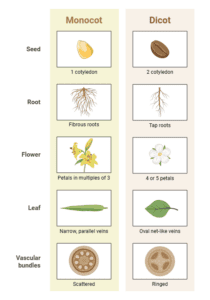
Dicotyledon

The Purdue Arboretum is a collaboration between the Department of Horticulture and Landscape Architecture and Administrative Operations

Purdue Arboretum, 625 Agriculture Mall Dr, West Lafayette, IN, 47907
© 2026 Purdue UniversityAn equal access/equal opportunity universityCopyright ComplaintsMaintained by Purdue Arboretum Explorer
Contact Purdue Arboretum at arboretum@purdue.edu for accessibility issues with this page | Accessibility Resources | Contact Us