
Angiosperm A plant that has its seeds encased in an ovary. All flowering plants belong to this group. Did you know? Nearly all fruits, vegetables, grains, and flowering ornamentals come from angiosperms, the flowering plants.
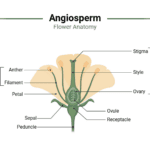
Glossary: Flower / inflorescence morphology
Purdue Arboretum botanical terminology reference and learning database.
Flower / inflorescence morphology
Anthesis The period when a flower is fully expanded and functioning.
Apetalous Without petals. This feature helps explain how flowers are arranged, how pollination happens, or how seeds begin to form. Did you know? Many wind-pollinated trees have apetalous flowers because they do not need showy petals to attract insects.
Bloom A fine powdery coating. (Also can simply mean a flower.) Did you know? The pale coating on grapes, blueberries, and plums is a natural waxy bloom, not dust or pesticide residue.
Bract A modified leaf, which is part of a flower cluster, or which surrounds a flower. Did you know? The bright red “petals” of a poinsettia are actually bracts. The true flowers are the tiny yellow structures in the center.
Bud A growth point from which a leaf, stem, or flower can develop Did you know? Tree buds are powerful winter identification clues because each species has distinctive bud shape, color, size, and arrangement.
Calyx The outer structure of a flower, consisting of individual petal-like parts called sepals Did you know? The leafy green crown on top of a strawberry is the persistent calyx that remains after flowering.
Campanulate Having a bell-shaped flower (like the Campanula, commonly known as Bellflower) Did you know? Bell-shaped flowers often shelter nectar from rain while giving bees a clear entrance.
Capitulum A small flower head. This feature helps explain how flowers are arranged, how pollination happens, or how seeds begin to form. Did you know? A sunflower head is not one flower. It is a capitulum made of hundreds or even thousands of small flowers.
Capsule A dry dehiscent fruit composed of more than one carpel.