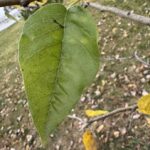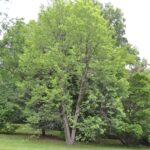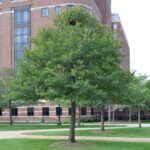
Shrub/Tree Indiana Native Prunus virginiana [Common Chokecherry] The Common Chokecherry can be a suckering small tree or large shrub that produces fragrant white racemes followed by small, purple-black cherries. These fruits can be used for pies, jellies, and jams (do not eat fresh). Suckers must be immediately removed to control growth.
Tree Indiana Native Quercus alba [White Oak] One of the most majestic trees at maturity with a picturesque framework, but requires many years to reach maturity. Long-lived, the kind of tree to use where it can be appreciated by succeeding generations. Slow growth eliminates it as a tree for quick effect. Roots are highly sensitive to disturbance, even foot traffic. Almost impossible to transplant from the wild. Often difficult to find in nurseries due to slow growth and recalcitrance to propagation by…
Tree Indiana Native Quercus coccinea [Scarlet Oak] Excellent scarlet fall foliage, comparable if not often better than the Pin Oak. Does not suffer iron chlorosis as bad as Pin Oak, being more tolerant of alkaline soils. Some report difficulty in transplanting.
Tree Indiana Native Quercus ellipsoidalis [Northern Pin Oak] Quercus ellipsoidalis is very closely related to Q. palustris (Pin Oak), but is better suited for the Midwest. Very similar to the Pin Oak, the Northern Pin Oak is a handsome tree with distinctive and regular branching, spreading to horizontal to drooping, from top to bottom of the tree. This effect is partly lost when lower limbs must be removed for traffic underneath. While this species is still prone to chlorosis (yellowing of leaves) in…
Tree Indiana Native Quercus marilandica [Blackjack Oak] The Blackjack Oak is a small to medium sized tree with distinct, stout, irregular branches. It is very tolerant of poor, dry conditions, but does not tolerate wet conditions. This oak's common name is in reference to its dark, blackjack-like leaves.
Tree Indiana Native Quercus michauxii [Swamp Chestnut Oak] Similar to Quercus montana but obtains a larger ultimate size and is found in moister soils. Common in low areas, river bottoms, swamp borders and ravines. It gained its common name of "Basket Oak" from the baskets created from its wood, and the common name "Cow Oak" from the sweet, edible acorns relished by cows.
Tree Indiana Native Quercus pagoda [Cherrybark Oak] Generally only hardy up to zone 6, this oak is larger than the closely related Southern Red Oak (Quercus falcata) and prefers wetter sites. It is native to southeastern regions of the United States and naturally grows as far north as southern Indiana and Illinois.
Tree Indiana Native Quercus rubra [Red Oak] One of the best and most reliable of oaks as a shade or street tree. More vigorous and fast-growing than most oaks. Good street tree since it performs reasonably well in small soil volumes (although it tends to branch close to ground). Oak wilt disease has been troublesome in certain areas of the Midwest. Hybridizes easily with other oaks (be careful of source).
Tree Indiana Native Quercus velutina [Black Oak] Quercus velutina is a large, deciduous oak with an irregular canopy. It is closely related to Q. rubra (Red Oak), which it is known to hybridize with. The interesting bark of the Q. velutina is nearly black and furrowed. Transplanting is made difficult by the long tap root. Not generally sold commercially.