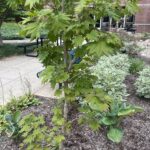
Tree Acer palmatum `Shishigashira` [Lion’s Head Japanese Maple] Avoid planting in windy sites and dry soil.
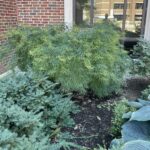
Tree Acer palmatum var. dissectum 'Waterfall' [Waterfall Japanese Maple] Best grown in moist, well-drained, organic soils. Avoid hot, dry, or excessively windy sites. New foliage may scorch in full sun location. Chlorosis may occur in high pH soils. Pruning should be kept to a minimum as it often results in significant bleeding especially in the spring/summer. The 'Waterfall' variety is a weeping cultivar that displays cascading branching.
Tree InvasiveThis plant is considered invasive Acer platanoides 'Emerald Queen' [Emerald Queen Norway Maple] This cultivar has ascending branches and an oval habit. Best selection of Norway Maples for urban sites. Fast growth rate and shallow root system. Brilliant yellow in the fall. When Norway maple escapes cultivation and invades natural areas it reduces species richness and native tree regeneration by out-competing other trees and understory species for resources, creating dense shade canopies, and spreading rapidly through high seed production. It also releases toxins that reduce the growth and…
Tree Acer pseudoplatanus [Sycamore Maple] Tolerates salt spray. Produces a lot of dead wood that needs removal. Anthracnose and canker disease can be serious.
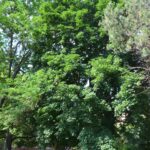
Tree Indiana Native Acer saccharum [Sugar Maple] Widely adapted to climate, but best in at least reasonably fertile soil. One of the best shade tree species over a wide area, but for best results select plants known for adaptability to the local region. Quite shade tolerant. Low maintenance in a good site. 50 gal. sap or more needed to make 1 gal. syrup. Not so drought-tolerant as silver maple, but reasonably so. Does poorly in compacted soils, and doesn't like salt spray.…
Shrub/Tree Aesculus pavia [Red Buckeye] The Red Buckeye can be a small tree or clump-forming, multi-stemmed shrub. The lustrous, deep green foliage is attractive, but tends to decline by August. Susceptible to leaf blotch, but less susceptible to mildew than Aesculus hippocastanum.
Tree InvasiveThis plant is considered invasive Ailanthus altissima [Tree of Heaven] Unusual form and texture not unlike a large sumac. Highly adaptable. Tolerates salt spray. Dioecious. Coarse and inclined to drop twigs. Male flowers are malodorous; female plants make many weed seedlings. Ailanthus altissima forms dense, clonal thickets which displace native species and can rapidly invade fields, meadows, and harvested forests. This invasive tree species is extremely tolerant of poor soil conditions and can even grow in cement cracks. Ailanthus altissima is not shade tolerant, but…
Tree InvasiveThis plant is considered invasive Alnus glutinosa [Black Alder] During establishment growth is fast but upon blooming of abundant flowering and fruiting growth rate slows. Will average 24" to 30" per year.
Liana (Climbing Vine) InvasiveThis plant is considered invasive Ampelopsis glandulosa var. heterophylla [Porcelain Ampelopsis] Best fruiting in full sun. Restricting root growth can enhance fruit production. Japanese beetles love them. Can be invasive. Rampant growth.
Shrub/Tree Indiana Native Aralia spinosa [Devil's Walkingstick] Slow growth rate, but fast on roots (forms a very coarse thicket). Sucker shoots can be a maintenance problem if tree form is desired. Sharp prickles also make maintenance difficult, and are a minor hazard to children. Otherwise, no serious problems with this plant. Very adaptable and easy to grow, tolerating most conditions except wet soil. Drought tolerant, and best in full sun. Excellent selection in a mass planting near buildings having poor soils.