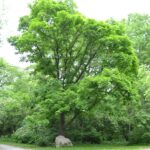
Tree Indiana Native Audio Recording AvailableID That Tree Video AvailablePurdue Plant Doctor Available Magnolia tripetala [Umbrella Magnolia] Full sun or light partial shade. Tropical appearance. Flowers are creamy white with an unpleasant smell. The cone-like rosy red fruit matures in September-October. Endangered in Indiana. Large leaves can be injured by hail or wind. Perhaps too coarse for most landscape situations. Indiana NativeAudio Recording AvailableID That Tree Video AvailablePurdue Plant Doctor Available
Shrub/Tree Audio Recording AvailablePurdue Plant Doctor Available Magnolia virginiana [Sweetbay Magnolia] Nice flower fragrance, but never overwhelming. Does well in wet soils, unlike other magnolias. Requires acid soil, some moisture, and tolerates some shade. Chlorosis can sometimes be a problem, especially prevalent on alkaline soils. Audio Recording AvailablePurdue Plant Doctor Available
Tree Audio Recording AvailablePurdue Plant Doctor Available Malus × 'Adirondack' [Adirondack Flowering Crabapple] The Flowering Crabapple is a popular small ornamental tree with an extremely showy flower display in the spring. This variant has a vase-shaped (somewhat columnar) habit, extremely upright branching, and high resistance to apple scab, fireblight, cedar-apple rust, and powdery mildew. Tends to flower and fruit in alternate years. Well-drained heavy loam soils and full sun promote best growth. Audio Recording AvailablePurdue Plant Doctor Available
Tree Audio Recording AvailablePurdue Plant Doctor Available Malus × 'Indian Magic' [Indian Magic Flowering Crabapple] The Flowering Crabapple is a popular small ornamental tree with an extremely showy flower display in the spring. 'Indian Magic' is not as disease resistant as others, being moderately susceptible to scab. Tends to flower and fruit in alternate years. Well-drained heavy loam soils and full sun promote best growth. Can be susceptible to many pests and diseases, including apple scab, fireblight, Japanese beetles, leaf spot, cedar-apple rust, and powdery mildew. May look ragged at… Audio Recording AvailablePurdue Plant Doctor Available
Tree Audio Recording AvailablePurdue Plant Doctor Available Malus sargentii [Sargent Crabapple] The smallest of all Malus species, almost a shrub. Strongly horizontal branching. Tends to be apomictic (seeds develop without fertilization), so is usually very uniform from seed (i.e. clonal). Sometimes flowers and fruits in alternate years. Susceptible to apple scab disease. May require pruning of wayward and crossing branches to maintain a nice form. Audio Recording AvailablePurdue Plant Doctor Available
Tree Audio Recording AvailablePurdue Plant Doctor Available Malus × 'Snowdrift' [Snowdrift Flowering Crabapple] The Flowering Crabapple is a popular small ornamental tree with an extremely showy flower display in the spring. 'Snowdrift' is a vigorous selection that is covered with numerous white blossoms in the spring, which are then followed by attractive orange-red crabapple fruits. Susceptible to apple scab and fire blight. Well-drained heavy loam soils and full sun promote best growth. May look ragged by the end of the summer. Audio Recording AvailablePurdue Plant Doctor Available
Tree Audio Recording Available Metasequoia glyptostroboides [Dawn Redwood] More tolerant of different sites than Taxodium distichum (Common Baldcypress). Prefers moist sites and can grow in water. Japanese beetles will feed on foliage. Does not like chalky soils with high pH. Audio Recording Available
Tree Indiana Native Audio Recording AvailableID That Tree Video AvailablePurdue Plant Doctor Available Morus rubra [Red Mulberry] The Red Mulberry is fairly adaptable and can sometimes be a prolific self-seeder. To prevent bleeding, it should be pruned in late fall or winter. Although somewhat more sensitive to soil requirements, Morus rubra is considered to be a better choice than the related Morus alba (White Mulberry), which has a much more invasive character. Morus rubra is dioecious, so male and female flowers are borne on separate trees. Female trees, if fertilized, bear edible… Indiana NativeAudio Recording AvailableID That Tree Video AvailablePurdue Plant Doctor Available
Shrub/Tree Audio Recording AvailablePurdue Plant Doctor Available Myrica pensylvanica [Northern Bayberry] Waxy gray berries were used by early settlers for making aromatic candles, and occasionally still are used for this purpose. Especially good plant for full sun and sandy soils, but grows well on many soils. Tolerates half shade. Relatively salt-tolerant. Forms colonies via suckers. Fixes nitrogen in the soil. Dioecious. Use female plants (when known) for fruiting, and occasional male for pollination. Difficult to transplant from field. Audio Recording AvailablePurdue Plant Doctor Available