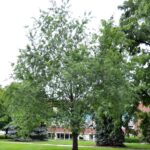
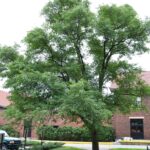
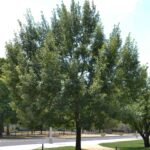
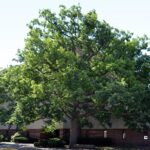
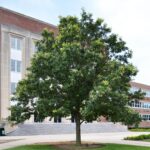
Tree Audio Recording Available Styphnolobium japonicum [Japanese Pagodatree] A widely adapted tree with good drought and pollution tolerance, and foliage texture comparable to Gleditsia, but a smaller tree and with more seasonal interest. Relatively trouble-free except for fungi that live in weaker twigs that cause twig blight and canker. Fungi invade most readily those twigs killed by cold or self-pruning. Seeds are poisonous. Difficult to train a central leader. More cold sensitive when young. Audio Recording Available
Tree Audio Recording AvailablePurdue Plant Doctor Available Styrax japonicus [Japanese Snowbell] Relatively trouble-free. Can be susceptible to Ambrosia beetle and canker. Partial shade best in Zones 7 and 8 due to heat intolerance. Audio Recording AvailablePurdue Plant Doctor Available
Shrub Audio Recording AvailablePurdue Plant Doctor Available Symphoricarpos × chenaultii [Chenault Coralberry] A more refined plant than the parent S. orbiculatus, perhaps more showy in flower and fruit and more useful in the shrub border. Useful as a bank cover or large scale groundcover. Transplants well. This plant has a beautiful fruit show and is shade tolerant, however, it is also a twiggy, "garbage can plant" (collects leaves and blowing debris); this quality (especially prominent in the fall and winter) limits its usability in the landscape. Audio Recording AvailablePurdue Plant Doctor Available
Shrub Audio Recording AvailablePurdue Plant Doctor Available Syringa × chinensis [Chinese Lilac] Can become ratty in appearance, and so should be pruned properly on 3 year cycle. Problems with aphids, powdery mildew, scales, and caterpillars, although powdery mildew is worst problem. Audio Recording AvailablePurdue Plant Doctor Available
Tree Audio Recording AvailablePurdue Plant Doctor Available Syringa reticulata [Japanese Tree Lilac] A very hardy and showy tree. Attractive, cherry-like mahogany-colored bark, distinctly different from all other lilacs. Widely adapted to soils and environments. Cut to ground to rejuvenate completely. Mildew resistant. Subject to infestations of borers and scale insects, but these are not usually serious enough to discourage its use where some maintenance is available. Alternate year flowering on different parts of the tree can sometimes occur, a problem that can be assuaged by deadheading (use… Audio Recording AvailablePurdue Plant Doctor Available
Shrub Audio Recording AvailablePurdue Plant Doctor Available Syringa vulgaris [Common Lilac] A difficult species to use in a functional way. Best for seasonal color and fragrance in the border or as an occasional specimen. Deadheading can promote flowering and prevent alternate bearing. Will get leggy without pruning (prune on a 3-year cycle). Powdery mildew is an increasingly serious problem the further south this is planted in its hardiness zone. Grows better in colder climates. Audio Recording AvailablePurdue Plant Doctor Available
Shrub Audio Recording AvailablePurdue Plant Doctor Available Syringa vulgaris 'Congo' [Congo Lilac] A difficult species to use in a functional way. Best for seasonal color and fragrance in the border or as an occasional specimen. Deadheading can promote flowering and prevent alternate bearing. Will get leggy without pruning (prune on a 3-year cycle). Powdery mildew is an increasingly serious problem the further south this is planted in its hardiness zone. Grows better in colder climates. Audio Recording AvailablePurdue Plant Doctor Available
Shrub Audio Recording AvailablePurdue Plant Doctor Available Syringa vulgaris 'Marie Legraye' [Marie Legraye Lilac] A difficult species to use in a functional way. Best for seasonal color and fragrance in the border or as an occasional specimen. Deadheading can promote flowering and prevent alternate bearing. Will get leggy without pruning (prune on a 3-year cycle). Powdery mildew is an increasingly serious problem the further south this is planted in its hardiness zone. Grows better in colder climates. Audio Recording AvailablePurdue Plant Doctor Available
Shrub Audio Recording AvailablePurdue Plant Doctor Available Syringa vulgaris 'May Day' [May Day Lilac] A difficult species to use in a functional way. Best for seasonal color and fragrance in the border or as an occasional specimen. Deadheading can promote flowering and prevent alternate bearing. Will get leggy without pruning (prune on a 3-year cycle). Powdery mildew is an increasingly serious problem the further south this is planted in its hardiness zone. Grows better in colder climates. Audio Recording AvailablePurdue Plant Doctor Available
Tree Indiana Native Audio Recording AvailableID That Tree Video AvailablePurdue Plant Doctor Available Taxodium distichum [Common Baldcypress] Nice planted in groupings around water. Develops cypress knees (possibly for gas exchange), but generally only near water. Indiana NativeAudio Recording AvailableID That Tree Video AvailablePurdue Plant Doctor Available