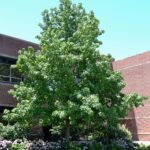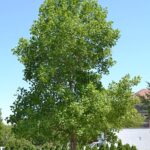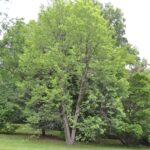
Tree Indiana Native Quercus rubra [Northern Red Oak] One of the best and most reliable of oaks as a shade or street tree. More vigorous and fast-growing than most oaks. Good street tree since it performs reasonably well in small soil volumes (although it tends to branch close to ground). Oak wilt disease has been troublesome in certain areas of the Midwest. Hybridizes easily with other oaks (be careful of source).
Tree Indiana Native Quercus shumardii [Shumard Oak] The Shumard Oak is a handsome tree that is drought and air pollution tolerant, and but can also be used in rain gardens. Transplanting and establishment can be difficult.
Tree Indiana Native Quercus stellata [Post Oak] A tough find in Indiana and mostly encountered in the wild throughout the southern states, the native Post Oak can be found in oak-hickory forests of southern Indiana. Open grown trees have a dense, round-topped crown with spreading branches for shade. Bark is similar to the White Oak, gray-brown in color with flat ridges, somewhat scaly, eventually ridged and furrowed. Fall color can vary, ranging from deep red to a golden brown.
Tree Indiana Native Quercus velutina [Black Oak] Quercus velutina is a large, deciduous oak with an irregular canopy. It is closely related to Q. rubra (Red Oak), which it is known to hybridize with. The interesting bark of the Q. velutina is nearly black and furrowed. Transplanting is made difficult by the long tap root. Not generally sold commercially.
Shrub Rhododendron sp. [Rhododendron] The massive genus of Rhododendron has between 800 and 900 species and countless hybrids and cultivars of numerous sizes, flower colors, and hardiness levels. Plants of this genus can be evergreen or deciduous. Azaleas are part of the Rhododendron genus.
Shrub Indiana Native Rhus aromatica [Fragrant Sumac] A highly variable species in both ultimate height and fall foliage color. Color probably also varies with soil type, possibly as a function of moisture content. Plants are native to dry, sandy, and rocky soils, and usually color well under these conditions. Useful for bank stabilization since it develops roots on stems touching the soil. It also suckers. Can spread too quickly for some sites (spreading rhizomes). Shear to ground to rejuvenate (try a brush-hog).
Shrub Rosa × 'Meisentmil' [sold as Lemon Drift®] [Lemon Drift Rose] The Lemon Drift Rose has petite yellow creamy flowers that make this shrub a beautiful statement planting. A great choice as well because the Drift Rose is disease resistant.
Shrub Rosa × 'Radwhite' [sold as White Knock Out®] [White Knock Out Rose] The White Knock Out Rose is a compact shrub with matte green foliage, making the creamy white flowers stand out against the dark leaves.
Shrub Indiana Native Rubus occidentalis [Black Raspberry] This thorny shrub is an Indiana native found along woodland edges. Although its natural habit is spreading, the Black Raspberry can be cut back to the ground to allow control of the spread and rejuvenation. The fruits of the Black Raspberry are sweet yet a bit tart, becoming a commercial commodity in parts of the United States. Best use in the landscape would be property boarders and erosion control. Best growth in part shade and…