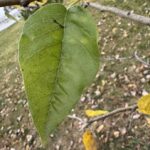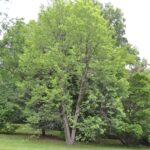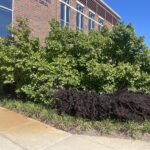
Tree Indiana Native Populus grandidentata [Bigtooth Aspen] This tree is very fast-growing with best development in moist, fertile soils but will grow on dry, sand or gravelly soils. It is very valuable for pulp wood. Often pyramidal in youth with a central leader, developing an oval, open, irregular crown at maturity.
Tree Indiana Native Populus tremuloides [Quaking Aspen] The common name of Populus tremuloides is derived from the tendency of the leaves to tremble (quake) in the wind, or even light breezes, due to flattened petioles. This is a fast-growing and short-lived species that regenerates from root suckers and can quickly recolonize disturbed sites. Generally, most of the specimens in a grove of P. tremuloides are clones, all originating from the same stem. This plant is dioecious, so groves are usually all male…
Tree Populus tremuloides 'NE Arb' [sold as Prairie Gold®] [Prairie Gold Quaking Aspen] Prairie Gold® Quaking Aspen is more tolerant to urban conditions including heat, drought, and humidity. The Aspen's name is derived from its golden yellow fall color. Native from Labrador to Alaska, south to Pennsylvania, Missouri, northern Mexico and lower California.
Tree Indiana Native Prunus pensylvanica [Pin Cherry] Pin or Wild Red Cherry is a slender, small shrub-like tree that is native to Indiana. Often seen as a pioneer species, Pin Cherry can be seen to develop in vacant areas. Its bark is shiny, red in color, and often aromatic when brusied or cut. P. pensylavnica produces a large amount of fruit when fully mature, which could promote weediness.
Shrub Indiana Native Prunus pumila [Sand Cherry] Prunus pumila is a creeping, low-growing small shrub naturally found in sandy locations, such as dunes, where it acts an important stabilizer. The cherry fruits are too bitter to eat fresh, but can be used in jams and jellies.
Tree Indiana Native Prunus serotina [Black Cherry] Probably the best native-American species of cherry for landscape use, but still useful only in a few situations, especially for naturalizing. A valuable timber tree, especially for furniture. Subject to several minor pests, none usually serious in naturalized situations. Wood is slightly brittle. Eastern tent caterpillar problematic is some years.
Tree Prunus serrulata 'Sekiyama' [Sekiyama Japanese Flowering Cherry] The Japanese Flowering Cherry prefers rich, moist, well-drained loams and full sun. It can tolerate part shade (at the expense of blooms), as well as heat, humidity, and even some drier soils (once it is established). This tree is susceptible to many pests, including leaf spot, powdery mildew, fireblight, Japanese beetles, aphids, scale, borers, leafhoppers, and caterpillars. 'Kwanzan', which is also known as 'Kanzan' or 'Sekiyama,' grows 30 to 40 feet high. This variant, sometimes…
Tree Indiana Native Quercus × deamii [Deam Oak] The Deam Oak is a rare hybrid between the White Oak (Quercus alba) and the Chinquapin Oak (Quercus muehlenbergii) that can be found in mature forests. Quercus x deamii was first discovered in Wells County, Indiana, about 4 miles outside the town of Bluffton in 1904 by Bruce Williamson, a zoologist, and his father. Not sure what they had found, they took the specimen to Charles C. Deam who later sent the sample to his…
Tree Indiana Native Quercus imbricaria [Shingle Oak] Somewhat tolerant of city conditions. Can be pruned into a hedge. Leaves persist into winter, after the normal leaf raking period, and then fall. Oak gall susceptible, but a minor problem.