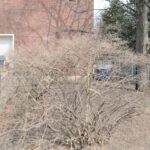
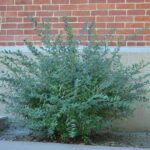
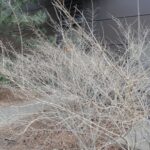
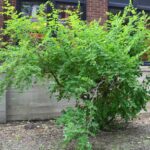
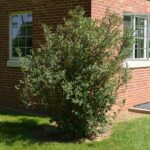
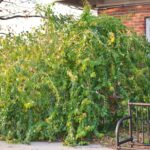
Shrub Purdue Plant Doctor Available Lonicera korolkowii [Blueleaf Honeysuckle] The Blueleaf Honeysuckle is an irregularly loose, open, and arching shrub. Attractive pink flowers appear in the leaf axils in late spring and are followed by bright red fruits that mature in mid to late summer. This plant is rare in the trade and quite difficult to establish. Transplant balled-and-burlapped or container-grown. Rejuvenate periodically by cutting back 6-12" from the ground. Like nearly all honeysuckles, this plant can be invasive in environments that it is… Purdue Plant Doctor Available
Shrub InvasiveThis plant is considered invasive Audio Recording AvailableID That Tree Video AvailablePurdue Plant Doctor Available Lonicera maackii [Amur Honeysuckle] Widely adaptable to different soils and exposures. Can be trained into a small patio tree. Suckers freely, requiring pruning in intensive situations. Seeds, carried by birds, germinate freely, and weed seedlings result. High shade tolerance contributes greatly to its highly invasive character. Perhaps the worst woody weed in the Midwestern and Northwestern US. Audio Recording AvailableID That Tree Video AvailablePurdue Plant Doctor Available
Shrub Purdue Plant Doctor Available Lonicera × purpusii 'Winter Beauty' [Purple-Stem Winter Honeysuckle] 'Winter Beauty' is a dense, rounded semi-evergreen shrub that has red-violet stems and produces an abundance of fragrant white flowers in late winter and early spring. Rejuvenate periodically by cutting back 6-12" from the ground. Purdue Plant Doctor Available
Shrub InvasiveThis plant is considered invasive ID That Tree Video AvailablePurdue Plant Doctor Available Lonicera tatarica [Tatarian Honeysuckle] Widely adapted to different soils and exposures, but avoid wet soils. Pruning of dead twigs is required periodically. Renewal pruning to a low framework every 5-8 years is helpful to maintain nice form and vigor. Russian aphid, which causes witches brooming, is a significant pest. Lonicera tatarica readily invades open woodlands, old fields, and other disturbed sites. It can spread rapidly due to birds and mammals dispersing the seeds and can form an extremely dense… ID That Tree Video AvailablePurdue Plant Doctor Available
Shrub InvasiveThis plant is considered invasive Purdue Plant Doctor Available Lonicera tatarica 'Zabelii' [Zabelii Tatarian Honeysuckle] Widely adapted to different soils and exposures, but avoid wet soils. Pruning of dead twigs is required periodically. Renewal pruning to a low framework every 5-8 years is helpful to maintain nice form and vigor. Russian aphid, which causes witches brooming, is a significant pest. Lonicera tatarica readily invades open woodlands, old fields, and other disturbed sites. It can spread rapidly due to birds and mammals dispersing the seeds and can form an extremely dense… Purdue Plant Doctor Available
Shrub/Tree Purdue Plant Doctor Available Magnolia × 'Jane' [Jane Magnolia] The Jane Magnolia is a shrubby magnolia that produces beautiful, large deep pink-purple flowers 2-4 weeks later than Magnolia stellata and M. x soulangeana, reducing the rick of frost damage. Flowers again sporadically throughout the summer. Part of the Little Girls Hybrid Series. Purdue Plant Doctor Available
Tree Audio Recording AvailablePurdue Plant Doctor Available Magnolia × soulangeana [Saucer Magnolia] Many of the showiest magnolia cultivars belong to this species. One of the most common flowering trees in the Midwest, it is apparently well-adapted. Its very early spring flowers can be killed by late frost; they turn brown and limp. Can be troubled by magnolia scale, but this can be kept under control by timely spraying. Fleshy roots with few laterals. Does not transplant well so best to buy container grown plants. Audio Recording AvailablePurdue Plant Doctor Available
Tree Purdue Plant Doctor Available Magnolia × soulangeana 'Purple Prince' [Purple Prince Saucer Magnolia] The Saucer Magnolia is one of the most common flowering trees in the Midwest, and is apparently well-adapted. 'Purple Prince' is known for its large, cup-like flowers with deep pinkish-purple tepals that are nearly white on the inside. Its very early spring flowers can be killed by late frost; they turn brown and limp. Can be troubled by magnolia scale, but this can be kept under control by timely spraying. Fleshy roots with few laterals.… Purdue Plant Doctor Available
Shrub/Tree Audio Recording AvailablePurdue Plant Doctor Available Magnolia stellata [Star Magnolia] Handsome specimen at all seasons. Needs at least some protection from strong wind in Zones 4 and 5. Somewhat prone to breakage in severe ice storms. Early blooming flowers often destroyed by late spring frosts. Audio Recording AvailablePurdue Plant Doctor Available
Shrub/Tree Purdue Plant Doctor Available Magnolia stellata 'Centennial' [Centennial Star Magnolia] 'Centennial' is an excellent, vigorous Magnolia stellata cultivar with large (5.5" across), pink-blushed white flowers with numerous tepals. This plant was released by the Arnold Arboretum of Harvard University in 1972 to commemorate its 100th anniversary. Handsome specimen at all seasons. Needs at least some protection from strong wind in Zones 4 and 5. Somewhat prone to breakage in severe ice storms. Early blooming flowers often destroyed by late spring frosts. Purdue Plant Doctor Available