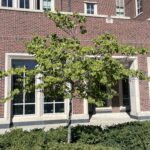
Tree Cercis canadensis 'Hearts of Gold' [Gold-Leaf Eastern Redbud] 'Hearts of Gold' is a striking redbud cultivar with reddish-orange tinted emerging leaves that turn bright yellow and finally deepen to a bright green towards the end of the summer. The yellow color develops most intensely under higher light conditions. A fine small tree that is relatively trouble-free and drought-resistant (although the yellow foliage color will become green in drought conditions). Canker, leaf spot, and verticillium wilt can be problematic for older trees, or trees…
Tree Cercis canadensis 'Royal White' [Royal White Eastern Redbud] 'Royal White' is known for its abundant white flowers and cold hardiness. This cultivar's white blooms are larger than those found on 'alba' and it is the most cold hardy form. A fine small tree that is relatively trouble-free and drought-resistant. Requires some protection from the sun in hotter climates, however flowering decreases with deep shade. Canker, leaf spot, and verticillium wilt can be problematic for older trees, or trees weakened by other environmental stresses.…
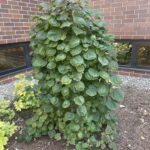
Tree Cercis canadensis 'Vanilla Twist' [Vanilla Twist Weeping Redbud] The Vanilla Twist cultivar features cascading branches that bloom clusters of white flowers.
Tree Cercis canadensis 'Wither’s Pink Charm' [Wither's Pink Charm Eastern Redbud] 'Wither's Pink Charm' produces beautiful pure pink flowers in the spring. A fine small tree that is relatively trouble-free and drought-resistant. Requires some protection from the sun in hotter climates, however flowering decreases with deep shade. Canker, leaf spot, and verticillium wilt can be problematic for older trees, or trees weakened by other environmental stresses. Long tap root means that older plants transplant poorly.
Shrub Chaenomeles speciosa [Common Flowering Quince] White, pink, orange, salmon, or red single or double flowers (depending on variant) occur in late April, are born on old wood just before the leaves fully emerge, and occur singly or 2-4 per cluster, creating an excellent dispersal of coloring throughout the shrub. Sparsely produces small, apple-like fruits, commonly called quinces, that are edible if used in preserves; harvest in October. Widely adapted to different soils and microclimates. Place in full sun location for…
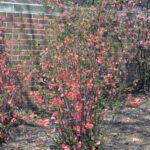
Shrub Chaenomeles speciosa 'Cameo' [Cameo Flowering Quince] 'Cameo' is known for its abundant beautiful, double, peach-pink flowers in April. The flowers are born on old wood just before the leaves fully emerge, and occur singly or 2-4 per cluster, creating an excellent dispersal of coloring throughout the shrub. Unlike the straight species, the bright, lustrous foliage of 'Cameo' provides seasonal interest after the one week of flower show, making it a more useful flowering quince. Sparsely produces small, apple-like fruits, commonly called…
Shrub Chaenomeles speciosa 'Rubra' [Red Flowering Quince] Strongly red single flowers occur in late April are born on old wood just before the leaves fully emerge, and occur singly or 2-4 per cluster, creating an excellent dispersal of coloring throughout the shrub. Sparsely produces small, apple-like fruits, commonly called quinces, that are edible if used in preserves; harvest in October. Widely adapted to different soils and microclimates. Place in full sun location for best flower display, although it is tolerant to partial…
Tree Chionanthus virginicus [White Fringetree] Dioecious with male plants showier in flower than females; plant a female if fruits are desired. Plants of known sex are not usually available unless selected in the flowering size. One of the last plants to leaf out in the spring.
Tree Cladrastis kentukea 'Perkins Pink' [Perkins Pink American Yellowwood] Perkins Pink is a beautiful pink-flowering form of the Indiana native, American Yellowwood. A soft pink flowers appear on pendulous, terminal panicals that reach 10 to 15 inches in length in late May to early June. A highly ornamental native tree, even though the pendulous clusters of flowers do not appear in great numbers every year. Well-adapted to Midwest conditions. Develops a tap root. Does not flower fully each year; part of a tree may…