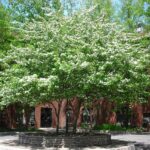
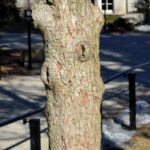
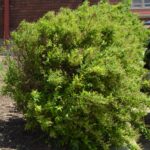
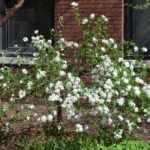
Tree Crataegus viridis 'Winter King' [Winter King Green Hawthorn] An attractive, nearly thornless vase-shaped small tree with beautiful white flower corymbs and large, bright red persistent fruits. This cultivar was discovered in a fence row by Bob Simpson in Vincennes, Indiana. Very adaptable, although leaves are often badly infected by rust so that the entire plant appears to be suffering from the measles.
Tree Crataegus × 'Vaughn' [Vaughn Hawthorn] This small tree is a hybrid of Crataegus crusgalli x C. phaenopyrum. It is generally grown for its fragrant clusters of white flowers in the spring and prolifically produced red fruits that persist into winter. Due to its numerous thorns, it is best used in areas with low traffic. Highly susceptible to rust.
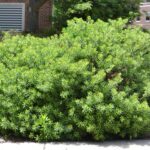
Shrub Daphne × burkwoodii 'Carol Mackie' [Variegated Burkwood Daphne] Requires excellent drainage, relatively low fertility, and consistent moisture. Best in a cool site, on soil with pH near neutral, in partial shade to full sun. Notably difficult to transplant. Sometimes dies suddenly with no warning signs. 'Carol Mackie' is more vigorous than the species type.
Shrub Indiana Native Dasiphora fruticosa [Bush Cinquefoil] Extreme hardiness and long season of bloom make this a favorite in severe climates. Low stature and tolerance of poor, dry soils give it added usefulness in other areas also. Can develop a ragged, unkept habit over time. Remove 1/3 of canes each year (3-year pruning cycle), and consider renewal pruning to a very low framework every 3-5 years if needed.
Shrub Deutzia gracilis [Slender Deutzia] Nice in flower as they can cover the plant, hardiest of all deutzias, and relatively pest free. Once flower show is over, plants can look bedraggled. Branches often killed by cold temperatures in Northern range (or just die back), and then it's often best to cut it back to 6". Renewal pruning every few years can maintain vigor and form. Prune to maintain form by removing old stems, and do so after flowering to encourage…
Shrub Deutzia gracilis 'Nikko' [Dwarf Slender Deutzia] 'Nikko' is a compact, dense, and rounded shrub. Nice in flower as they can cover the plant, and relatively pest free. Branches often killed by cold temperatures in Northern range (or just die back), and then it's often best to cut it back to 6". Renewal pruning every few years can maintain vigor and form. Prune to maintain form by removing old stems, and do so after flowering to encourage best flower show the following…
Tree Indiana Native Diospyros virginiana [Common Persimmon] Most are usually dioecious and have a deep tap root which makes large plants difficult to transplant. Flowers attract bees while the fruit attracts birds and many mammals. The fruit is astringent when green, sweet and edible when ripe. Fruits, twigs, and leaves can be a littler problem.
Shrub InvasiveThis plant is considered invasive Elaeagnus umbellata 'Cardinal' [Cardinal Autumn Olive] Elaeagnus umbellata 'Cardinal' was originally introduced by the Soil Conservation Service and is not recommended for the home landscape. Widely adaptable and invasive plant in the Midwest. Like other members of the family, fixes atmospheric nitrogen. Spread by birds and through rooting suckers. Especially tolerant of extreme cold and drought, as well as extreme heat, unlike the related Elaeagnus angustifolia (Russian Olive).
Shrub Exochorda racemosa [Common Pearlbush] The Common Pearlbush is lovely in the spring time with its abundance of beautiful, white flowers, but is unfortunately a rather non-descript shrub during the rest of the year. It is a tough plant, able to withstand both heat and drought. The common name refers to the round, pearl-like white flower buds.
Shrub Forsythia × intermedia [Border Forsythia] The most showy forsythia cultivars are found in this vigorous and adaptable hybrid species. Cut stems excised in mid-winter will flower indoors due to very short chilling requirement. Hardy to USDA Zone 4 for vegetative parts and USDA 5(6) for flowers. Flower buds are killed by severe winters in zone 5, and frequently in colder zones. Plants, however, are hardy in Zone 4. Too big for most foundations and small border plantings (Don't Shear!). Remove…