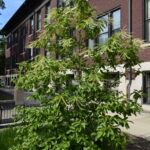
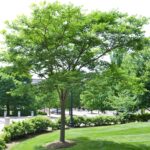
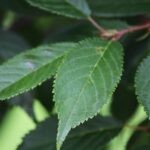
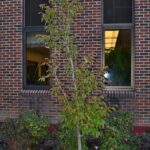
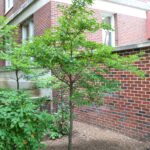
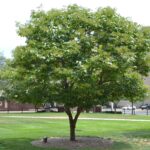
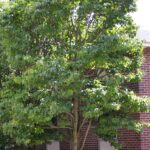
Tree Indiana Native Oxydendrum arboreum [Sourwood] This plant gets it common and scientific name from its sour-tasting leaves. The genus name is derived from the Greek word "oxys", meaning sour, and "dendron", meaning tree. Honey produced from the pollen of Sourwood flowers is considered valuable. The attractive, slightly fragrant flowers are often prolifically produced, especially in full sun, and are effective for up to four weeks. Like all Ericaceous plants, Oxydendrum arboreum requires rich, organic, moist, well-drained, and acidic soil. This…
Tree InvasiveThis plant is considered invasive Phellodendron amurense [Amur Corktree] A striking tree for its interesting bark and massive framework. Widely adaptable to soil, trouble-free, and drought and pollution resistance. Easily transplanted. May be less hardy when young and rapidly growing. Fruits smell like turpentine when crushed (or stepped on). This tree is demonstrating invasive characteristics in suburban and urban fringe forests. It escapes intended plantings to invade and displace native hardwood forests. Note: only female plants have the potential to become invasive. Phellodendron amurense…
Tree Pinus thunbergii 'Thunderhead' [Thunderhead Japanese Pine] Compact cultivar with irregular growing habit.
Tree Prunus × incam 'Okame' [Okame Cherry] 'Okame' is a small cherry tree that performs well in the landscape and provides multi-season interest with beautiful, pink flowers very early in the spring, handsome dark green summer foliage, excellent orange, red, and bronze fall color, and shining, reddish bark in the winter.
Tree Quercus palustris 'Pringreen' [sold as Green Pillar®] [Green Pillar Pin Oak] This cultivar is a columnar habit, great for those smaller spaces. Its fall color is a vibrant red, which leads many to believe that the Scarlet Oak, (Quercus cocinea) is in the genetics of this cultivar. Green Pillar Pin Oak is grafted onto root stock, so graft incompatibility may be an issue in the future. Requires an acidic soil and is subject to severe iron chlorosis on calcareous soils. This can be corrected but it…
Tree Stewartia pseudocamellia [Japanese Stewartia] In the wild, this specimen can grow up to 60' high, much larger than the mature landscape tree which ranges from 20-40' high. The outstanding, multi-colored bark is rich and flaking, ranging from soft grays and browns to orangish brown. There are no serious pests or diseases for this specimen.
Tree Styrax japonicus [Japanese Snowbell] Relatively trouble-free. Can be susceptible to Ambrosia beetle and canker. Partial shade best in Zones 7 and 8 due to heat intolerance.
Tree Syringa reticulata [Japanese Tree Lilac] A very hardy and showy tree. Attractive, cherry-like mahogany-colored bark, distinctly different from all other lilacs. Widely adapted to soils and environments. Cut to ground to rejuvenate completely. Mildew resistant. Subject to infestations of borers and scale insects, but these are not usually serious enough to discourage its use where some maintenance is available. Alternate year flowering on different parts of the tree can sometimes occur, a problem that can be assuaged by deadheading (use…
Tree Syringa reticulata 'Ivory Silk' [Ivory Silk Japanese Tree Lilac] The Ivory Silk Japanese Tree Lilac is a very hardy and showy tree, great choice for a specimen tree. Attractive, cherry-like mahogany-colored bark, which is distinctly different from all other lilacs. Widely adapted to soils and environments, Ivory Silk Japanese Tree Lilac can be a great choice for those difficult areas in the landscape. Cut to ground to rejuvenate completely. Some consider the beautiful creamy white flowers to be malodorous, like a privet.