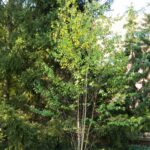
Tree Amelanchier laevis 'Cumulus' [Cumulus Allegheny Serviceberry] Amelanchier laevis 'Cumulus' is a single-stemmed, strongly upright small tree, excellent as a small street tree and for very early, but short-lived, blooms. This tree is sometimes grafted, so rootstock suckers can be a problem. Fruits are edible and a prime source of food for birds. Subject to the troubles of Rosaceous plants in general, including fire-blight and mites, which can be controlled, usually quite easily.
Tree Amelanchier laevis 'JFS-Arb' [sold as Spring Flurry®] [Spring Flurry Allegheny Serviceberry] An excellent tree for naturalizing and for very early, but short-lived, bloom, the Spring Flurry Allegheny Serviceberry has an upright form and grows larger than the species type, up to 35 feet tall. Fruits are edible and a prime source of food for birds. Subject to the troubles of Rosaceous plants in general, including fire-blight and mites, which can be controlled, usually quite easily.
Tree Amelanchier laevis 'Rogers' [sold as Lustre®] [Lustre Allegheny Serviceberry] Lustre Allegheny Serviceberry is a medium-size tree and is a good choice for attracting birds as the berries are edible.
Tree Amelanchier laevis 'Snowcloud' [Snowcloud Serviceberry] The Snowcloud® Serviceberry gets its name from the large white flowers that the tree blooms in Spring.
Tree Amelanchier × grandiflora 'Autumn Brilliance' [sold as Autumn Brilliance®] [Autumn Brilliance Apple Serviceberry] A. x grandiflora 'Autumn Brilliance is a vigorous selection with impressive blooms and bright red fall colors. It is resistant to leaf spot. The berries are frequently used to make jams, jellies, and pies. This selection can be found in both single and multi-trunk forms.
Tree Indiana Native Asimina triloba [Common Pawpaw] Needs filtered or full shade in its first few years, then tolerates full sun. Good specimen tree in a shady landscape. Fruits resemble a short, fat banana, at first green then turning yellowish then brown as they ripen in the fall, and taste like a combination between a banana and mango. Suckers rapidly.
Tree Betula albosinensis [Chinese Paper Birch] Betula albosinensis is a common tree in Europe but not often found here in the United States. It is considered by many to have the most handsome bark of any of the birches. The bark peels off in layers that have been likened to tissue paper. The straight species has bark that is pinkish-copper to orange-red to orange-brown with a white bloom.
Tree Indiana Native Betula alleghaniensis [Yellow Birch] Graceful tree, interesting for its shining bark beginning yellowish or bronze and exfoliating in thin shreds, becoming reddish brown until finally forming blackish-brown plates. Especially well adapted to wet soils. Does not do well in dry situations. Less subject to the borer troubles of B. papyrifera in the Midwest.
Tree Indiana Native Betula nigra [River Birch] Graceful tree, interesting for its curling bark, and especially well adapted to wet soils. Immune to the bronze birch borer, which is a serious problem for the native Betula papyrifera in the Midwest. This species prefers full sun and is quite heat tolerant, but does not have tolerance for drought. If pruning is required, prune in summer or during the dormant season.