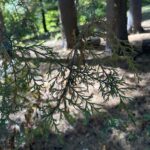
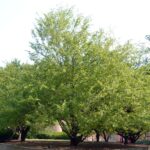
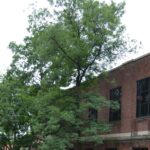
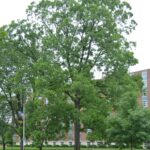
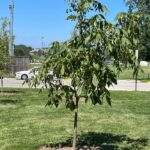
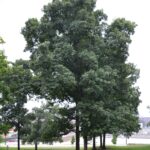
Tree Indiana Native Carya laciniosa [Shellbark Hickory] This high branching tree has a straight, slender trunk, narrowing crown, and small spreading branches with the lower branches drooping and upper branches ascending. The nut that is produced is sweet and edible. The Shellbark Hickory is similar to C. ovata (Shagbark Hickory) in many respects, except it does not grow as large and tends to grow near lowlands or bottomlands where there is more moisture in the soil. The wood from this tree provides…
Tree Indiana Native Carya ovata [Shagbark Hickory] The bark of Carya ovata gives the tree its common name and is characteristically rough and shaggy on mature trees, growing in long flat plates, making especially good winter interest. The wood of this tree is especially hard, making it useful for a variety of products. This tree develops a large taproot, making it difficult to transplant.
Tree Indiana Native Carya tomentosa [Mockernut Hickory] This tree is found on ridges, dry hills, and slopes but grows best in moist, well-drained soil. The fall color is deep golden yellow to golden brown and persists. Fruit is round to elliptical with a thick husk splitting at the base and contains an edible seed.
Tree Carya × nussbaumeri [Hican] This tree is a hybrid of the pecan and shellbark hickory, thus the common name of "Hican". It was developed to produce a nut with the taste of pecans, but with the weaker shell of the shellbark hickory. This plant has a large tap root and can be difficult to transplant. Dropped fruits, stems, and leaves can be a litter problem. Can be prone to various fungal leaf spots.
Tree Indiana Native Celtis laevigata [Sugar Hackberry] The Sugar Hackberry is very similar to the Common Hackberry (Celtis occidentalis) and is especially useful in large-scale situations with dry soils and heavy winds. This species gained its common name from the juicy, sweet berries it produces. Subject to a leaf nipple gall (caused by psyllid insect Pachypsylla dismamma, one of many jumping plant lice). However, the Sugar Hackberry is more resistant to witches'-broom disease (caused by Eriophyid mite) than the Common Hackberry. Especially…
Tree Indiana Native Celtis occidentalis [Common Hackberry] As well adapted to Midwestern conditions as American Elm, and a reasonably good substitute in form as well. Especially useful in large-scale situations with dry soils and heavy winds. Subject to a leaf nipple gall (caused by psyllid insect Pachypsylla dismamma, one of many jumping plant lice) and witches'-broom disease (caused by Eriophyid mite), both minor in most situations in the Midwest. Especially coarse texture limits use in designed landscapes.
Tree Celtis occidentalis 'Prairie Pride' [Prairie Pride Hackberry] As well adapted to Midwestern conditions as American Elm, and a reasonably good substitute in form as well. Especially useful in large-scale situations with dry soils and heavy winds. 'Prairie Pride' has glossy, thick, leathery leaves and is less of a litter problem than the species type due to its lower fruit production. Subject to a leaf nipple gall (caused by psyllid insect Pachypsylla dismamma, one of many jumping plant lice), but is not subject…
Tree Cercidiphyllum japonicum [Katsuratree] More hardy once established than when young. A striking specimen tree, useful for partial shade and accent. Unusually free of insect problems. Leafs out early in spring. Forms multiple trunks unless pruned. Does not transplant well. Not very drought-tolerant, particularly after transplanting.
Tree Indiana Native Cercis canadensis [Eastern Redbud] A fine small tree that grows wild in many parts of Indiana. Relatively trouble-free and drought-resistant. Requires some protection from the sun in hotter climates, however flowering decreases with deep shade. Canker, leaf spot, and verticillium wilt can be problematic for older trees, or trees weakened by other environmental stresses. Due to genetic variability, be sure of seed source. Long tap root means that older plants transplant poorly.