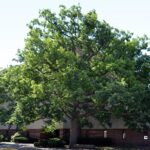
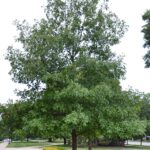
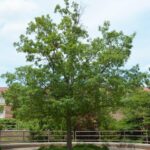
Tree Indiana Native Audio Recording AvailableID That Tree Video AvailablePurdue Plant Doctor Available Quercus alba [White Oak] One of the most majestic trees at maturity with a picturesque framework, but requires many years to reach maturity. Long-lived, the kind of tree to use where it can be appreciated by succeeding generations. Slow growth eliminates it as a tree for quick effect. Roots are highly sensitive to disturbance, even foot traffic. Almost impossible to transplant from the wild. Often difficult to find in nurseries due to slow growth and recalcitrance to propagation by… Indiana NativeAudio Recording AvailableID That Tree Video AvailablePurdue Plant Doctor Available
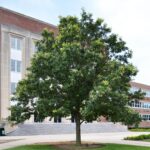
Tree Indiana Native Audio Recording AvailableID That Tree Video AvailablePurdue Plant Doctor Available Quercus bicolor [Swamp White Oak] The Swamp White Oak is a sturdy, long-lived tree that is generally tolerant to average conditions and even wet soil, but requires full sun and acidic soil. Indiana NativeAudio Recording AvailableID That Tree Video AvailablePurdue Plant Doctor Available
Tree Purdue Plant Doctor Available Quercus bicolor 'Bonnie and Mike' [sold as Beacon®] [Beacon Oak] 'Bonnie and Mike' is a cultivar with dense and glossy green foliage. Good for urban use with its tight upright columnar branching. It also has yellow fall color. Purdue Plant Doctor Available
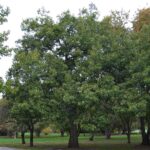
Tree Indiana Native Audio Recording AvailableID That Tree Video AvailablePurdue Plant Doctor Available Quercus coccinea [Scarlet Oak] Excellent scarlet fall foliage, comparable if not often better than the Pin Oak. Does not suffer iron chlorosis as bad as Pin Oak, being more tolerant of alkaline soils. Some report difficulty in transplanting. Indiana NativeAudio Recording AvailableID That Tree Video AvailablePurdue Plant Doctor Available
Tree Audio Recording AvailablePurdue Plant Doctor Available Quercus × 'Crimschmidt' [sold as Crimson Spire™] [Crimson Spire Oak] The Crimson Spire Oak is notable for its powdery mildew resistance and reddish fall color that it gained from its White Oak parent, in addition to the dense, strong, vertical, columnar form, and tolerance to drought and urban conditions gained from its Fastigiate English Oak parent. Audio Recording AvailablePurdue Plant Doctor Available
Tree Indiana Native Audio Recording AvailablePurdue Plant Doctor Available Quercus × deamii [Deam Oak] The Deam Oak is a rare hybrid between the White Oak (Quercus alba) and the Chinquapin Oak (Quercus muehlenbergii) that can be found in mature forests. Quercus x deamii was first discovered in Wells County, Indiana, about 4 miles outside the town of Bluffton in 1904 by Bruce Williamson, a zoologist, and his father. Not sure what they had found, they took the specimen to Charles C. Deam who later sent the sample to his… Indiana NativeAudio Recording AvailablePurdue Plant Doctor Available
Tree Indiana Native Audio Recording AvailableID That Tree Video AvailablePurdue Plant Doctor Available Quercus ellipsoidalis [Northern Pin Oak] Quercus ellipsoidalis is very closely related to Q. palustris (Pin Oak), but is better suited for the Midwest. Very similar to the Pin Oak, the Northern Pin Oak is a handsome tree with distinctive and regular branching, spreading to horizontal to drooping, from top to bottom of the tree. This effect is partly lost when lower limbs must be removed for traffic underneath. While this species is still prone to chlorosis (yellowing of leaves) in… Indiana NativeAudio Recording AvailableID That Tree Video AvailablePurdue Plant Doctor Available
Tree Audio Recording AvailablePurdue Plant Doctor Available Quercus falcata [Southern Red Oak] Generally only hardy up to zone 6, this oak is native to southeastern regions of the United States, but can sometimes be grown in colder climates. This tree gained its specific epithet name, "falcata", from the sickle-like weapon of the same name, in reference to the sickle-shaped lobes of the leaves. Root disturbance is known to severely affect this species, and can lead to decline or death. Audio Recording AvailablePurdue Plant Doctor Available
Tree Indiana Native Audio Recording AvailablePurdue Plant Doctor Available Quercus imbricaria [Shingle Oak] Somewhat tolerant of city conditions. Can be pruned into a hedge. Leaves persist into winter, after the normal leaf raking period, and then fall. Oak gall susceptible, but a minor problem. Indiana NativeAudio Recording AvailablePurdue Plant Doctor Available
Tree Indiana Native Audio Recording AvailableID That Tree Video AvailablePurdue Plant Doctor Available Quercus lyrata [Overcup Oak] The Overcup Oak is a medium-sized oak with an oval crown and lower branches that sweep upward. This species thrives in lowlands and bottomlands and can tolerate extended flooding. The common name is derived from its acorn, which can be nearly 3/4 "cupped" by the cap. Acorns generally aren't produced until the tree is around 25-30 years old. Indiana NativeAudio Recording AvailableID That Tree Video AvailablePurdue Plant Doctor Available