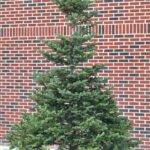
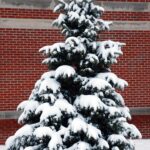
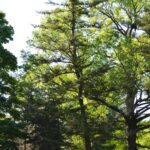
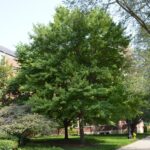
Tree Abies balsamea [Balsam Fir] Used mainly as a specimen tree and popular as a Christmas tree. Does not hold its needles very long in a dry house and for this reason is not as desirable as pines. In youth it looks good but under hot, dry conditions may lose the older needles and become open and unkempt.
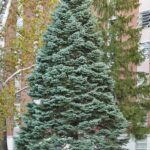
Tree Abies balsamea var. phanerolepis [Canaan Fir] The Canaan Fir is more tolerant of different environmental conditions than many other firs. It can tolerate wetter soils, and because of its later bud break, is more resistant to damage caused by late spring frost. Can be affected by spruce budworms, wooly adelgid, and several canker diseases, as well as deer. This species transplants well.
Tree Abies concolor [White Fir] Similar to Picea pungens f. glauca in color and general form, but less positive, and so easier to use in a variety of situations. Better adapted to hot, dry summers than most other firs.
Tree Abies concolor 'Blue Select' [Blue Select White Fir] Better adapted to hot, dry summers than most other firs. 'Blue Select' is noted for its intense blue upright needles.
Tree Abies concolor 'Conica' [Conica White Fir] 'Conica' is a narrow habit white fir, with a spread reaching 10-15' wide. Similar to Picea pungens f. glauca in color and general form, but less positive, and easier to use in a variety of situations. Better adapted to hot, dry summers than most other firs, but prefers cooler cilmates.
Tree Abies nordmanniana [Nordmann Fir] In the wild, this species can reach over a staggering 200'. Many uses for this tree are for spacious parks and screening.
Tree Acer rubrum 'Fairview Flame' [Fairview Flame Red Maple] Tolerant of wet, poorly drained soils and also dry conditions. Moderately weak wooded. Does not tolerate heavy pollution.
Tree Acer rubrum [sold as October Glory®] [October Glory Red Maple] The October Glory Maple is one of the more popular Red Maple cultivars used in landscapes. This cultivar tends to hold its lustrous green leaves well into the fall season before changing to a vivid reddish-orange. Early freezes in northern parts of the country can hinder fall color.
Tree Acer sp. [Maple] The Maple genus, Acer, is comprised of about 120 species of mostly deciduous trees that are commonly used ornamentally in the landscape, and commercially for timber and even syrup.
Tree Aesculus hippocastanum [Common Horsechestnut] Widely adapted to soils and environments; however, very dry conditions must be avoided. Leaf blotch often disfigures foliage. Spiny fruits in autumn can be troublesome underfoot, and eliminates species type as a good street tree. Fruits are toxic containing 3-5% saponins.
Shrub Alnus serrulata [Hazel Alder] Closely related to Alnus rugosa, differing chiefly in its leaves, which are usually broadest above the middle and have the margins set with fine, nearly regular teeth. Multi-stemmed habit and tends to sucker.
Tree Indiana Native Amelanchier arborea [Downy Serviceberry] Would grow well on a streambank. Susceptible to rust, leaf blight, powdery mildew, fruit rot, leaf minor, borers, and scale. Rarely requires pruning.
Shrub/Tree Indiana Native Amelanchier canadensis [Shadblow Serviceberry] Amelanchier canadensis, the Shadblow Serviceberry, tends to be confused with Amelanchier arborea, the Downy Serviceberry, and Amelanchier laevis, the Allegheny Serviceberry. However, A. canadensis, compared to A. arborea and A. laevis, is generally much more shrub-like (often forming thickets), flowers a week later, and produces upright flower clusters (as opposed to the pendulous racemes of A. arborea and A. laevis). The Shadblow Serviceberry is excellent for woodland plantings, naturalizing, and along stream and pond banks.…
Shrub/Tree Indiana Native Amelanchier canadensis 'Sprizam' [sold as Spring Glory®] [Spring Glory Shadblow Serviceberry] A new variety, notable for its compact, upright habit reaching only 12' tall and 8-10' wide.
Tree Indiana Native Amelanchier laevis [Allegheny Serviceberry] An excellent small tree for naturalizing and for very early, but short-lived, bloom. Fruits are edible and a prime source of food for birds. Can produce fruit by apomixis. Subject to the troubles of Rosaceous plants in general, including fire-blight and mites, which can be controlled, usually quite easily.
Tree Amelanchier laevis 'Snowcloud' [Snowcloud Serviceberry] The Snowcloud® Serviceberry gets its name from the large white flowers that the tree blooms in Spring.
Tree Amelanchier × grandiflora 'Autumn Brilliance' [sold as Autumn Brilliance®] [Autumn Brilliance Apple Serviceberry] A. x grandiflora 'Autumn Brilliance is a vigorous selection with impressive blooms and bright red fall colors. It is resistant to leaf spot. The berries are frequently used to make jams, jellies, and pies. This selection can be found in both single and multi-trunk forms.
Shrub Indiana Native Arctostaphylos uva-ursi [Bearberry] Hard to establish, can develop winter burn from sun and wind when cold. Does not like excessive summer heat. Can develop foliar diseases (leaf spot) when stressed. Leaves are used to make a tea in some parts of Russia, where it is known as Kutai and Caucasian Tea. The dried leaves have been used to treat diseases of the bladder and kidney, and inflammatory diseases.
Shrub Indiana Native Aronia arbutifolia [Red Chokeberry] Red Chokeberry is often a multi-stem shrub that's native to Indiana as well as Eastern North America to Minnesota and south as far as Texas. This shrub bears white to slightly pinkish flowers with prominent anthers that gives it a unique look. Red berries form in September to often December. Best grown in mass plantings or for a naturalizing species in the landscape. Though the berries are bitter to taste, they are often used in…
Shrub Indiana Native Aronia melanocarpa [Black Chokeberry] This Indiana native shrub is similar to the Red Chokeberry in habit and form, but differs in that the Black Chokeberry is larger, has black-colored fruits, broader leaves, and generally larger flowers. Place in a higher light location for the best flower and fruit display. Best used for naturalizing, mass plantings, and wetland reclamation projects. The berries are edible, but only palatable when used in jellies and jams.
Tree Indiana Native Asimina triloba [Common Pawpaw] Needs filtered or full shade in its first few years, then tolerates full sun. Good specimen tree in a shady landscape. Fruits resemble a short, fat banana, at first green then turning yellowish then brown as they ripen in the fall, and taste like a combination between a banana and mango. Suckers rapidly.
Tree Betula nigra 'Cully' [sold as Heritage™] [Heritage River Birch] This vigorous cultivar makes a graceful tree, interesting for its richly colored, strongly curling bark and large, glossy leaves. It is somewhat resistant to leaf spot and is especially well adapted to wet soils. Immune to the bronze birch borer, which is a serious problem for the native Betula papyrifera in the Midwest. This species prefers full sun and is quite heat tolerant, but does not have tolerance for drought. If pruning is required, prune…
Tree Betula × 'Crimson Frost' [Crimson Frost Birch] This hybrid birch is very closely related to Betula platyphylla in form and care, with the exception of its striking red-purple leaves. It is a graceful tree, interesting for its pure white bark that contrasts nicely with the dark foliage. The Crimson Frost Birch is especially well adapted to wet soils, and does not do well in dry situations. Less subject to the borer troubles of B. papyrifera in the Midwest, although still susceptible.
Tree Carpinus betulus [European Hornbeam] Carpinus betulus is relatively trouble-free and tolerates a wide range of soil conditions and some shade. This plant is also very tolerant of heavy pruning, making it useful as a hedge.
Tree Indiana Native Carya cordiformis [Bitternut Hickory] Carya cordiformis is naturally found growing in low woodlands and along rivers, streams, and ponds. This is one of the fastest growing of the hickories. The long taproot can make this species difficult to transplant. There are no serious insect or disease threats.
Tree Indiana Native Carya glabra [Pignut Hickory] With its straight trunk and strong, hard wood, the Pignut Hickory is most commonly grown for the lumber industry and is not generally used as an ornamental tree. In the wild, it tends to grow on ridges and hillsides in dry to moist soils. This large tree needs a great deal of room to grow and transplants poorly due to its large taproot. The nuts are generally too bitter for humans to eat, but are…
Tree Indiana Native Carya illinoinensis [Pecan] The Pecan is a tall, straight-trunked tree and is the largest of the hickories. It is well-known for its sweet, edible nuts and because of this, it is an important horticultural crop in the south, where it produces fruit most abundantly. However, it is not generally recommended for use in the landscape, due to its pest susceptibility and litter problem. With its large taproot, it can also be quite difficult to transplant.
Tree Indiana Native Carya laciniosa [Shellbark Hickory] This high branching tree has a straight, slender trunk, narrowing crown, and small spreading branches with the lower branches drooping and upper branches ascending. The nut that is produced is sweet and edible. The Shellbark Hickory is similar to C. ovata (Shagbark Hickory) in many respects, except it does not grow as large and tends to grow near lowlands or bottomlands where there is more moisture in the soil. The wood from this tree provides…
Tree Indiana Native Carya ovata [Shagbark Hickory] The bark of Carya ovata gives the tree its common name and is characteristically rough and shaggy on mature trees, growing in long flat plates, making especially good winter interest. The wood of this tree is especially hard, making it useful for a variety of products. This tree develops a large taproot, making it difficult to transplant.
Tree Indiana Native Carya tomentosa [Mockernut Hickory] This tree is found on ridges, dry hills, and slopes but grows best in moist, well-drained soil. The fall color is deep golden yellow to golden brown and persists. Fruit is round to elliptical with a thick husk splitting at the base and contains an edible seed.
Tree Indiana Native Castanea dentata [American Chestnut] Highly susceptible to chesnut blight, causing this tree to be nearly extinct in the wild.
Tree Castanea dentata × mollissima [Dunstan Chestnut] Celebrated due to the quality of its fruit. Excellent nut quality that is attractive to deer and wildlife. Nuts drop in autumn, September-October. Often chosen as an orchard tree.
Liana (Climbing Vine) Indiana Native Celastrus scandens [American Bittersweet] Sun to partial shade (best flowers in full sun), and tolerant of soil conditions (except wet). Tends to be invasive. Birds are fond of fruits. Tends toward dioeciousness. Female plants need a male pollinator to produce more abundant fruits. Can girdle trees it grows on. Euonymus scale and two-marked treehoppers can cause damage.
Tree Indiana Native Celtis occidentalis [Common Hackberry] As well adapted to Midwestern conditions as American Elm, and a reasonably good substitute in form as well. Especially useful in large-scale situations with dry soils and heavy winds. Subject to a leaf nipple gall (caused by psyllid insect Pachypsylla dismamma, one of many jumping plant lice) and witches'-broom disease (caused by Eriophyid mite), both minor in most situations in the Midwest. Especially coarse texture limits use in designed landscapes.
Shrub Indiana Native Cephalanthus occidentalis [Common Buttonbush] Buttonbush is an Indiana native and a wet-soil tolerant shrub found near marshes, wetlands, and river banks. This is a great choice for those wet areas in the landscape or a featured shrub in your rain garden. The flowers of this shrub are globe-like in shape and bloom from June through August, attracting wildlife such as butterflies. The leaves of the Buttonbush emerge late in the Spring and might look dead until mid-May. Though this…
Tree Cercis canadensis 'Appalachian Red' [Appalachian Red Eastern Redbud] 'Appalachian Red' is known for its profusion of intensely bright pink (not quite red) flowers in the spring. A fine small tree that is relatively trouble-free and drought-resistant. Requires some protection from the sun in hotter climates, however flowering decreases with deep shade. Canker, leaf spot, and verticillium wilt can be problematic for older trees, or trees weakened by other environmental stresses. Long tap root means that older plants transplant poorly.
Tree Cercis canadensis 'Forest Pansy' [Purple-Leaf Eastern Redbud] 'Forest Pansy' is a unique and attractive cultivar that has deep purple foliage, which generally fades to a dark, lustrous green in late summer or under drought conditions. Beautiful rose-purple flowers smother the branches in the spring. A fine small tree that is relatively trouble-free and drought-resistant. Requires some protection from the sun in hotter climates, however flowering decreases with deep shade. Canker, leaf spot, and verticillium wilt can be problematic for older trees, or…
Tree Cercis canadensis 'Hearts of Gold' [Gold-Leaf Eastern Redbud] 'Hearts of Gold' is a striking redbud cultivar with reddish-orange tinted emerging leaves that turn bright yellow and finally deepen to a bright green towards the end of the summer. The yellow color develops most intensely under higher light conditions. A fine small tree that is relatively trouble-free and drought-resistant (although the yellow foliage color will become green in drought conditions). Canker, leaf spot, and verticillium wilt can be problematic for older trees, or trees…
Shrub Chaenomeles × superba 'Crimson and Gold' [Crimson and Gold Flowering Quince] The Crimson and Gold Quince offers season-round interest. Also the Quince plant produces edit Pear-shaped fruit that is bitter right off the stem but can be used in sweet fall recipes. The Crimson and Gold cultivar shows of it's color with bright red flowers that bloom in Spring. In winter the fruits hold on to the thorny stems after the plant loses it's foliage.
Tree Chionanthus retusus [Chinese Fringetree] The Chinese Fringetree can be a large, multi-stemmed shrub or a small single- or multi-trunked tree. In late spring to early summer, Chionanthus retusus produces a beautiful show of pure, white, fringe-like flowers that are borne in clusters on branch ends. For optimal flowering, place in a full sun location. This species is dioecious and female plants produce very ornamental blue fruits that are attractive to wildlife. Plants of known sex are not usually available…
Tree Chionanthus virginicus [White Fringetree] Dioecious with male plants showier in flower than females; plant a female if fruits are desired. Plants of known sex are not usually available unless selected in the flowering size. One of the last plants to leaf out in the spring.
Shrub Indiana Native Clethra alnifolia [Summersweet Clethra] Spreads by underground stems to make large clumps, but can be restrained when necessary. Can be badly infested with mites, especially on dry soils. Can suffer in full sun and/or dry soils, but can bloom well in shade.
Tree Indiana Native Cornus alternifolia [Pagoda Dogwood] Broad-spreading, low branched, forming stratified tiers, very interesting branching habit. Leaf spot and twig blight/canker can be problem for older trees.
Shrub Indiana Native Cornus amomum [Silky Dogwood] Easy to transplant. Relatively trouble-free. A three-year pruning cycle improves form, vigor, and winter stem color effect. Cutting all stems 6-12" from ground in late winter has similar effect. Best in mass plantings. Excellent for winter color. Scale and leaf spot can be a problem. Can appear a bit coarse in the landscape.
Shrub/Tree Cornus mas [Cornelian Cherry Dogwood] Large multi-stemmed shrub or small tree of oval rounded outline, usually branching to the ground. Small yellow flowers are beautiful when borne in mass in the spring. No serious disease problems. Sometimes it suckers abundantly, and these suckers should be removed to control spread; this is especially important if maintaining this plant in tree form.
Shrub/Tree Indiana Native Cornus racemosa [Gray Dogwood] The Gray Dogwood is a tough, suckering, deciduous shrub that is native to Indiana and is noted for its small, white flower clusters, white fruits, and persisting red fruit pedicels. Tolerates poor soils (including wet soils), drought, full sun, full shade, and air pollution. Suckers can become a problem if not controlled.
Shrub Indiana Native Cornus sericea [Redosier Dogwood] This plant has red twigs all year round, but the color is especially prominent in winter. Grows well in a variety of situations, including wet soil. Easy to transplant. Relatively trouble-free. A three-year pruning cycle improves form, vigor, and winter stem color effect. Cutting all stems 6-12" from ground in late winter has similar effect. Best in mass plantings. Excellent for winter color. Leaf blights and twig cankers can be problematic.
Shrub Indiana Native Corylus americana [American Hazelnut] The American Hazelnut is a medium to fast growing shrub and an Indiana native. Being monoecious, the male catkins are 1 1/2 to 3" long, that emerge yellowish brown and are quite showy in early spring. The female catkins are inconspicuous with its stigma and style barely protruding out of the buds, but the color is a rich red. The American Hazelnut is a great large shrub for native restoration projects or adding seasonal interest…
Tree Corylus colurna [Turkish Filbert] Horizontal branch structure (with lower branches often touching the ground), strong central leader, and bark give good winter character. Does great in hot summers and cold winters, very adaptable. Quite drought tolerant after establishment, leaves stay green when maples scorch. Needs supplemental water immediately after transplanting and until established. Otherwise drought tolerant. Nuts are edible and can be roasted.
Tree Indiana Native Crataegus crus-galli [Cockspur Hawthorn] The strong horizontal branching is good for softening vertical lines of buildings. The 2-3" thorns can be dangerous, especially around children. Although attractive, some find the small, white flowers malodorous. Fireblight, leaf spot, and cedar-hawthorn rust are among the worst problems to affect this species. Japanese beetles like to feed on hawthorns.
Tree Indiana Native Crataegus mollis [Downy Hawthorn] Quite susceptible to cedar-hawthorn rust, with leaves heavily spotted with orange in some years. Rust limits usage in many areas. Large fruit pose a maintenance issue when they drop.
Tree Indiana Native Crataegus phaenopyrum [Washington Hawthorn] One of the finest small trees for winter color. The 1-3" thorns can be dangerous, especially around children. Fireblight, leaf spot, and cedar-hawthorn rust are among the worst problems, although more trouble-free than many hawthorns. Japanese beetles like to feed on hawthorns.
Tree Crataegus viridis 'Winter King' [Winter King Green Hawthorn] An attractive, nearly thornless vase-shaped small tree with beautiful white flower corymbs and large, bright red persistent fruits. This cultivar was discovered in a fence row by Bob Simpson in Vincennes, Indiana. Very adaptable, although leaves are often badly infected by rust so that the entire plant appears to be suffering from the measles.
Tree Crataegus × lavalleei [Lavalle Hawthorn] The Lavalle Hawthorn is a small, rounded tree that resulted from a cross of Crataegus mexicana and C. crusgalli. Quite resistant to rust and less thorny than its Cockspur Hawthorn parent.
Tree Crataegus × mordenensis [Morden Hawthorn] This uncommon plant resulted from a cross between Crataegus laevigata 'Paul's Scarlet' and C. succulenta'. It has attractive clusters of double flowers and is highly resistant to hawthorn rust.
Tree Crataegus × 'Vaughn' [Vaughn Hawthorn] This small tree is a hybrid of Crataegus crusgalli x C. phaenopyrum. It is generally grown for its fragrant clusters of white flowers in the spring and prolifically produced red fruits that persist into winter. Due to its numerous thorns, it is best used in areas with low traffic. Highly susceptible to rust.
Tree Indiana Native Diospyros virginiana [Common Persimmon] Most are usually dioecious and have a deep tap root which makes large plants difficult to transplant. Flowers attract bees while the fruit attracts birds and many mammals. The fruit is astringent when green, sweet and edible when ripe. Fruits, twigs, and leaves can be a littler problem.
Tree Diospyros virginiana 'Meader' [Meader Persimmon] Most usually dioecious. Flowers attract bees. Fruit attracts birds and many mammals. The fruit is astringent when green, sweet and edible when ripe. Fruits, twigs, and leaves can be a littler problem. Deep tap root makes large plants difficult to transplant. Can be poisonous to horses. ‘Meader’ is a self-fertile cultivar usually producing fruit after 2-3 years.
Shrub/Tree Indiana Native Euonymus atropurpureus [Eastern Wahoo] The Easter Wahoo is an Indiana native shrub/small tree that can be found in open woods or along forest edges and is grown for its attractive red fruits and great fall color. Due to its irregular habit, the Eastern Wahoo can be an issue in the formal landscape, but regular pruning can fix this issue. Far less invasive than the infamous Euonymus alatus (Winged Euonymus or Burning Bush). Flowers are small, rich purple that bloom…
Tree Indiana Native Fagus grandifolia [American Beech] In a proper site, an excellent trouble-free shade tree with year-round interest. Less adaptable to hot, dry conditions than the exotic F. sylvatica, but somewhat more cold hardy. F. grandifolia is preferred in Zone 4. Like F. sylvatica, this tree is so shallow rooted and casts such heavy shade that grass does not grow well beneath it. Low branching habit is a concern for use in the tree lawn as a street tree (may require…
Tree Fagus sylvatica [European Beech] In a proper site, an excellent trouble-free shade tree with year-round interest. More adaptable to hot, dry conditions than our native F. grandifolia, but somewhat less hardy. F. grandifolia is preferred in Zone 4. Like F. grandifolia, this tree is so shallow rooted and casts such heavy shade that grass does not grow well beneath it. Low branching habit is a concern for use in the tree lawn as a street tree (may require more…
Tree Fagus sylvatica 'Purpurea' [Purple-Leaf European Beech] In a proper site, an excellent trouble-free shade tree with year-round interest. More adaptable to hot, dry conditions than our native F. grandifolia, but somewhat less hardy. F. grandifolia is preferred in Zone 4. Like F. grandifolia, this tree is so shallow rooted and casts such heavy shade that grass does not grow well beneath it. Low branching habit is a concern for use in the tree lawn as a street tree (may require more…
Tree Fagus sylvatica 'Red Obelisk' [Red Obelisk European Beech] The Red Obelisk European Beech has a gorgeous columnar form and this tree is notable season round. The foliage is crimson red with light red-white tips. The stem is smooth and light gray.
Shrub/Tree Indiana Native Forestiera acuminata [Swamp Privet] The Swamp Privet is a large shrub typically found near swamps, floodplains, wet woods and marshes. Purple-black fruits (drupes) ripen during late summer and is a food source for water fowl, such as ducks. Forestiera acumunata is dioecious, so one would need a male and female for the shrub to produce its fruit. Leaves are a dark green and looks evergreen from a glance, yet turns a golden yellow in fall.
Tree Indiana Native Fraxinus americana [White Ash] Not as adaptable as Green Ash but has better esthetics. Heavy crops of seeds on female trees cause litter, and these germinate freely making the tree slightly weedy. An unattractive ash flower gall (caused by mites) can develop on male flowers and persist into winter. Subject to storm damage, so plant in areas that shelter the tree from strong winds. Emerald Ash Borer is severely affecting all species of this genus. Damage can be prevented…
Tree Ginkgo biloba [Ginkgo] The Ginkgo is a long-lived deciduous conifer and gymnosperm. It is frequently termed a "living fossil," as it is the only surviving member of a group of ancient plants with fossils dating back to 270 million years ago. This plant is dioecious, and the so-called fruits (which are actually naked seeds with a soft seed coat) are borne on female trees, are green or tan-orange, and have an offensive odor when ripe and decaying. Fruits…
Tree Indiana Native Gleditsia triacanthos f. inermis [Thornless Common Honeylocust] This large tree has finely compound leaves that provide a pleasant, dappled shade in the summer. The thornless forma inermis is only sold in commerce, as the profuse thorns of the species type can be a liability. Mimosa webworm and locust mite are serious pests in the Midwest, and are becoming more serious (especially in areas tending toward monoculture). Can be controlled with spraying.
Tree Halesia carolina 'Arnold Pink' [Pink Carolina Silverbell] This small tree is interesting when in bloom with pink bell-shaped flowers that are larger than the straight species, but this plant is rather neutral otherwise. However, it is relatively trouble free and useful in many situations as a neutral background plant, or for its flowers. Best grown as a single stem and allowed to branch low (20-30"). Does not transplant well (a particular problem with field-grown plants).
Tree Indiana Native Ilex opaca [American Holly] This species, like other hollies, is dioecious, so plant females for fruit and an occasional male for pollination. Winter desiccation injury can occur on leaves in exposed sites. Holly leaf miners are one of the major pest problems for Ilex opaca.
Tree Ilex opaca 'Old Heavy Berry' [Old Heavy Berry American Holly] 'Old Heavy Berry' is an excellent, vigorous female cultivar with good winter hardiness and an abundance of large, bright red fruits. This species, like other hollies, is dioecious, so plant females for fruit and an occasional male for pollination. Winter desiccation injury can occur on leaves in exposed sites. Holly leaf miners are one of the major pest problems for Ilex opaca.
Tree Indiana Native Juglans cinerea [Butternut] Juglans cinera is a large, rounded tree similar to, but overall smaller than the Black Walnut (Juglans nigra). It is not commonly grown for ornamental purposes. The nut, once one is able to crack the hard shell, is edible, sweet, oily, and buttery. Long tap root makes transplanting difficult. This species is valued for its wood and between overharvesting and losses from Butternut Canker (Sirococcus clavigignenti-juglandacearum), this species has become rare in its native habitat.
Tree Indiana Native Juglans nigra [Black Walnut] Nuts are a serious litter problem, staining sidewalks and driveways. Juglone (found in leaf litter and possibly roots) is toxic to many plants, like tomatoes, blackberries, red pines, and many others. Black Walnut wood is valuable and has a variety of commercial uses, especially for furniture.
Shrub Indiana Native Juniperus horizontalis [Creeping Juniper] Widely adapted to soils and climates, as evidenced by its broad natural range. Tolerates slightly alkaline and heavy clay soils, but not wet soils. Young plants can be seriously injured by Phomopsis blight in some areas. Plants of all ages are susceptible to mite infestation.
Tree Juniperus virginiana 'Canaertii' [Canaert Eastern Redcedar] 'Canaertii' is a picturesque, pyramidal female cultivar that produces a profusion of bloomy blue berries (cones). Widely adapted to soils and climates. Does well in alkaline soils, but not wet soils. Alternate host for cedar-apple rust disease, and 'Canaertii' is especially susceptible. Plant other juniper species in areas having many apples, hawthorns, etc. Susceptible to bagworms.
Tree Indiana Native Juniperus virginiana 'Taylor' [Eastern Redcedar] Fantastic upright conical-columnar form; may have originated or been tested through Nebraska Statewide Arboretum. Widely adapted to soils and climates, as evidenced by the species' wide geographic range. Does well in alkaline soils, but not wet soils. Alternate host for cedar-apple rust disease. Plant other juniper species in areas having many apples, hawthorns, etc. Susceptible to bagworms.
Tree Indiana Native Larix laricina [Eastern Larch] The Eastern Larch, or more commonly referred to as Tamarack, is a cold hardy deciduous pine found in northern portions of Canada, Alaska, and as far south as Minnesota, Illinois, and Pennsylvania. The Tamarack grows in particularly moist soils and is salt tolerant. It grows open and pyramidal with a slender trunk, and has horizontal and drooping branchlets. During the fall, its soft, blueish-green needle-like leaves turn a rich, golden color. This tree does best…
Shrub Ligustrum 'Vicaryi' [Golden Privet] Cross between L. ovalifolium 'Aureum' and L. vulgare. Vase-shaped habit and the leaves are golden yellow for the entire growing season.
Shrub Indiana Native Lindera benzoin [Spicebush] The Spicebush is an excellent native shrub for naturalizing or in borders. Tolerant of full shade, although it tends to become leggy in lower light situations. Difficult to transplant; use container-grown plants. Prefers moist soils; not especially drought tolerant. Dioecious.
Tree Indiana Native Liquidambar styraciflua [American Sweetgum] Handsome shade tree with few troubles and outstanding seasonal interest. Widely adapted to soils and climates, as evidenced by its wide range. Fall foliage coloration varies greatly in timing and intensity among individuals. Rather difficult to transplant in large sizes. Varies widely in hardiness. Select native northern stock for use in North. Horned fruits can be a serious litter problem, dulling mower blades and injuring bare feet. Also see Liquidambar styraciflua (Shuttle Gum Group).
Tree Indiana Native Liriodendron tulipifera [Tuliptree] Handsome, tall shade tree with strong central leader. Performs best in good soil with adequate moisture. Variable in hardiness, depending on geographic source. Use native stock when possible. State tree of Indiana, Kentucky, North Carolina, and Tennessee. Slightly weak-wooded. Subject to damage in very windy sites. Subject to aphid and scale insects when weakened. Needs good drainage and a lot of soil (tree lawn may be too small). Its poorly branched fleshy root system (taproot)…
Tree Indiana Native Liriodendron tulipifera 'Little Volunteer' [Little Volunteer Tulip-tree] 'Little Volunteer' is a dwarf cultivar with smaller 4-lobed and flat-topped green leaves. It makes a wonderful street tree with its smaller size in habit, leaf, and flower. While keeping the classic yellow fall color and yellow-orange-green flower as other varieties.
Tree Magnolia acuminata 'Yellow Bird' [Yellow Bird Magnolia] 'Yellow Bird' is a cultivar that has a pyramidal habit and is fast growing. Its flowers are almost non-fragrant, yellow with a greenish tinge at the base of outer tepals. Tepals are longer than the straight species, reaching 3" to 4" long. Since it flowers later, flowering is more dependable without the threat of frosts.
Tree Indiana Native Magnolia tripetala [Umbrella Magnolia] Full sun or light partial shade. Tropical appearance. Flowers are creamy white with an unpleasant smell. The cone-like rosy red fruit matures in September-October. Endangered in Indiana. Large leaves can be injured by hail or wind. Perhaps too coarse for most landscape situations.
Tree Magnolia virginiana 'Northern Belle' [Northern Belle Sweetbay Magnolia] The most cold-hardy evergreen magnolia. Large white blossoms that open with the scent of vanilla. This is great around woodlands and near water, where it still grows in very wet soil. Can take full sun or partial shade. Pests and diseases are almost never a problem and has some resistance to drought.
Tree Malus domestica 'Flower of Kent' [The Flower of Kent] Also known as Isaac Newton's Apple Tree, Flower of Kent is a descendent of the original apple tree that was said to inspire Sir Isaac Newton's theory of gravity.
Tree Indiana Native Malus ionensis [Prairie Crabapple] Apples are not quite edible when raw due to the high amounts of pectin causing a bitter taste. Although the high amount of pectin makes the fruit good for jellies or jams.
Tree Indiana Native Nyssa sylvatica [Black Gum] Especially useful in wet soils. One of the most beautiful of trees, with habit comparable to Quercus palustris, but usually more irregular, and with a greater number of more slender main limbs. Silvery-gray, picturesque branching; strong horizontal accent. Difficult to transplant due to taproot; use container-grown plants when possible, or at least plants dug with a soil ball. Shelter from wind. In the North, select native northern stock as the species has a wide geographic…
Tree Indiana Native Nyssa sylvatica 'Wildfire' [Wildfire Blackgum] Especially useful in wet soils. One of the most beautiful trees, with habit comparable to Quercus palustris, but usually more irregular, and with a greater number of more slender main limbs. Silvery-grey, picturesque branching; strong horizontal accent. Difficult to transplant due to taproot; use container-grown plants when possible, or at least plants dug with a soil ball. Shelter from wind. In the North, select native northern stock as the species has a wide geographic range.…
Shrub Indiana Native Opuntia humifusa [Pricklypear] The Pricklypear is a cactus native to the eastern United States, including Indiana, and is hardy to USDA zone 4. The cactus pads can break off and root into the ground, forming colonies. It is an evergreen plant, but becomes shriveled and wilted during cold winters. Fruits are edible and are often used to make jams and candies. The pads (fleshy green segments with thorns) are also edible as a roasted vegetable. This plant has…
Tree Indiana Native Ostrya virginiana [American Hophornbeam] A good, trouble-free small shade tree worthy of greater use. Very graceful with many drooping branches that create a rounded habit. Best on drier slopes, and is usually found in native ecosystems. Slow growing, and difficult to transplant. Does not tolerate periodic flooding (as does Carpinus caroliniana) or salt.
Liana (Climbing Vine) Indiana Native Parthenocissus quinquefolia [Virginia Creeper] One of the strongest-climbing vines, given solid support for attachment of the adhesive discs on tendrils (not root). Not a vine for trellises or fences. Tolerates any soil, and sun or shade. Limited value as groundcover.
Tree Pinus resinosa [Red Pine] Forms a decent screen when young, especially on poor, dry soils, but soon drops lowers limbs necessitating the need of companion plants to complete the screen. Develops a shorter, thicker trunk when grown in the open. Pine bud moth (as well as other moths) can be problem if not controlled. Foliage presentation not always full or clearly esthetic. Best in groves or plantations where bark color can be admired.
Tree Indiana Native Pinus strobus [Eastern White Pine] More graceful than most pines, both as a young and an old specimen. Excellent neutral screening plant, it can be kept full by occasional pruning. Among best pines for resistance to moth borers. Transplants easily with a bit of shade tolerance. Somewhat less adapted to severe exposures and very dry soils than Pinus resinosa or Pinus nigra. Very sensitive to air pollution and road salt. Susceptible to White Pine Blister Rust. Decaying needles acidify soil…
Tree Indiana Native Populus deltoides [Eastern Cottonwood] Populus deltoides is a large, fast-growing tree that is not generally advised for use in the landscape. This plant is weak-wooded, weedy, and a litter problem, dropping twigs, flowers, branches, leaves, and fruits (the cottony masses that float through the air in early summer). In the wild, it tends to grow along streams, rivers, and other moist areas. Susceptible to many pests and diseases, especially canker.
Tree Indiana Native Populus grandidentata [Bigtooth Aspen] This tree is very fast-growing with best development in moist, fertile soils but will grow on dry, sand or gravelly soils. It is very valuable for pulp wood. Often pyramidal in youth with a central leader, developing an oval, open, irregular crown at maturity.