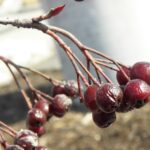
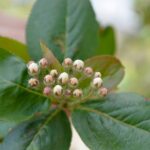
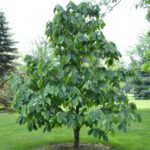
Shrub Indiana Native Aronia arbutifolia [Red Chokeberry] Red Chokeberry is often a multi-stem shrub that's native to Indiana as well as Eastern North America to Minnesota and south as far as Texas. This shrub bears white to slightly pinkish flowers with prominent anthers that gives it a unique look. Red berries form in September to often December. Best grown in mass plantings or for a naturalizing species in the landscape. Though the berries are bitter to taste, they are often used in…
Shrub Indiana Native Aronia melanocarpa [Black Chokeberry] This Indiana native shrub is similar to the Red Chokeberry in habit and form, but differs in that the Black Chokeberry is larger, has black-colored fruits, broader leaves, and generally larger flowers. Place in a higher light location for the best flower and fruit display. Best used for naturalizing, mass plantings, and wetland reclamation projects. The berries are edible, but only palatable when used in jellies and jams.
Tree Indiana Native Asimina triloba [Common Pawpaw] Needs filtered or full shade in its first few years, then tolerates full sun. Good specimen tree in a shady landscape. Fruits resemble a short, fat banana, at first green then turning yellowish then brown as they ripen in the fall, and taste like a combination between a banana and mango. Suckers rapidly.
Tree Betula nigra 'Cully' [sold as Heritage™] [Heritage River Birch] This vigorous cultivar makes a graceful tree, interesting for its richly colored, strongly curling bark and large, glossy leaves. It is somewhat resistant to leaf spot and is especially well adapted to wet soils. Immune to the bronze birch borer, which is a serious problem for the native Betula papyrifera in the Midwest. This species prefers full sun and is quite heat tolerant, but does not have tolerance for drought. If pruning is required, prune…
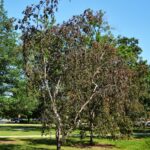
Tree Betula × 'Crimson Frost' [Crimson Frost Birch] This hybrid birch is very closely related to Betula platyphylla in form and care, with the exception of its striking red-purple leaves. It is a graceful tree, interesting for its pure white bark that contrasts nicely with the dark foliage. The Crimson Frost Birch is especially well adapted to wet soils, and does not do well in dry situations. Less subject to the borer troubles of B. papyrifera in the Midwest, although still susceptible.
Tree Carpinus betulus [European Hornbeam] Carpinus betulus is relatively trouble-free and tolerates a wide range of soil conditions and some shade. This plant is also very tolerant of heavy pruning, making it useful as a hedge.
Tree Indiana Native Carya cordiformis [Bitternut Hickory] Carya cordiformis is naturally found growing in low woodlands and along rivers, streams, and ponds. This is one of the fastest growing of the hickories. The long taproot can make this species difficult to transplant. There are no serious insect or disease threats.
Tree Indiana Native Carya glabra [Pignut Hickory] With its straight trunk and strong, hard wood, the Pignut Hickory is most commonly grown for the lumber industry and is not generally used as an ornamental tree. In the wild, it tends to grow on ridges and hillsides in dry to moist soils. This large tree needs a great deal of room to grow and transplants poorly due to its large taproot. The nuts are generally too bitter for humans to eat, but are…
Tree Indiana Native Carya illinoinensis [Pecan] The Pecan is a tall, straight-trunked tree and is the largest of the hickories. It is well-known for its sweet, edible nuts and because of this, it is an important horticultural crop in the south, where it produces fruit most abundantly. However, it is not generally recommended for use in the landscape, due to its pest susceptibility and litter problem. With its large taproot, it can also be quite difficult to transplant.
Tree Indiana Native Carya laciniosa [Shellbark Hickory] This high branching tree has a straight, slender trunk, narrowing crown, and small spreading branches with the lower branches drooping and upper branches ascending. The nut that is produced is sweet and edible. The Shellbark Hickory is similar to C. ovata (Shagbark Hickory) in many respects, except it does not grow as large and tends to grow near lowlands or bottomlands where there is more moisture in the soil. The wood from this tree provides…