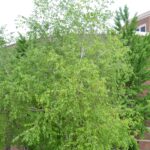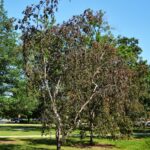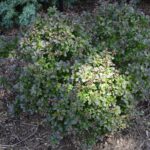
Shrub Calycanthus floridus 'Aphrodite' [Aphrodite Sweetshrub] 'Aphrodite' has an upright form with deep red flowers. The flowers are fragrant and large and bloom throughout the summer season. Large bright green leaves, can grow to be bigger than a human hand.
Liana (Climbing Vine) Audio Recording AvailableID That Tree Video Available Campsis radicans [Common Trumpetcreeper] Very tolerant of soils and environment, except it does not tolerate shade. Can be trained as a standard. May require special support on some surfaces, especially as it becomes large and heavy (could pull down weaker structures). May also require pruning to keep size in check. Audio Recording AvailableID That Tree Video Available
Tree Indiana Native Audio Recording AvailableID That Tree Video Available Carpinus caroliniana [American Hornbeam] A clean, trouble-free small tree, useful in intensive situations such as patios and malls, and equally interesting in naturalized plantings. Useful as a large hedge if coppiced when young. Performs well in heavy shade and tolerates periodic flooding. Difficult to transplant. Move balled-and-burlapped for best results. Sometimes called Blue Beech and Ironwood (although these are best not used). Indiana NativeAudio Recording AvailableID That Tree Video Available
Tree Indiana Native Audio Recording AvailableID That Tree Video AvailablePurdue Plant Doctor Available Carya illinoinensis [Pecan] The Pecan is a tall, straight-trunked tree and is the largest of the hickories. It is well-known for its sweet, edible nuts and because of this, it is an important horticultural crop in the south, where it produces fruit most abundantly. However, it is not generally recommended for use in the landscape, due to its pest susceptibility and litter problem. With its large taproot, it can also be quite difficult to transplant. Indiana NativeAudio Recording AvailableID That Tree Video AvailablePurdue Plant Doctor Available
Shrub Purdue Plant Doctor Available Caryopteris × clandonensis 'Dark Knight' [Dark Knight Bluebeard] Purdue Plant Doctor Available
Shrub Purdue Plant Doctor Available Caryopteris × clandonensis 'Longwood Blue' [Longwood Blue Bluebeard] This deciduous shrub is known for it's showy purple-blue flowers that bloom in spikey clusters, terminal and axillary clusters. Sources say that these clusters resemble blue smoke or mist resulting in its nickname Blue Mist. Purdue Plant Doctor Available
Tree Indiana Native Audio Recording AvailableID That Tree Video Available Castanea dentata [American Chestnut] Highly susceptible to chesnut blight, causing this tree to be nearly extinct in the wild. Indiana NativeAudio Recording AvailableID That Tree Video Available
Tree Indiana Native Audio Recording AvailableID That Tree Video AvailablePurdue Plant Doctor Available Catalpa speciosa [Northern Catalpa] Coarse winter trunks and branches are bold and striking; picturesque. Best for difficult areas. Wood is rot resistant, but is somewhat brittle so branches can fall in wind and ice storms. Too coarse of texture for most urban landscapes. Short-lived to about 50 years. Indiana NativeAudio Recording AvailableID That Tree Video AvailablePurdue Plant Doctor Available
Shrub Indiana Native Audio Recording Available Ceanothus americanus [New Jersey Tea] New Jersey Tea is a native prairie plant that has thick, deep-reaching, red roots (which can even grow up to 8" in diameter), making it very drought tolerant, but also difficult to transplant. This small, compact shrub is able to fix atmospheric nitrogen and is quite adaptable, not only tolerating drought, but different soil types as well. It is even capable of growing in sandy and rocky soils. The leaves of New Jersey Tea were… Indiana NativeAudio Recording Available
Liana (Climbing Vine) Indiana Native Audio Recording AvailableID That Tree Video AvailablePurdue Plant Doctor Available Celastrus scandens [American Bittersweet] Sun to partial shade (best flowers in full sun), and tolerant of soil conditions (except wet). Tends to be invasive. Birds are fond of fruits. Tends toward dioeciousness. Female plants need a male pollinator to produce more abundant fruits. Can girdle trees it grows on. Euonymus scale and two-marked treehoppers can cause damage. Indiana NativeAudio Recording AvailableID That Tree Video AvailablePurdue Plant Doctor Available