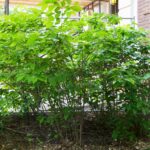
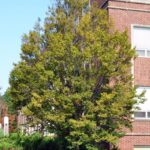
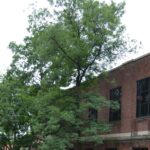
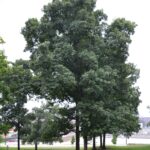
Liana (Climbing Vine) Indiana Native Audio Recording AvailableID That Tree Video AvailablePurdue Plant Doctor Available Celastrus scandens [American Bittersweet] Sun to partial shade (best flowers in full sun), and tolerant of soil conditions (except wet). Tends to be invasive. Birds are fond of fruits. Tends toward dioeciousness. Female plants need a male pollinator to produce more abundant fruits. Can girdle trees it grows on. Euonymus scale and two-marked treehoppers can cause damage. Indiana NativeAudio Recording AvailableID That Tree Video AvailablePurdue Plant Doctor Available
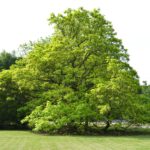
Tree Indiana Native Audio Recording AvailableID That Tree Video AvailablePurdue Plant Doctor Available Celtis occidentalis [Common Hackberry] As well adapted to Midwestern conditions as American Elm, and a reasonably good substitute in form as well. Especially useful in large-scale situations with dry soils and heavy winds. Subject to a leaf nipple gall (caused by psyllid insect Pachypsylla dismamma, one of many jumping plant lice) and witches'-broom disease (caused by Eriophyid mite), both minor in most situations in the Midwest. Especially coarse texture limits use in designed landscapes. Indiana NativeAudio Recording AvailableID That Tree Video AvailablePurdue Plant Doctor Available
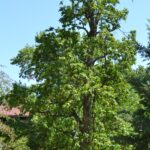
Tree Audio Recording Available Cercidiphyllum japonicum [Katsuratree] More hardy once established than when young. A striking specimen tree, useful for partial shade and accent. Unusually free of insect problems. Leafs out early in spring. Forms multiple trunks unless pruned. Does not transplant well. Not very drought-tolerant, particularly after transplanting. Audio Recording Available
Tree Indiana Native Audio Recording AvailableID That Tree Video AvailablePurdue Plant Doctor Available Cercis canadensis [Eastern Redbud] A fine small tree that grows wild in many parts of Indiana. Relatively trouble-free and drought-resistant. Requires some protection from the sun in hotter climates, however flowering decreases with deep shade. Canker, leaf spot, and verticillium wilt can be problematic for older trees, or trees weakened by other environmental stresses. Due to genetic variability, be sure of seed source. Long tap root means that older plants transplant poorly. Indiana NativeAudio Recording AvailableID That Tree Video AvailablePurdue Plant Doctor Available
Tree Audio Recording AvailablePurdue Plant Doctor Available Cercis canadensis 'Forest Pansy' [Purple-Leaf Eastern Redbud] 'Forest Pansy' is a unique and attractive cultivar that has deep purple foliage, which generally fades to a dark, lustrous green in late summer or under drought conditions. Beautiful rose-purple flowers smother the branches in the spring. A fine small tree that is relatively trouble-free and drought-resistant. Requires some protection from the sun in hotter climates, however flowering decreases with deep shade. Canker, leaf spot, and verticillium wilt can be problematic for older trees, or… Audio Recording AvailablePurdue Plant Doctor Available
Tree Audio Recording AvailablePurdue Plant Doctor Available Cercis canadensis 'Rubye Atkinson' [Pink Flowering Eastern Redbud] 'Rubye Atkkinson' has strongly pink and slightly smaller flowers, distinctly different from the purplish-pink flowers of the straight species. A fine small tree that is relatively trouble-free and drought-resistant. Requires some protection from the sun in hotter climates, however flowering decreases with deep shade. Canker, leaf spot, and verticillium wilt can be problematic for older trees, or trees weakened by other environmental stresses. Long tap root means that older plants transplant poorly. Audio Recording AvailablePurdue Plant Doctor Available
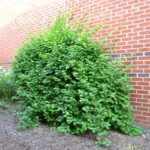
Shrub Audio Recording AvailablePurdue Plant Doctor Available Chaenomeles speciosa [Common Flowering Quince] White, pink, orange, salmon, or red single or double flowers (depending on variant) occur in late April, are born on old wood just before the leaves fully emerge, and occur singly or 2-4 per cluster, creating an excellent dispersal of coloring throughout the shrub. Sparsely produces small, apple-like fruits, commonly called quinces, that are edible if used in preserves; harvest in October. Widely adapted to different soils and microclimates. Place in full sun location for… Audio Recording AvailablePurdue Plant Doctor Available
Tree Audio Recording AvailablePurdue Plant Doctor Available Chionanthus virginicus [White Fringetree] Dioecious with male plants showier in flower than females; plant a female if fruits are desired. Plants of known sex are not usually available unless selected in the flowering size. One of the last plants to leaf out in the spring. Audio Recording AvailablePurdue Plant Doctor Available
Tree Indiana Native Audio Recording AvailableID That Tree Video AvailablePurdue Plant Doctor Available Cladrastis kentukea [American Yellowwood] A highly ornamental native tree, even though the pendulous clusters of flowers do not appear in great numbers every year. Well-adapted to Midwest conditions. Develops a tap root. Does not flower fully each year; part of a tree may flower one year, part the next, but the effect is striking even when only certain branches bear flowers. Bees are attracted to the flowers. Flowers appear only after many years from seed. Avoid pruning in spring… Indiana NativeAudio Recording AvailableID That Tree Video AvailablePurdue Plant Doctor Available
Liana (Climbing Vine) Audio Recording AvailablePurdue Plant Doctor Available Clematis × jackmanii [Jackman's Clematis] The Jackman Clematis is a hybrid with large, rich purple sepals that develop on new growth. The root system should be kept cool by deep soil preparation and mulching around the base. It is said that Clematis prefer "a warm top and a cool bottom". While this is generally true, provide some shade to the top portion during the day for the best results. Climbs by twining stems and clasping leaves, so it needs a… Audio Recording AvailablePurdue Plant Doctor Available