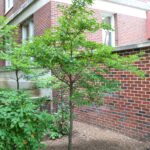
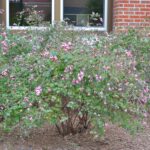
Shrub Indiana Native Audio Recording Available Vaccinium angustifolium [Lowbush Blueberry] The Lowbush Blueberry requires acidic soils with a pH between 4.5 and 5.5. Iron chlorosis can be a problem in higher pH soils. Mulch around roots to maintain high organic matter. For higher blossom and berry output, grow in full sun. Berries are sweet and edible. Indiana NativeAudio Recording Available
Shrub Indiana Native Audio Recording AvailableID That Tree Video AvailablePurdue Plant Doctor Available Viburnum acerifolium [Mapleleaf Viburnum] The Mapleleafe Viburnum is a shade and drought tolerant plant that is excellent for naturalizing. Tolerant to the poison excreted by Black Walnuts. Indiana NativeAudio Recording AvailableID That Tree Video AvailablePurdue Plant Doctor Available
Shrub Audio Recording AvailablePurdue Plant Doctor Available Viburnum × burkwoodii [Burkwood Viburnum] Trouble-free plant tolerant of soils and pollution (except sulfur). Also, does not tolerate more severe drought. Very fragrant when in bloom, although to a lesser degree than Viburnum carlesii (Koreanspice Viburnum). Bacterial spot and powdery mildew susceptibility (but not always a problem). Sulfur containing pesticides burn or defoliate leaves. Too thin to be a solid screen. Audio Recording AvailablePurdue Plant Doctor Available
Shrub Indiana Native Audio Recording AvailablePurdue Plant Doctor Available Viburnum dentatum [Arrowwood Viburnum] Can look ragged in dry soil. Flowers malodorous to some. Attractive to birds. Name derived from Native American use of strong sucker shoots for arrow shafts. The most durable of viburnums. Serves as a nice neutral background shrub. Indiana NativeAudio Recording AvailablePurdue Plant Doctor Available
Shrub Audio Recording AvailablePurdue Plant Doctor Available Viburnum farreri [Fragrant Viburnum] Some winter protection promotes best growth. Early flowering in spring is sometimes followed by a later frost/freeze that kills back the flowers and inhibits leaf growth. Audio Recording AvailablePurdue Plant Doctor Available
Shrub Audio Recording AvailablePurdue Plant Doctor Available Viburnum opulus [European Cranberrybush Viburnum] Widely tolerant of soils and microclimates, although found in more wet sites in wild stands. May be troubled by aphids. The snowball variety, V. opulus 'Roseum', is badly troubled by aphids. Prune on a 3-year cycle to maintain best form and fruiting. Flower cymes have an outer showy and sterile ring and an inner inconspicuous and fertile cluster which produces the berries. Audio Recording AvailablePurdue Plant Doctor Available
Shrub Audio Recording AvailablePurdue Plant Doctor Available Viburnum plicatum f. tomentosum [Doublefile Viburnum] The Doublefire Viburnum is fertile and more commonly used in the landscape than the sterile Japanese Snowball Viburnum (Viburnum plicatum f. plicatum). The white flowers are reminiscent of a lace doily with sterile showy flowers at edge surrounding the non-showy fertile flowers. Flower clusters accentuate the horizontal branching. Fruits are red that change to black if not eaten by birds, beginning in late summer. Audio Recording AvailablePurdue Plant Doctor Available
Shrub Audio Recording AvailablePurdue Plant Doctor Available Viburnum × rhytidophylloides 'Willowwood' [Willowwood Lantanaphyllum Viburnum] Poor tolerance to heavy wind environments. Great plant in the Midwest, flowering in the spring and even sporadically into the fall. Foliage sometimes lasting well into the winter. Prune right after flowering, because new buds for the following year form in the summer. Audio Recording AvailablePurdue Plant Doctor Available
Liana (Climbing Vine) Wisteria frutescens 'Amethyst Falls' [Amethyst Falls Wisteria] Slower growth, more compact habit, and slightly smaller foliage than the species