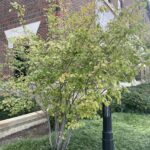
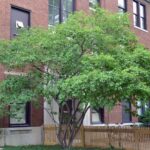
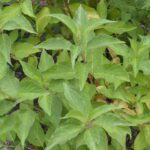
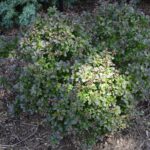
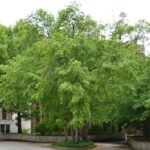
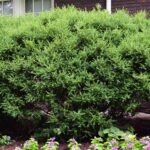
Tree Indiana Native Amelanchier laevis [Allegheny Serviceberry] An excellent small tree for naturalizing and for very early, but short-lived, bloom. Fruits are edible and a prime source of food for birds. Can produce fruit by apomixis. Subject to the troubles of Rosaceous plants in general, including fire-blight and mites, which can be controlled, usually quite easily.
Tree Amelanchier laevis 'Rogers' [sold as Lustre®] [Lustre Allegheny Serviceberry] Lustre Allegheny Serviceberry is a medium-size tree and is a good choice for attracting birds as the berries are edible.
Tree Amelanchier laevis 'Snowcloud' [Snowcloud Serviceberry] The Snowcloud® Serviceberry gets its name from the large white flowers that the tree blooms in Spring.
Tree Amelanchier × grandiflora 'Autumn Brilliance' [sold as Autumn Brilliance®] [Autumn Brilliance Apple Serviceberry] A. x grandiflora 'Autumn Brilliance is a vigorous selection with impressive blooms and bright red fall colors. It is resistant to leaf spot. The berries are frequently used to make jams, jellies, and pies. This selection can be found in both single and multi-trunk forms.
Shrub InvasiveThis plant is considered invasive Berberis thunbergii var. atropurpurea 'Crimson Pygmy' [Red Dwarf Japanese Barberry] The Red Dwarf Japanese Barberry is exceedingly popular due to its dense, low growing form, brilliant foliage, and tolerance to tough urban conditions. For the best leaf coloration, place in full sun. This plant tolerates dry soils, but will suffer in wet, poorly drained soils.
Tree Indiana Native Betula nigra [River Birch] Graceful tree, interesting for its curling bark, and especially well adapted to wet soils. Immune to the bronze birch borer, which is a serious problem for the native Betula papyrifera in the Midwest. This species prefers full sun and is quite heat tolerant, but does not have tolerance for drought. If pruning is required, prune in summer or during the dormant season.
Shrub Buxus sinica var. insularis [Korean Littleleaf Boxwood] The Korean Littleleaf Boxwood grows best when placed in areas of moderate shade that are away from strong winter sun and wind. It has shallow roots and prefers moist, cool soils. This shrub flowers in April; flowers can attract bees due to the fragrance but are not showy.
Shrub Buxus × 'Green Velvet' [Green Velvet Boxwood] This species is a hybrid of Buxus sinica and Buxus sempervirens and is primarily used for smaller spaces.
Tree Carpinus betulus 'Columnaris' [Columnar European Hornbeam] Carpinus betulus is relatively trouble-free and tolerates a wide range of soil conditions and some shade. This plant is also very tolerant of heavy pruning, making it useful as a hedge. The cultivar 'Columnaris' is a narrow, columnar cultivar that is slow-growing with densely set branches and leaves.
Tree Indiana Native Catalpa speciosa [Northern Catalpa] Coarse winter trunks and branches are bold and striking; picturesque. Best for difficult areas. Wood is rot resistant, but is somewhat brittle so branches can fall in wind and ice storms. Too coarse of texture for most urban landscapes. Short-lived to about 50 years.