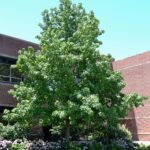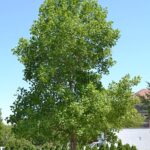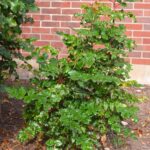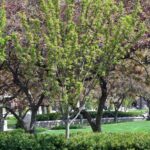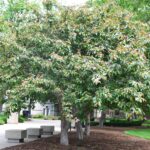
Tree Indiana Native Magnolia tripetala [Umbrella Magnolia] Full sun or light partial shade. Tropical appearance. Flowers are creamy white with an unpleasant smell. The cone-like rosy red fruit matures in September-October. Endangered in Indiana. Large leaves can be injured by hail or wind. Perhaps too coarse for most landscape situations.
Shrub Mahonia aquifolium [Oregon Grapeholly] Widely adapted to soil type and environment, except high pH soils that will cause chlorosis. Quite susceptible to winter-burn. Do not plant in sites exposed to strong winds or afternoon sun in winter. Can get leggy with age. Fruits are edible and can be used in jellies.
Tree Malus × 'Adirondack' [Adirondack Flowering Crabapple] The Flowering Crabapple is a popular small ornamental tree with an extremely showy flower display in the spring. This variant has a vase-shaped (somewhat columnar) habit, extremely upright branching, and high resistance to apple scab, fireblight, cedar-apple rust, and powdery mildew. Tends to flower and fruit in alternate years. Well-drained heavy loam soils and full sun promote best growth.
Tree Malus × 'Indian Magic' [Indian Magic Flowering Crabapple] The Flowering Crabapple is a popular small ornamental tree with an extremely showy flower display in the spring. 'Indian Magic' is not as disease resistant as others, being moderately susceptible to scab. Tends to flower and fruit in alternate years. Well-drained heavy loam soils and full sun promote best growth. Can be susceptible to many pests and diseases, including apple scab, fireblight, Japanese beetles, leaf spot, cedar-apple rust, and powdery mildew. May look ragged at…
Tree Malus sargentii [Sargent Crabapple] The smallest of all Malus species, almost a shrub. Strongly horizontal branching. Tends to be apomictic (seeds develop without fertilization), so is usually very uniform from seed (i.e. clonal). Sometimes flowers and fruits in alternate years. Susceptible to apple scab disease. May require pruning of wayward and crossing branches to maintain a nice form.
Tree Nyssa sylvatica 'David Odom' [sold as Afterburner® Tupelo] [Afterburner® Tupelo] Female trees must have a male pollinator to set fruit, difficult to transplant due to taproot.
Tree InvasiveThis plant is considered invasive Phellodendron amurense [Amur Corktree] A striking tree for its interesting bark and massive framework. Widely adaptable to soil, trouble-free, and drought and pollution resistance. Easily transplanted. May be less hardy when young and rapidly growing. Fruits smell like turpentine when crushed (or stepped on). This tree is demonstrating invasive characteristics in suburban and urban fringe forests. It escapes intended plantings to invade and displace native hardwood forests. Note: only female plants have the potential to become invasive. Phellodendron amurense…
Tree Indiana Native Platanus occidentalis [American Sycamore] One of the largest of shade trees, making massive, majestic specimens. Tolerant of urban conditions, but generally found in riparian areas in the wild. The mottled, multi-colored, exfoliating bark is very beautiful and makes for excellent winter interest. Needs a large volume of soil space. Anthracnose leaf and twig blight occasionally disfigure this tree, and can damage it severely. Leaves, twigs, bark, and fruit contribute to a significant litter problem. Although this species can tolerate…
Tree Populus tremuloides 'NE Arb' [sold as Prairie GoldĀ®] [Prairie Gold Quaking Aspen] Prairie GoldĀ® Quaking Aspen is more tolerant to urban conditions including heat, drought, and humidity. The Aspen's name is derived from its golden yellow fall color. Native from Labrador to Alaska, south to Pennsylvania, Missouri, northern Mexico and lower California.
Tree Prunus sargentii [Sargent Cherry] One of the better performing and useful cherries available. Beautiful, polished reddish to chestnut brown bark on older trunks. Subject to several minor pests, none usually serious.