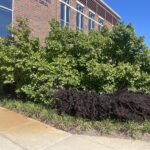
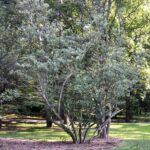
Tree Purdue Plant Doctor Available Magnolia × 'Ann' [Ann Magnolia] 'Ann' is a cross between M. liliiflora 'Nigra' and M. stellata 'Rosea'. It was developed by the National Arboretum as a part of a hybrid series called the Little Girl series. These plants flower 2-4 weeks later than other Magnolias which reduces risk of damage due to late spring frost. Flowers are slightly fragrant. Purdue Plant Doctor Available
Shrub Audio Recording AvailablePurdue Plant Doctor Available Mahonia aquifolium [Oregon Grapeholly] Widely adapted to soil type and environment, except high pH soils that will cause chlorosis. Quite susceptible to winter-burn. Do not plant in sites exposed to strong winds or afternoon sun in winter. Can get leggy with age. Fruits are edible and can be used in jellies. Audio Recording AvailablePurdue Plant Doctor Available
Tree Indiana Native Purdue Plant Doctor Available Malus ionensis [Prairie Crabapple] Apples are not quite edible when raw due to the high amounts of pectin causing a bitter taste. Although the high amount of pectin makes the fruit good for jellies or jams. Indiana NativePurdue Plant Doctor Available
Liana (Climbing Vine) Mandevilla × amoena [Mandevilla Vine] The Mandevilla Vine is a vigorous plant that climbs by twining. Can be grown in containers and as a houseplant. 'Alice du Pont' is more common in commerce than the species type.
Fern Matteuccia struthiopteris subsp. pensylvanica [Ostrich Fern] The Ostritch fern is native to North America, Europe, and northern Asia. They usually stay around 2 to 3 feet tall, but could reach 6 feet under the correct conditions. The frons arise in mid-summer and persist through the winter.
Shrub Purdue Plant Doctor Available Microbiota decussata [Russian Arborvitae] The Russian Arborvitae is a low spreading, groundcover conifer that was discovered in Russia in 1921. It is generally easy to grow and can be a good substitute for Juniper in part shade situations, although it is best in full sun. This plant is not tolerant of extreme heat. Seeds of this plant can remain in a dormant state for up to 28 months. Purdue Plant Doctor Available
Shrub Purdue Plant Doctor Available Microbiota decussata 'Prides' [sold as Celtic Pride™] [Celtic Pride Russian Arborvitae] The Russian Arborvitae is a low spreading, groundcover conifer that was discovered in Russia in 1921. It is generally easy to grow and can be a good substitute for Juniper in part shade situations, although it is best in full sun. 'Prides', often sold under the name Celtic Pride is known for its excellent disease resistance and tolerance to difficult conditions. Seeds of this plant can remain in a dormant state for up to 28… Purdue Plant Doctor Available
Tree InvasiveThis plant is considered invasive Audio Recording AvailableID That Tree Video AvailablePurdue Plant Doctor Available Morus alba [White Mulberry] It will grow in nearly any situation. There are occasional problems with cankers, mites, and bacterial blights. Morus alba is very similar to the native red mulberry (Morus rubra), but may be distinguished by the leaves. Its leaves have glossy surfaces whereas the leaves of Morus rubra do not. Morus alba is found throughout the United States, where it invades old fields, urban lots, roadsides, forest edges, and other disturbed areas. It poses an ecological… Audio Recording AvailableID That Tree Video AvailablePurdue Plant Doctor Available
Tree Indiana Native Audio Recording AvailableID That Tree Video AvailablePurdue Plant Doctor Available Morus rubra [Red Mulberry] The Red Mulberry is fairly adaptable and can sometimes be a prolific self-seeder. To prevent bleeding, it should be pruned in late fall or winter. Although somewhat more sensitive to soil requirements, Morus rubra is considered to be a better choice than the related Morus alba (White Mulberry), which has a much more invasive character. Morus rubra is dioecious, so male and female flowers are borne on separate trees. Female trees, if fertilized, bear edible… Indiana NativeAudio Recording AvailableID That Tree Video AvailablePurdue Plant Doctor Available
Shrub Purdue Plant Doctor Available Nandina domestica [Heavenly Bamboo] The beautiful red fruits are so prolific they can even bend down branches. Tolerates full sun or shade, even fruits well in shade. Prune by cutting canes back to ground. Develops iron chlorosis on Southwestern US due to high soil pH. 'Atropurpurea Nana' stays 2' high with reddish-green color throughout summer, turning dark red in winter. Purdue Plant Doctor Available