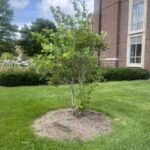
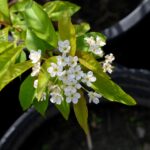
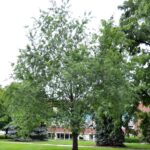
Shrub Pinus mugo var. pumilio [Dwarf Mountain Pine] The Pinus mugo var. pumilio dwarf shrub is found in the wild in the mountains of eastern and central Europe. The shrub can spread up to 10' wide but typically stays short in height, 3'-5' at maturity. Avoid planting in poorly-drained wet soils.
Tree Pinus resinosa [Red Pine] Forms a decent screen when young, especially on poor, dry soils, but soon drops lowers limbs necessitating the need of companion plants to complete the screen. Develops a shorter, thicker trunk when grown in the open. Pine bud moth (as well as other moths) can be problem if not controlled. Foliage presentation not always full or clearly esthetic. Best in groves or plantations where bark color can be admired.
Tree Indiana Native Pinus strobus [Eastern White Pine] More graceful than most pines, both as a young and an old specimen. Excellent neutral screening plant, it can be kept full by occasional pruning. Among best pines for resistance to moth borers. Transplants easily with a bit of shade tolerance. Somewhat less adapted to severe exposures and very dry soils than Pinus resinosa or Pinus nigra. Very sensitive to air pollution and road salt. Susceptible to White Pine Blister Rust. Decaying needles acidify soil…
Tree Indiana Native Populus balsamifera [Balsam Poplar] Buds exude a resin (the source of "balm of Gilead") that is traditionally used as an ointment to relieve chest congestion. The resin is also flammable, so twigs are used for starting fires. The streaked brown and grey wood is used in carving and woodworking. Trees are found along forest edges, forests, meadows and fields, and shores of rivers or lakes.
Tree Indiana Native Populus grandidentata [Bigtooth Aspen] This tree is very fast-growing with best development in moist, fertile soils but will grow on dry, sand or gravelly soils. It is very valuable for pulp wood. Often pyramidal in youth with a central leader, developing an oval, open, irregular crown at maturity.
Tree Indiana Native Populus tremuloides [Quaking Aspen] The common name of Populus tremuloides is derived from the tendency of the leaves to tremble (quake) in the wind, or even light breezes, due to flattened petioles. This is a fast-growing and short-lived species that regenerates from root suckers and can quickly recolonize disturbed sites. Generally, most of the specimens in a grove of P. tremuloides are clones, all originating from the same stem. This plant is dioecious, so groves are usually all male…
Tree Indiana Native Prunus pensylvanica [Pin Cherry] Pin or Wild Red Cherry is a slender, small shrub-like tree that is native to Indiana. Often seen as a pioneer species, Pin Cherry can be seen to develop in vacant areas. Its bark is shiny, red in color, and often aromatic when brusied or cut. P. pensylavnica produces a large amount of fruit when fully mature, which could promote weediness.
Shrub Indiana Native Prunus pumila [Sand Cherry] Prunus pumila is a creeping, low-growing small shrub naturally found in sandy locations, such as dunes, where it acts an important stabilizer. The cherry fruits are too bitter to eat fresh, but can be used in jams and jellies.
Tree Indiana Native Prunus serotina [Black Cherry] Probably the best native-American species of cherry for landscape use, but still useful only in a few situations, especially for naturalizing. A valuable timber tree, especially for furniture. Subject to several minor pests, none usually serious in naturalized situations. Wood is slightly brittle. Eastern tent caterpillar problematic is some years.
Tree Indiana Native Quercus × deamii [Deam Oak] The Deam Oak is a rare hybrid between the White Oak (Quercus alba) and the Chinquapin Oak (Quercus muehlenbergii) that can be found in mature forests. Quercus x deamii was first discovered in Wells County, Indiana, about 4 miles outside the town of Bluffton in 1904 by Bruce Williamson, a zoologist, and his father. Not sure what they had found, they took the specimen to Charles C. Deam who later sent the sample to his…