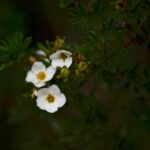
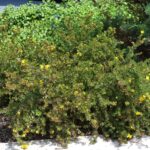
Shrub Dasiphora fruticosa 'Abbotswood' [White Bush Cinquefoil] 'Abbotswood' has beautiful, large, white flowers and an especially long blooming period. Extreme hardiness and long season of bloom make Potentilla fruticosa a favorite in severe climates. Low stature and tolerance of poor, dry soils give it added usefulness in other areas also. Can develop a ragged, unkept habit over time. Remove 1/3 of canes each year (3-year pruning cycle), and consider renewal pruning to a very low framework every 3-5 years if needed.
Shrub Dasiphora fruticosa 'Yellow Bird' [Yellow Bird Bush Cinquefoil] 'Yellow Bird' has large, single to semi-double yellow flowers. Extreme hardiness and long season of bloom make Potentilla fruitcosa a favorite in severe climates. Low stature and tolerance of poor, dry soils give it added usefulness in other areas also. Can develop a ragged, unkept habit over time. Remove 1/3 of canes each year (3-year pruning cycle), and consider renewal pruning to a very low framework every 3-5 years if needed.
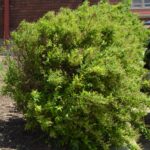
Shrub Deutzia gracilis [Slender Deutzia] Nice in flower as they can cover the plant, hardiest of all deutzias, and relatively pest free. Once flower show is over, plants can look bedraggled. Branches often killed by cold temperatures in Northern range (or just die back), and then it's often best to cut it back to 6". Renewal pruning every few years can maintain vigor and form. Prune to maintain form by removing old stems, and do so after flowering to encourage…
Shrub Deutzia gracilis 'Nikko' [Dwarf Slender Deutzia] 'Nikko' is a compact, dense, and rounded shrub. Nice in flower as they can cover the plant, and relatively pest free. Branches often killed by cold temperatures in Northern range (or just die back), and then it's often best to cut it back to 6". Renewal pruning every few years can maintain vigor and form. Prune to maintain form by removing old stems, and do so after flowering to encourage best flower show the following…
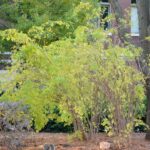
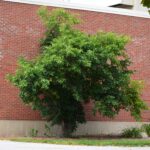
Shrub/Tree InvasiveThis plant is considered invasive Elaeagnus angustifolia [Russian-olive] Widely adaptable and invasive plant in the Midwest. Like other members of the family, fixes atmospheric nitrogen. Can be a large shrub or small tree. Spreads by rooting suckers. Especially tolerant of extreme cold and drought, but does not tolerate extreme heat of the south. Verticillium wilt and stem canker may be a problem in some areas. Needs some pruning to keep vigorous and in good form. Berries used to make sherbet in some parts…
Shrub Eleutherococcus sieboldianus [Fiveleaf Aralia] Tolerates a wide range of soil and environmental conditions, including dry city conditions and shade. Little seasonal interest other than foliage, but extremely durable shrub. Prickles on stems can make pruning difficult. In poor sites, renewal pruning can improve form. In rich organic soils, renewal pruning can lead to rank growth. Usually dioecious.
Shrub Eleutherococcus sieboldianus 'Variegatus' [Variegated Aralia] This cultivar has attractive, creamy variegated foliage and is more compact than the straight species. Tolerates a wide range of soil and environmental conditions, including dry city conditions and shade. Prickles on stems can make pruning difficult. In poor sites, renewal pruning can improve form. In rich organic soils, renewal pruning can lead to rank growth. Usually dioecious.
Shrub InvasiveThis plant is considered invasive Euonymus alatus [Winged Euonymus] Widely tolerant of most soil and microclimatic conditions, but develops good fall foliage color only when exposed to considerable direct sun. Tolerates heavy pruning. Can be troubled by scale insects, although not so frequently as the evergreen euonymus. Fruits are toxic. Avoid very dry or wet sites. Can be invasive, seeding into woodlots.
Shrub InvasiveThis plant is considered invasive Euonymus alatus 'Compactus' [Dwarf Winged Euonymus] The dense and lower-growing 'Compactus' is one of the most common Winged Euonymus cultivars. Widely tolerant of most soil and microclimatic conditions, but develops good fall foliage color only when exposed to considerable direct sun. Tolerates heavy pruning. Can be troubled by scale insects, although not so frequently as the evergreen euonymus. Fruits are toxic. Avoid very dry or wet sites. Can be invasive, seeding into woodlots.
Shrub/Tree Euonymus europaeus [Common Spindle Tree] Euonymus europaeus is an adaptable small tree (sometimes large shrub) that can spread and become invasive. The Common Spindle Tree's primary ornamental interest is its attractive and interesting fruits in the fall. Unfortunately, this tree can otherwise be quite unattractive, irregular, and spindley.