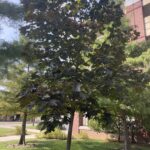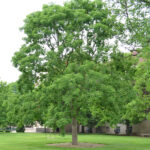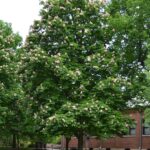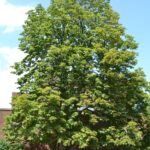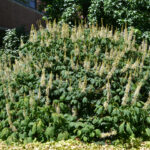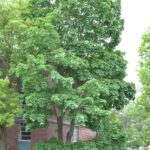
Tree InvasiveThis plant is considered invasive Acer platanoides [Norway Maple] One of the densest shade trees, widely adaptable to soils and environments, including dry and polluted city conditions. Transplants easily. Extremely dense canopy and shallow root system make it impossible to maintain good turf beneath. Can be a weed problem, especially in cooler parts of the northeast US. Slight susceptibility to verticillium wilt, anthracnose, and leaf scorch. Can be damaged by 2,4-D drift. Does not perform well in southern US (warm nights severely retard growth).…
Tree InvasiveThis plant is considered invasive Acer platanoides 'Crimson King' [Crimson King Norway Maple] Crimson King is a common cultivar used in the industry for its rich maroon foliage throughout the growing season. One of the densest shade trees, widely adaptable to soils and environments, including dry and polluted city conditions. Transplants easily. Extremely dense canopy and shallow root system make it impossible to maintain good turf beneath. Slight susceptibility to verticillium wilt, anthracnose, and leaf scorch. When Norway maple escapes cultivation and invades natural areas it reduces species…
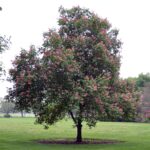
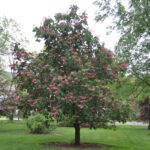
Tree Aesculus × carnea 'Briotii' [Ruby Red Horsechestnut] Has decent tolerance to drought and urban environments. Buds are not as sticky as its parent plant, Aesculus hippocastanum. Flower panicles are larger than both parent species with a rich red coloration, making it a popular tree choice in England.
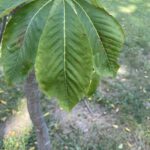
Tree Indiana Native Aesculus flava [Yellow Buckeye] The Yellow Buckeye is a large, majestic native tree that is widely adapted to soils and environments; however, very dry conditions must be avoided. Drought causes early leaf drop and leaf blotch, and leaf scorch can disfigure foliage in dry soil. That being said, this species is less prone to foliar problems than the related Aesculus glabra (Ohio Buckeye) is. Difficult to transplant once established due to long taproot. Large, abundant fruits in autumn can…
Tree Indiana Native Aesculus glabra [Ohio Buckeye] Widely adapted to soils and environments; however, very dry conditions must be avoided. Drought causes early leaf drop. Leaf blotch and leaf scorch often disfigure foliage, especially in dry soil. Spiny fruits in autumn can be troublesome underfoot, and eliminates species type as a good street tree. Fruits are toxic, containing 3-5% saponins.
Tree Aesculus hippocastanum [Common Horsechestnut] Widely adapted to soils and environments; however, very dry conditions must be avoided. Leaf blotch often disfigures foliage. Spiny fruits in autumn can be troublesome underfoot, and eliminates species type as a good street tree. Fruits are toxic containing 3-5% saponins.
Tree Aesculus hippocastanum 'Baumannii' [Baumann Common Horsechestnut] 'Baumannii' is known for its large panicles of double flowers. The flowers are sterile, so none of the large, littering, poisonous fruit of the species type are produced, increasing this tree's usability. Widely adapted to soils and environments; however, very dry conditions must be avoided. Leaf blotch often disfigures foliage.
Shrub Indiana Native Aesculus parviflora [Bottlebrush Buckeye] Can be kept at a smaller size for a time with careful pruning, but it will in time occupy much space. Tolerates some shade, and can even be attractive under large shade trees. Suckers quite freely.
Shrub/Tree Aesculus pavia [Red Buckeye] The Red Buckeye can be a small tree or clump-forming, multi-stemmed shrub. The lustrous, deep green foliage is attractive, but tends to decline by August. Susceptible to leaf blotch, but less susceptible to mildew than Aesculus hippocastanum.
Tree Aesculus × carnea [Red Horsechestnut] More drought resistant and more resistant to blotch and mildew than A. hippocastanum. Comes true to type from seed. Flowers at early age. Does not perform well in dry sites. Prickly fruits may be a problem underfoot. Fruits are poisonous (containing toxic saponins). Often develops branches having narrow crotch angles (branches that should be removed).