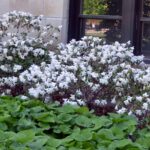
Shrub Purdue Plant Doctor Available Rhododendron minus var minus 'White Perfection' [White Perfection Carolina Rhododendron] A widely adaptable, hardey (perhaps more than indicated) small compact shrub. Flowers are relatively small, but numerous, making it very showy in spring. Subject to winter-burning of foliage, but not as much as other rhododendrons. Blooming occurs while the plant is young and occurs heavily. Susceptible to a large number of pests and diseases, which can largely be prevented by good cultural practices. Purdue Plant Doctor Available
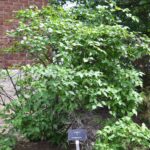
Shrub Audio Recording Available Rhodotypos scandens [Black Jetbead] Relatively trouble-free. Tolerant of a variety of soils and environments, particularly dryness and shade. Commonly becomes straggly if growing in a site that is too dry or too wet. Audio Recording Available
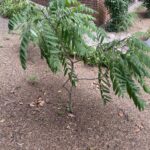
Shrub Indiana Native Audio Recording AvailableID That Tree Video AvailablePurdue Plant Doctor Available Rhus glabra [Smooth Sumac] Large, club-like fruit clusters and rather coarse compound leaves make this a plant that can best be appreciated from a distance, and so it is at its best in large-scale plantings. Picturesque branches. Hard to kill this plant. Can be rejuvenated by cutting to ground in late winter. Plants are dioecious, so only females have the fruiting interest, but all plants are reliably colorful in fall foliage. Spreads rapidly by suckers. Indiana NativeAudio Recording AvailableID That Tree Video AvailablePurdue Plant Doctor Available
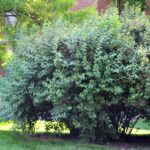
Shrub Audio Recording AvailablePurdue Plant Doctor Available Ribes alpinum [Alpine Currant] Dioecious (male clones used mostly because these are thought to be rust resistant). Quite resistant to white pine blister rust, whereas other Ribes are not. Many insects and diseases. Flowers not showy and fruits not edible. Audio Recording AvailablePurdue Plant Doctor Available
Shrub Indiana Native Audio Recording AvailablePurdue Plant Doctor Available Robinia hispida var. fertilis [Bristly Locust] Can fix nitrogen. Especially well adapted to poor, dry, alkaline soils. Though native, can be invasive on sandy soils. Frequent pruning may be needed. Indiana NativeAudio Recording AvailablePurdue Plant Doctor Available
Tree Indiana Native Audio Recording AvailableID That Tree Video AvailablePurdue Plant Doctor Available Robinia pseudoacacia [Black Locust] Widely variable in form, the most picturesque are straight-trunked with branches abruptly fanning out at the top. Fixes N2. Locust borers are troublesome and difficult to control, but many trees live with them successfully for many years. Leaf minors and permanently wet soils can be problems. Indiana NativeAudio Recording AvailableID That Tree Video AvailablePurdue Plant Doctor Available
Shrub/Tree Purdue Plant Doctor Available Salix caprea [Pussy Willow] Salix caprea is one of several species commonly referred to as "Pussy Willows". The common name is derived from the silky soft male catkins (species is dioecious). Tolerates heavy pruning and can be cut to the ground every 3-5 years to maintain size. The wood of this plant is weak and easily damaged. This species is susceptible to many pests and diseases. Purdue Plant Doctor Available
Shrub/Tree Indiana Native Audio Recording AvailablePurdue Plant Doctor Available Salix humilis [Prairie Willow] Prairie Willow is more drought tolerant than other willows. Rabbits and deer eat the twigs. The nectar is used by bees to provide high quality honey. Indiana NativeAudio Recording AvailablePurdue Plant Doctor Available
Shrub Purdue Plant Doctor Available Salix purpurea 'Canyon Blue' [Canyon Blue Purpleosier Willow] Canyon Blue Purpleosier Willow is very similar to the compact cultivar Nana in its habit and shape. What stands out is its deeper bluish leave color. This is a great choice for wet areas, soil stability, and in rain gardens. Unlike most willows (Salix ssp.), the Purpleosier tends to stay a compacted shrub and will sucker less than others in this genus. Purdue Plant Doctor Available
Shrub Purdue Plant Doctor Available Salix purpurea 'Nana' [Dwarf Purpleosier Willow] Salix purpurea 'Nana' is a dioecious, compact, rounded shrub well-suited for wet areas, rain gardens, and bank stablizition. Tolerates heavy pruning. Purdue Plant Doctor Available