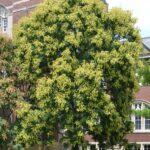
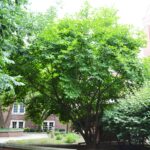
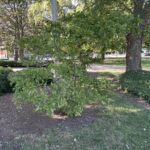
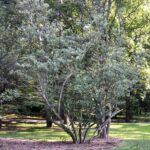
Tree Koelreuteria paniculata [Goldenraintree] Colorful small tree in bloom and interesting for its form. Tolerates heat, drought, wind, alkaline soils, and air pollution. Newly emerging leaves can be damaged by late spring freezes. Rather weak-wooded. Can be damaged or killed by –25 degrees F. Invasive in some parts of the country.
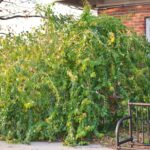
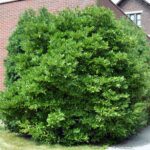
Shrub InvasiveThis plant is considered invasive Lonicera maackii [Amur Honeysuckle] Widely adaptable to different soils and exposures. Can be trained into a small patio tree. Suckers freely, requiring pruning in intensive situations. Seeds, carried by birds, germinate freely, and weed seedlings result. High shade tolerance contributes greatly to its highly invasive character. Perhaps the worst woody weed in the Midwestern and Northwestern US.
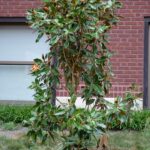
Tree Magnolia grandiflora 'Little Gem' [Little Gem Southern Magnolia] Though the straight species of Magnolia gradiflora is not hardy in Indiana, 'Little Gem' can be hardy up to zone 6(7). If planted, place in an area that is protected from winter winds and extreme temperature drops, such as an enclosed courtyard. 'Little Gem' is a dwarf cultivar of the Southern Magnolia, ranging from 15' to 20' in height and 10' in width. Typically seen as more of a shrub from, rather than the iconic…
Tree Magnolia × loebneri 'Leonard Messel' [Leonard Messel Loebner Magnolia] 'Leonard Messel' is a small, rounded, vigorous tree that produces large, fragrant, purple-pink flowers in early spring. Although this cultivar has more frost-resistant flower buds, it is still wise to plant this tree in a protected location to prevent spring frosts from damaging the flowers.
Tree Magnolia × soulangeana [Saucer Magnolia] Many of the showiest magnolia cultivars belong to this species. One of the most common flowering trees in the Midwest, it is apparently well-adapted. Its very early spring flowers can be killed by late frost; they turn brown and limp. Can be troubled by magnolia scale, but this can be kept under control by timely spraying. Fleshy roots with few laterals. Does not transplant well so best to buy container grown plants.
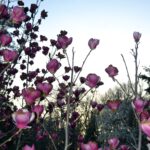
Tree Magnolia × soulangeana 'Purple Prince' [Purple Prince Saucer Magnolia] The Saucer Magnolia is one of the most common flowering trees in the Midwest, and is apparently well-adapted. 'Purple Prince' is known for its large, cup-like flowers with deep pinkish-purple tepals that are nearly white on the inside. Its very early spring flowers can be killed by late frost; they turn brown and limp. Can be troubled by magnolia scale, but this can be kept under control by timely spraying. Fleshy roots with few laterals.…
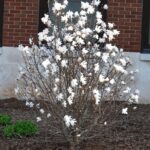
Shrub/Tree Magnolia stellata [Star Magnolia] Handsome specimen at all seasons. Needs at least some protection from strong wind in Zones 4 and 5. Somewhat prone to breakage in severe ice storms. Early blooming flowers often destroyed by late spring frosts.
Shrub/Tree Magnolia stellata 'Centennial' [Centennial Star Magnolia] 'Centennial' is an excellent, vigorous Magnolia stellata cultivar with large (5.5" across), pink-blushed white flowers with numerous tepals. This plant was released by the Arnold Arboretum of Harvard University in 1972 to commemorate its 100th anniversary. Handsome specimen at all seasons. Needs at least some protection from strong wind in Zones 4 and 5. Somewhat prone to breakage in severe ice storms. Early blooming flowers often destroyed by late spring frosts.
Tree Magnolia stellata 'Royal Star' [Royal Star Magnolia] Magnolia stellata 'Royal Star' is a small flowering tree that has a more rounded habit than the straight M. stellata, with its flower buds pink that open to 12-18 white tepals. Flowers are fragrant and reach 3 to 4" in diameter. Flowers appear early spring, but can be damaged by spring frosts. Needs protection from strong winds, as it has been known to be weak-branched.
Shrub/Tree Magnolia virginiana [Sweetbay Magnolia] Nice flower fragrance, but never overwhelming. Does well in wet soils, unlike other magnolias. Requires acid soil, some moisture, and tolerates some shade. Chlorosis can sometimes be a problem, especially prevalent on alkaline soils.