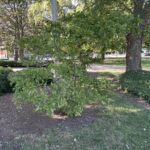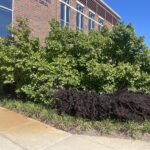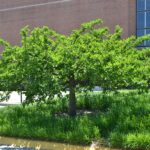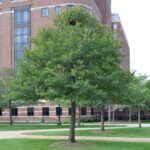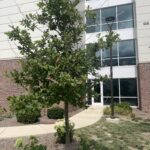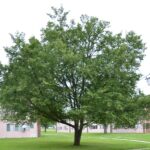
Tree Magnolia stellata 'Royal Star' [Royal Star Magnolia] Magnolia stellata 'Royal Star' is a small flowering tree that has a more rounded habit than the straight M. stellata, with its flower buds pink that open to 12-18 white tepals. Flowers are fragrant and reach 3 to 4" in diameter. Flowers appear early spring, but can be damaged by spring frosts. Needs protection from strong winds, as it has been known to be weak-branched.
Shrub/Tree Magnolia × 'Susan' [Susan Magnolia] The Susan Magnolia is a shrubby magnolia that produces long, slender, reddish purple buds openning to beautiful, large reddish purple flowers. 5" slightly twisted flowers are erect and have 6 tepals . Flowes later than Magnolia stellata in Spring, but can also flower sporadically throughout the Summer. Summer flowers are of lighter color due to the heat. Part of the Little Girls Hybrid Series.
Tree Malus sargentii [Sargent Crabapple] The smallest of all Malus species, almost a shrub. Strongly horizontal branching. Tends to be apomictic (seeds develop without fertilization), so is usually very uniform from seed (i.e. clonal). Sometimes flowers and fruits in alternate years. Susceptible to apple scab disease. May require pruning of wayward and crossing branches to maintain a nice form.
Tree Malus sargentii 'Candymint Sargent' [Candymint Sargent Crabapple] 'Candymint Sargent' has strongly horizontal branching, even more so than the straight species. Sargent Crabapples are the smallest of all Malus species, almost a shrub. Tends to be apomictic (seeds develop without fertilization), so is usually very uniform from seed (i.e. clonal). Tends to flower and fruit in alternate years. Susceptible to apple scab disease, but is highly Japanese beetle resistant. May require pruning of wayward and crossing branches to maintain a nice form.
Tree Indiana Native Nyssa sylvatica [Black Gum] Especially useful in wet soils. One of the most beautiful of trees, with habit comparable to Quercus palustris, but usually more irregular, and with a greater number of more slender main limbs. Silvery-gray, picturesque branching; strong horizontal accent. Difficult to transplant due to taproot; use container-grown plants when possible, or at least plants dug with a soil ball. Shelter from wind. In the North, select native northern stock as the species has a wide geographic…
Tree Nyssa sylvatica 'David Odom' [sold as Afterburner® Tupelo] [Afterburner® Tupelo] Female trees must have a male pollinator to set fruit, difficult to transplant due to taproot.
Tree Nyssa sylvatica 'Hayman Red' [sold as Red Rage®] [Red Rage Black Gum] 'Haymanred', the broadly pyramidal cultivar of the Indiana native Black Gum, is know for its rich and vibrant fall color, lustrous dark green leaves and resistance to leaf spot. Selected from southern Indiana and introduced by Mike Hayman, it is one of the best cultivars of black gum. Can be difficult to transplant due to its taproot, use container-grown plants or plants dug with a soil ball. Can be used in areas with wet soils.
Tree Nyssa sylvatica 'WFH1' [sold as Tupelo Tower™] [Tupelo Tower Black Gum] Tupelo Tower is one of the only upright, of columnar habit, unlike the straight species. Its tight habit, brilliant fall color, and urban tolerances make this cultivar highly saught after. Typically, a slightly acidic soil is needed for this species to perform well. Difficult to transplant, so best purchase as container grown. Wet soils tolerant.
Tree Indiana Native Nyssa sylvatica 'Wildfire' [Wildfire Blackgum] Especially useful in wet soils. One of the most beautiful trees, with habit comparable to Quercus palustris, but usually more irregular, and with a greater number of more slender main limbs. Silvery-grey, picturesque branching; strong horizontal accent. Difficult to transplant due to taproot; use container-grown plants when possible, or at least plants dug with a soil ball. Shelter from wind. In the North, select native northern stock as the species has a wide geographic range.…
Tree Indiana Native Ostrya virginiana [American Hophornbeam] A good, trouble-free small shade tree worthy of greater use. Very graceful with many drooping branches that create a rounded habit. Best on drier slopes, and is usually found in native ecosystems. Slow growing, and difficult to transplant. Does not tolerate periodic flooding (as does Carpinus caroliniana) or salt.