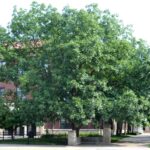
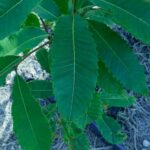
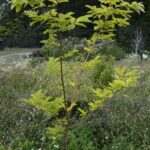
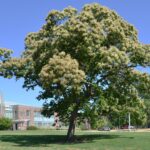
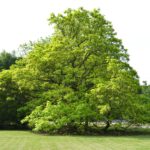
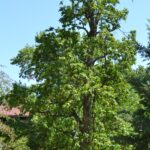
Tree Castanea dentata × mollissima [Dunstan Chestnut] Celebrated due to the quality of its fruit. Excellent nut quality that is attractive to deer and wildlife. Nuts drop in autumn, September-October. Often chosen as an orchard tree.
Tree Castanea mollissima [Chinese Chestnut] Overall tough and durable, but can be susceptible to blight, twig canker, and orient chestnut wasp. Also susceptible to weevils, which damages the roots. Prefers well-drained, loamy soils, full sun, and hot, arid conditions.
Tree Catalpa bignonioides 'Aurea' [Golden Southern Catalpa] The Golden Southern Catalpa can tolerate full sun, but does best in part sun to part shade. This species is weak wooded and should not be placed where it is open to wind and storm damage. 'Aurea' is known for its rich yellow leaf coloration and its broad form. Its flowers are trumpet shaped and white with yellow and purple spots.
Tree Catalpa ovata [Chinese Catalpa] The Chinese Catalpa is smaller than other Catalpa species, generally only reaching 30 feet. It produces attractive yellow-white flowers in the spring, but they are not as ornamental as those of other Catalpa species. Its coarse winter trunk and branches are bold and striking; picturesque, but can be too coarse for many urban landscapes. Best for difficult areas. Wood is rot resistant, but is somewhat brittle so branches can fall in wind and ice storms.…
Tree Indiana Native Catalpa speciosa [Northern Catalpa] Coarse winter trunks and branches are bold and striking; picturesque. Best for difficult areas. Wood is rot resistant, but is somewhat brittle so branches can fall in wind and ice storms. Too coarse of texture for most urban landscapes. Short-lived to about 50 years.
Tree Cedrus atlantica 'Glauca Pendula' [Weeping Blue Atlas Cedar] Cedrus atlantica 'Glauca Pendula' is an interesting and beautiful plant with distinctly blue foliage. The habit of this weeping cultivar is determined by training. If left alone and unsupported, the central leader will weep gracefully downwards, but the central leader can also be staked to create a more upright form with cascading branches coming from a straight trunk. Either method produces a quality specimen plant for the landscape. This plant should be moved balled and…
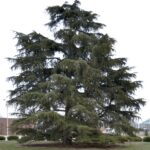
Tree Cedrus libani ssp. stenocoma 'Purdue Hardy' [Cedar of Lebanon] Widely adaptable, the Cedar of Lebanon was considered hardy from Zone 7 southward until hardy strains were imported from higher elevations in Asia Minor, beginning with the Arnold Arboretum expedition in 1903. The Cedar of Lebanon prefers pollution-free, open, and sunny areas. It is difficult to transplant and is not tolerant of air pollution or shade. This tree is also very difficult to propagate from cuttings (i.e. asexually). It is the most cold-hardy of the…
Tree Indiana Native Celtis laevigata [Sugar Hackberry] The Sugar Hackberry is very similar to the Common Hackberry (Celtis occidentalis) and is especially useful in large-scale situations with dry soils and heavy winds. This species gained its common name from the juicy, sweet berries it produces. Subject to a leaf nipple gall (caused by psyllid insect Pachypsylla dismamma, one of many jumping plant lice). However, the Sugar Hackberry is more resistant to witches'-broom disease (caused by Eriophyid mite) than the Common Hackberry. Especially…
Tree Indiana Native Celtis occidentalis [Common Hackberry] As well adapted to Midwestern conditions as American Elm, and a reasonably good substitute in form as well. Especially useful in large-scale situations with dry soils and heavy winds. Subject to a leaf nipple gall (caused by psyllid insect Pachypsylla dismamma, one of many jumping plant lice) and witches'-broom disease (caused by Eriophyid mite), both minor in most situations in the Midwest. Especially coarse texture limits use in designed landscapes.
Tree Celtis occidentalis 'Chicagoland' [Chicagoland Hackberry] Develops a single upright leader, a 15-year-old tree was 26' high and 14' wide, a chance seedling selected by Roy Klehm, South Barrington, IL.