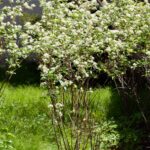
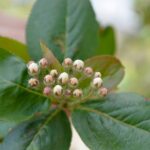
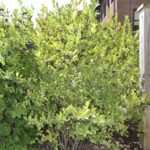
Shrub Audio Recording AvailablePurdue Plant Doctor Available Aronia arbutifolia 'Brilliantissima' [Brilliant Red Chokeberry] The Brilliant Red Chokeberry has dark green leaves that turn a stunning deep red in the fall. 'Brilliant' produces larger and more abundant flowers and a greater number of red berries than the species type. Because birds find the fruits unappealing, the berries are allowed to persist well into the winter months. This plant tends to sucker and create colonies. Audio Recording AvailablePurdue Plant Doctor Available
Shrub Purdue Plant Doctor Available Aronia arbutifolia 'Erecta' [Erecta Red Chokeberry] 'Erecta' has a more upright form than the species and does not bear as colorful of fruit Purdue Plant Doctor Available
Shrub Indiana Native Audio Recording AvailablePurdue Plant Doctor Available Aronia melanocarpa [Black Chokeberry] This Indiana native shrub is similar to the Red Chokeberry in habit and form, but differs in that the Black Chokeberry is larger, has black-colored fruits, broader leaves, and generally larger flowers. Place in a higher light location for the best flower and fruit display. Best used for naturalizing, mass plantings, and wetland reclamation projects. The berries are edible, but only palatable when used in jellies and jams. Indiana NativeAudio Recording AvailablePurdue Plant Doctor Available
Shrub Purdue Plant Doctor Available Aronia melanocarpa 'Autumn Magic' [Autumn Magic Black Chokeberry] The Autumn Magic Black Chokeberry is known for its outstanding bright purple to red to orange fall color, compact form, and large, attractive fruits. Place in a higher light location for the best flower and fruit display. Best used for naturalizing, mass plantings, and wetland reclamation projects. The berries are edible, but only palatable when used in jellies and jams. Purdue Plant Doctor Available
Shrub Purdue Plant Doctor Available Aronia melanocarpa 'Morton' [sold as Iroquis Beauty™] [Iroquois Beauty Black Chokeberry] Cultivar 'Morton', sold as Iroquois Beauty, is a compact shrub that reaches 5 to 6 feet. The flowering and fruiting are similar to that of the straight species, but the compact form allows this shrub to e better utilized in a mass planting. Great for rain gardens, bioswales, and lowlands that collect water in the landscape. Glossy green leaves will turn a brilliant orange-red in the fall. Its black fruit attracts wildlife, such as birds. Purdue Plant Doctor Available
Shrub Purdue Plant Doctor Available Aronia melanocarpa 'Viking' [Viking Black Chokeberry] Purdue Plant Doctor Available
Herbaceous Purdue Plant Doctor Available Aruncus dioicus [Goat's Beard] Purdue Plant Doctor Available
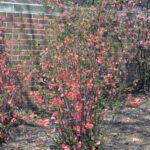
Shrub Purdue Plant Doctor Available Chaenomeles japonica [Japanese Flowering Quince] Orange-red to scarlet flowers occur in early to mid-April and are born on one-year-old wood just before the leaves fully emerge, creating an excellent dispersal of coloring throughout the shrub. Sparsely produces small, apple-like fruits, commonly called quinces, that are edible if used in preserves; harvest in October. Widely adapted to different soils and microclimates. Place in full sun location for best flower display, although it is tolerant to partial shade. Subject to occasional scale… Purdue Plant Doctor Available
Shrub Audio Recording AvailablePurdue Plant Doctor Available Chaenomeles speciosa [Common Flowering Quince] White, pink, orange, salmon, or red single or double flowers (depending on variant) occur in late April, are born on old wood just before the leaves fully emerge, and occur singly or 2-4 per cluster, creating an excellent dispersal of coloring throughout the shrub. Sparsely produces small, apple-like fruits, commonly called quinces, that are edible if used in preserves; harvest in October. Widely adapted to different soils and microclimates. Place in full sun location for… Audio Recording AvailablePurdue Plant Doctor Available
Shrub Audio Recording AvailablePurdue Plant Doctor Available Chaenomeles speciosa 'Cameo' [Cameo Flowering Quince] 'Cameo' is known for its abundant beautiful, double, peach-pink flowers in April. The flowers are born on old wood just before the leaves fully emerge, and occur singly or 2-4 per cluster, creating an excellent dispersal of coloring throughout the shrub. Unlike the straight species, the bright, lustrous foliage of 'Cameo' provides seasonal interest after the one week of flower show, making it a more useful flowering quince. Sparsely produces small, apple-like fruits, commonly called… Audio Recording AvailablePurdue Plant Doctor Available