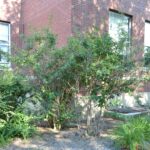
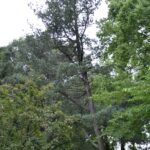
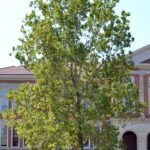
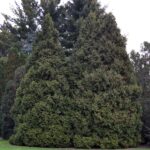
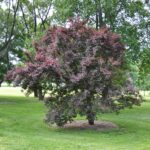
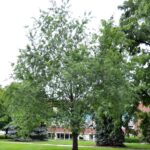
Shrub Sorbaria sorbifolia [Ural Falsespirea] Coarse texture and unusual spirea-like flowers give this plant unique summer interest. Best in large-scale situations. Spreads vigorously by suckering if not contained. Intensive root pruning can be used to control spread. Does not do the best in dry soils but does tolerate them. Does poorly in heavy wind. Flowers turn brown with senescence and esthetic is slightly improved by their removal. To some, a bit too coarse in winter habit.
Tree Stewartia pseudocamellia [Japanese Stewartia] In the wild, this specimen can grow up to 60' high, much larger than the mature landscape tree which ranges from 20-40' high. The outstanding, multi-colored bark is rich and flaking, ranging from soft grays and browns to orangish brown. There are no serious pests or diseases for this specimen.
Tree Styphnolobium japonicum [Japanese Pagodatree] A widely adapted tree with good drought and pollution tolerance, and foliage texture comparable to Gleditsia, but a smaller tree and with more seasonal interest. Relatively trouble-free except for fungi that live in weaker twigs that cause twig blight and canker. Fungi invade most readily those twigs killed by cold or self-pruning. Seeds are poisonous. Difficult to train a central leader. More cold sensitive when young.
Tree Styrax japonicus [Japanese Snowbell] Relatively trouble-free. Can be susceptible to Ambrosia beetle and canker. Partial shade best in Zones 7 and 8 due to heat intolerance.
Shrub Symphoricarpos × chenaultii [Chenault Coralberry] A more refined plant than the parent S. orbiculatus, perhaps more showy in flower and fruit and more useful in the shrub border. Useful as a bank cover or large scale groundcover. Transplants well. This plant has a beautiful fruit show and is shade tolerant, however, it is also a twiggy, "garbage can plant" (collects leaves and blowing debris); this quality (especially prominent in the fall and winter) limits its usability in the landscape.
Shrub Syringa × chinensis [Chinese Lilac] Can become ratty in appearance, and so should be pruned properly on 3 year cycle. Problems with aphids, powdery mildew, scales, and caterpillars, although powdery mildew is worst problem.
Shrub Syringa pubescens ssp. patula 'Miss Kim' [Miss Kim Manchurian Lilac] 'Miss Kim' is known for its prolific fragrant ice-blue flower panicles and more dense, compact habit. Powdery mildew resistant. Very low maintenance. Heat tolerant, so grows better in warmer climates than other lilacs. Also known as Syringa patula 'Miss Kim'.
Shrub Syringa vulgaris [Common Lilac] A difficult species to use in a functional way. Best for seasonal color and fragrance in the border or as an occasional specimen. Deadheading can promote flowering and prevent alternate bearing. Will get leggy without pruning (prune on a 3-year cycle). Powdery mildew is an increasingly serious problem the further south this is planted in its hardiness zone. Grows better in colder climates.
Tree Indiana Native Thuja occidentalis [Eastern Arborvitae] One of the best plants for screening in moist, well-aerated soils. Bagworms can be a problem. Subject to several other insect pests, all of which usually can be controlled with timely spraying. Deer may feed on foliage. Winter color can be poor.