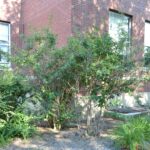
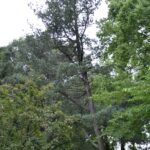
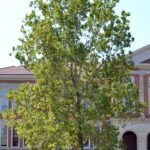
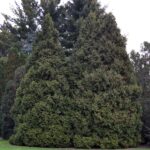
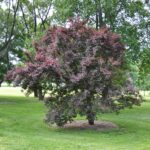
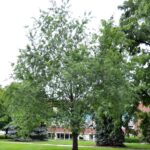
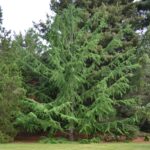
Tree Indiana Native Nyssa sylvatica [Black Gum] Especially useful in wet soils. One of the most beautiful of trees, with habit comparable to Quercus palustris, but usually more irregular, and with a greater number of more slender main limbs. Silvery-gray, picturesque branching; strong horizontal accent. Difficult to transplant due to taproot; use container-grown plants when possible, or at least plants dug with a soil ball. Shelter from wind. In the North, select native northern stock as the species has a wide geographic…
Tree Indiana Native Ostrya virginiana [American Hophornbeam] A good, trouble-free small shade tree worthy of greater use. Very graceful with many drooping branches that create a rounded habit. Best on drier slopes, and is usually found in native ecosystems. Slow growing, and difficult to transplant. Does not tolerate periodic flooding (as does Carpinus caroliniana) or salt.
Liana (Climbing Vine) Parthenocissus tricuspidata [Boston Ivy] One of the strongest-climbing vines, give solid support for attachment of the adhesive discs on tendrils. Not a vine for trellises or fences. Very tolerant of urban soils. Not a good groundcover.
Shrub Philadelphus coronarius [Sweet Mockorange] Well adapted to different light (even shade) and soil conditions, especially to dry situations. Relatively trouble-free, and one of the most fragrant of the mockoranges. None of the mockoranges have much landscape interest after the season of bloom. Becomes leggy if not pruned. Pruning should be done after flowering (flower buds form on previous years wood), and to maintain fullness of form.
Tree Pinus parviflora [Japanese White Pine] The species exhibits good salt tolerance. Although subject to rusts, wood rots, nematodes, and sawflies, none are serious.
Tree Indiana Native Platanus occidentalis [American Sycamore] One of the largest of shade trees, making massive, majestic specimens. Tolerant of urban conditions, but generally found in riparian areas in the wild. The mottled, multi-colored, exfoliating bark is very beautiful and makes for excellent winter interest. Needs a large volume of soil space. Anthracnose leaf and twig blight occasionally disfigure this tree, and can damage it severely. Leaves, twigs, bark, and fruit contribute to a significant litter problem. Although this species can tolerate…
Shrub/Tree Platycladus orientalis [Oriental Arborvitae] Best in at least fairly moist soils, and with fairly high humidity. Habit tends toward becoming thinner (open) with age. Subject to "winter-burn" near the edge of its useful range. Certain forms provide very positive accent, but can be over-used. Bagworms can also be a problem.
Tree Prunus cerasifera 'Atropurpurea' [Purple Cherry Plum] This tree is not pollution tolerant and is short-lived, often living to only about 20 years. There are numerous diseases and pests that can affect Prunus cerasifera, especially canker, fireblight, leaf spots, powdery mildew, aphids, scale, borers, and tent caterpillars. Despite its drawbacks, this tree is extraordinarily popular and has been used extensively in the landscape. The straight species Prunus cerasifera is not often seen, with purple-leaf forms, such as 'Atropurpurea' being the most predominant.…
Tree Indiana Native Prunus serotina [Black Cherry] Probably the best native-American species of cherry for landscape use, but still useful only in a few situations, especially for naturalizing. A valuable timber tree, especially for furniture. Subject to several minor pests, none usually serious in naturalized situations. Wood is slightly brittle. Eastern tent caterpillar problematic is some years.
Tree Pseudolarix amabilis [Golden Larch] No serious diseases. Should be protected from too much wind.