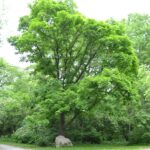
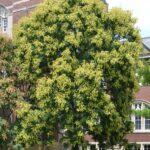
Tree Indiana Native Gleditsia aquatica [Water Locust] This native Indiana tree species is found in three southwestern counties near the lower Wabash River. It is often found in wet or ponded locations where there is standing water or high water tables. Not recommended for the landscape as it has large, multi-pronged thorns. Like its cousin, the honey locust, it has compound leaves, but can be differentiated by its location, much smaller seed pods, and flattened thorns along the branches.
Shrub Hypericum calycinum [Creeping St. John's Wort] Relatively trouble-free. Tolerates dry conditions well (even drier shade). Generally, tops are killed back in severe winters near its limit of hardiness. Mowing to the ground each spring improves aesthetics of the following regrowth. Slow to leaf out in spring. Can be invasive via spreading stolons. Poisonous to animals.
Tree Kalopanax septemlobus [Castor Aralia] No disease or insect problems. Stout prickles could cause injury. Slight weediness via the seeds. Not common in commerce.
Tree Koelreuteria paniculata [Goldenraintree] Colorful small tree in bloom and interesting for its form. Tolerates heat, drought, wind, alkaline soils, and air pollution. Newly emerging leaves can be damaged by late spring freezes. Rather weak-wooded. Can be damaged or killed by –25 degrees F. Invasive in some parts of the country.
Shrub/Tree Lagerstroemia indica [Common Crapemyrtle] Can be grown as a tree or shrub. This species prefers hot sunny sites. For Zones 5 and 6, apply winter mulch to protect roots. Flower color ranges from white, pink, purple, or deep red that terminates the current year's growth. Long flowering period from July to September. Can have problems with powdery mildew.
Tree Indiana Native Liquidambar styraciflua [American Sweetgum] Handsome shade tree with few troubles and outstanding seasonal interest. Widely adapted to soils and climates, as evidenced by its wide range. Fall foliage coloration varies greatly in timing and intensity among individuals. Rather difficult to transplant in large sizes. Varies widely in hardiness. Select native northern stock for use in North. Horned fruits can be a serious litter problem, dulling mower blades and injuring bare feet. Also see Liquidambar styraciflua (Shuttle Gum Group).
Tree Indiana Native Liquidambar styraciflua (Shuttle Gum Group) [American Sweetgum] This group of Liquidambar styraciflua (Sweetgum) trees was germinated in August of 1984 after a mission aboard the space shuttle Discovery. Purdue astronaut Charles Walker of Bedford, Indiana, brought back 200 tiny trees; these recognize Purdue's many astronauts. Sweetgums are handsome shade trees with few troubles and outstanding seasonal interest. Widely adapted to soils and climates, as evidenced by their wide range. Fall foliage coloration varies greatly in timing and intensity among individuals. Rather difficult…
Tree Indiana Native Liriodendron tulipifera [Tuliptree] Handsome, tall shade tree with strong central leader. Performs best in good soil with adequate moisture. Variable in hardiness, depending on geographic source. Use native stock when possible. State tree of Indiana, Kentucky, North Carolina, and Tennessee. Slightly weak-wooded. Subject to damage in very windy sites. Subject to aphid and scale insects when weakened. Needs good drainage and a lot of soil (tree lawn may be too small). Its poorly branched fleshy root system (taproot)…
Tree Indiana Native Maclura pomifera [Osage-Orange] Withstands wind and dry conditions well. Used by farmers as a hedgerow for livestock fencing because of its thorniness. Highly deer resistant. Fruits are said to be an insect and rodent repellent. Extremely decay resistant wood, containing 1% by weight 2,3,4,5-tetrahydroxystilbene (a fungitoxic compound). Large fruits create litter problem; select staminate trees to avoid fruit (unless you believe the fruits are of interest). Due to invasive root system, do not plant near sewer or drainage…
Tree Malus × 'Adirondack' [Adirondack Flowering Crabapple] The Flowering Crabapple is a popular small ornamental tree with an extremely showy flower display in the spring. This variant has a vase-shaped (somewhat columnar) habit, extremely upright branching, and high resistance to apple scab, fireblight, cedar-apple rust, and powdery mildew. Tends to flower and fruit in alternate years. Well-drained heavy loam soils and full sun promote best growth.