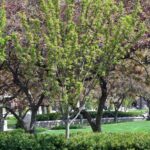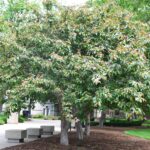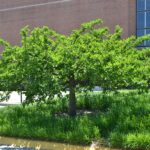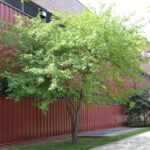
Tree Malus × 'Indian Magic' [Indian Magic Flowering Crabapple] The Flowering Crabapple is a popular small ornamental tree with an extremely showy flower display in the spring. 'Indian Magic' is not as disease resistant as others, being moderately susceptible to scab. Tends to flower and fruit in alternate years. Well-drained heavy loam soils and full sun promote best growth. Can be susceptible to many pests and diseases, including apple scab, fireblight, Japanese beetles, leaf spot, cedar-apple rust, and powdery mildew. May look ragged at…
Tree Malus sargentii [Sargent Crabapple] The smallest of all Malus species, almost a shrub. Strongly horizontal branching. Tends to be apomictic (seeds develop without fertilization), so is usually very uniform from seed (i.e. clonal). Sometimes flowers and fruits in alternate years. Susceptible to apple scab disease. May require pruning of wayward and crossing branches to maintain a nice form.
Tree Malus × 'Snowdrift' [Snowdrift Flowering Crabapple] The Flowering Crabapple is a popular small ornamental tree with an extremely showy flower display in the spring. 'Snowdrift' is a vigorous selection that is covered with numerous white blossoms in the spring, which are then followed by attractive orange-red crabapple fruits. Susceptible to apple scab and fire blight. Well-drained heavy loam soils and full sun promote best growth. May look ragged by the end of the summer.
Shrub/Tree Myrica pensylvanica [Northern Bayberry] Waxy gray berries were used by early settlers for making aromatic candles, and occasionally still are used for this purpose. Especially good plant for full sun and sandy soils, but grows well on many soils. Tolerates half shade. Relatively salt-tolerant. Forms colonies via suckers. Fixes nitrogen in the soil. Dioecious. Use female plants (when known) for fruiting, and occasional male for pollination. Difficult to transplant from field.
Tree Indiana Native Oxydendrum arboreum [Sourwood] This plant gets it common and scientific name from its sour-tasting leaves. The genus name is derived from the Greek word "oxys", meaning sour, and "dendron", meaning tree. Honey produced from the pollen of Sourwood flowers is considered valuable. The attractive, slightly fragrant flowers are often prolifically produced, especially in full sun, and are effective for up to four weeks. Like all Ericaceous plants, Oxydendrum arboreum requires rich, organic, moist, well-drained, and acidic soil. This…
Tree Parrotia persica [Persian Parrotia] One of the best trees for foliage and bark effect. Very adaptable, tolerating drought, various soils, heat, cold, etc. Prefers full sun but tolerates light shade. Sites with strong winter winds will surely cause tip dieback in Northern Indiana.
Liana (Climbing Vine) Parthenocissus tricuspidata [Boston Ivy] One of the strongest-climbing vines, give solid support for attachment of the adhesive discs on tendrils. Not a vine for trellises or fences. Very tolerant of urban soils. Not a good groundcover.
Tree Pinus parviflora [Japanese White Pine] The species exhibits good salt tolerance. Although subject to rusts, wood rots, nematodes, and sawflies, none are serious.
Shrub/Tree Platycladus orientalis [Oriental Arborvitae] Best in at least fairly moist soils, and with fairly high humidity. Habit tends toward becoming thinner (open) with age. Subject to "winter-burn" near the edge of its useful range. Certain forms provide very positive accent, but can be over-used. Bagworms can also be a problem.
Tree Pseudolarix amabilis [Golden Larch] No serious diseases. Should be protected from too much wind.