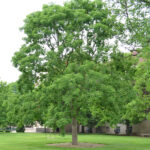
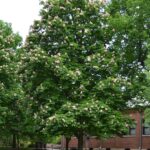
Tree Audio Recording AvailablePurdue Plant Doctor Available Aesculus hippocastanum [Common Horsechestnut] Widely adapted to soils and environments; however, very dry conditions must be avoided. Leaf blotch often disfigures foliage. Spiny fruits in autumn can be troublesome underfoot, and eliminates species type as a good street tree. Fruits are toxic containing 3-5% saponins. Audio Recording AvailablePurdue Plant Doctor Available
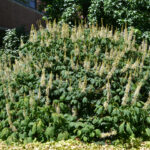
Shrub Indiana Native Audio Recording AvailablePurdue Plant Doctor Available Aesculus parviflora [Bottlebrush Buckeye] Can be kept at a smaller size for a time with careful pruning, but it will in time occupy much space. Tolerates some shade, and can even be attractive under large shade trees. Suckers quite freely. Indiana NativeAudio Recording AvailablePurdue Plant Doctor Available
Shrub/Tree Purdue Plant Doctor Available Aesculus pavia [Red Buckeye] The Red Buckeye can be a small tree or clump-forming, multi-stemmed shrub. The lustrous, deep green foliage is attractive, but tends to decline by August. Susceptible to leaf blotch, but less susceptible to mildew than Aesculus hippocastanum. Purdue Plant Doctor Available
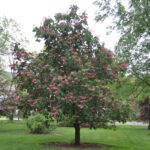
Tree Audio Recording AvailablePurdue Plant Doctor Available Aesculus × carnea [Red Horsechestnut] More drought resistant and more resistant to blotch and mildew than A. hippocastanum. Comes true to type from seed. Flowers at early age. Does not perform well in dry sites. Prickly fruits may be a problem underfoot. Fruits are poisonous (containing toxic saponins). Often develops branches having narrow crotch angles (branches that should be removed). Audio Recording AvailablePurdue Plant Doctor Available
Tree InvasiveThis plant is considered invasive Audio Recording AvailableID That Tree Video AvailablePurdue Plant Doctor Available Ailanthus altissima [Tree of Heaven] Unusual form and texture not unlike a large sumac. Highly adaptable. Tolerates salt spray. Dioecious. Coarse and inclined to drop twigs. Male flowers are malodorous; female plants make many weed seedlings. Ailanthus altissima forms dense, clonal thickets which displace native species and can rapidly invade fields, meadows, and harvested forests. This invasive tree species is extremely tolerant of poor soil conditions and can even grow in cement cracks. Ailanthus altissima is not shade tolerant, but… Audio Recording AvailableID That Tree Video AvailablePurdue Plant Doctor Available
Liana (Climbing Vine) InvasiveThis plant is considered invasive Audio Recording AvailablePurdue Plant Doctor Available Ampelopsis glandulosa var. heterophylla [Porcelain Ampelopsis] Best fruiting in full sun. Restricting root growth can enhance fruit production. Japanese beetles love them. Can be invasive. Rampant growth. Audio Recording AvailablePurdue Plant Doctor Available
Shrub/Tree Indiana Native Audio Recording AvailableID That Tree Video Available Aralia spinosa [Devil's Walkingstick] Slow growth rate, but fast on roots (forms a very coarse thicket). Sucker shoots can be a maintenance problem if tree form is desired. Sharp prickles also make maintenance difficult, and are a minor hazard to children. Otherwise, no serious problems with this plant. Very adaptable and easy to grow, tolerating most conditions except wet soil. Drought tolerant, and best in full sun. Excellent selection in a mass planting near buildings having poor soils. Indiana NativeAudio Recording AvailableID That Tree Video Available
Shrub Audio Recording AvailablePurdue Plant Doctor Available Aronia arbutifolia 'Brilliantissima' [Brilliant Red Chokeberry] The Brilliant Red Chokeberry has dark green leaves that turn a stunning deep red in the fall. 'Brilliant' produces larger and more abundant flowers and a greater number of red berries than the species type. Because birds find the fruits unappealing, the berries are allowed to persist well into the winter months. This plant tends to sucker and create colonies. Audio Recording AvailablePurdue Plant Doctor Available
Shrub Indiana Native Audio Recording AvailablePurdue Plant Doctor Available Aronia melanocarpa [Black Chokeberry] This Indiana native shrub is similar to the Red Chokeberry in habit and form, but differs in that the Black Chokeberry is larger, has black-colored fruits, broader leaves, and generally larger flowers. Place in a higher light location for the best flower and fruit display. Best used for naturalizing, mass plantings, and wetland reclamation projects. The berries are edible, but only palatable when used in jellies and jams. Indiana NativeAudio Recording AvailablePurdue Plant Doctor Available
Shrub Purdue Plant Doctor Available Aronia melanocarpa 'Viking' [Viking Black Chokeberry] Purdue Plant Doctor Available