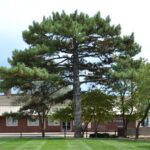
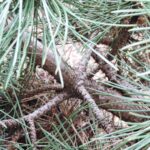
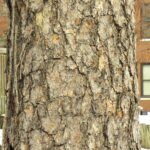
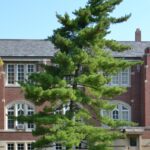
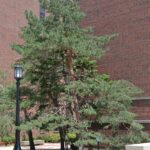
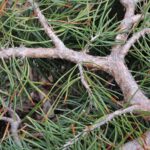
Tree Pinus nigra [Austrian Pine] An excellent plant for screening when young. Needs a companion planting eventually for low screening as it loses branches at the base. Tolerates city conditions. Tolerates clay, dry, and alkaline soils, and heat. May be badly damaged by sapsuckers. Sphaeropsis tip blight is a more serious problem. Pine foliar nematode (transmitted by a beetle) can also be problematic.
Shrub Pinus nigra 'Hornibrookiana' [Dwarf Austrian Pine] 'Hornbrookiana' is a compact and mounded dwarf cultivar. Tolerates city conditions. Tolerates clay, dry, and alkaline soils, and heat. May be badly damaged by sapsuckers. Sphaeropsis tip blight is a more serious problem. Pine foliar nematode (transmitted by a beetle) can also be problematic.
Tree Pinus ponderosa [Ponderosa Pine] Pinus ponderosa is a very tolerant tree, adaptable to a wide range of conditions, except for shade and poor drainage. Older trees often lack lower limbs. It is dominant in western North America, where it can reach up to 230 feet tall, and is an extremely important timber tree.
Tree Indiana Native Pinus strobus [Eastern White Pine] More graceful than most pines, both as a young and an old specimen. Excellent neutral screening plant, it can be kept full by occasional pruning. Among best pines for resistance to moth borers. Transplants easily with a bit of shade tolerance. Somewhat less adapted to severe exposures and very dry soils than Pinus resinosa or Pinus nigra. Very sensitive to air pollution and road salt. Susceptible to White Pine Blister Rust. Decaying needles acidify soil…
Tree Pinus strobus 'Contorta' [Contorted Eastern White Pine] 'Contorta' has a loose, irregular, upright form and twisted needles, branchlets, and branches. The Eastern White Pine is among the best pines for resistance to moth borers. Transplants easily with a bit of shade tolerance. Somewhat less adapted to severe exposures and very dry soils than Pinus resinosa or Pinus nigra. Very sensitive to air pollution and road salt. Susceptible to White Pine Blister Rust. Decaying needles acidify soil beneath (to about pH 4.5), which…
Tree Pinus strobus 'Fastigiata' [Columnar Eastern White Pine] 'Fastigiata' is a strongly narrow, upright cultivar. Excellent neutral screening plant, it can be kept full by occasional pruning. Among best pines for resistance to moth borers. Transplants easily with a bit of shade tolerance. Somewhat less adapted to severe exposures and very dry soils than Pinus resinosa or Pinus nigra. Very sensitive to air pollution and road salt. Susceptible to White Pine Blister Rust. Decaying needles acidify soil beneath (to about pH 4.5), which…
Tree Pinus strobus 'Pendula' [Weeping Eastern White Pine] 'Pendula' is weeping, semi-dwarf cultivar with long, pendulous branches. The ultimate form of this cultivar depends on how it is pruned and trained. More graceful than most pines, both as a young and an old specimen. Excellent neutral screening plant, it can be kept full by occasional pruning. Among best pines for resistance to moth borers. Transplants easily with a bit of shade tolerance. Somewhat less adapted to severe exposures and very dry soils than…
Tree Pinus sylvestris [Scotch Pine] Effective as a screen with pruning. Tolerant of fairly dry soils, but not a good specimen in shade or on wet soils. Sphaeropsis, nematodes, and pine wilt fungus are serious problems; not recommended by Morton Arboretum.
Shrub Pinus sylvestris 'Hillside Creeper' [Creeping Scotch Pine] 'Hillside Creeper' is a low-growing, spreading evergreen that can be used as a groundcover. Tolerant of fairly dry soils, but not a good specimen in shade or on wet soils.
Tree Indiana Native Populus balsamifera [Balsam Poplar] Buds exude a resin (the source of "balm of Gilead") that is traditionally used as an ointment to relieve chest congestion. The resin is also flammable, so twigs are used for starting fires. The streaked brown and grey wood is used in carving and woodworking. Trees are found along forest edges, forests, meadows and fields, and shores of rivers or lakes.