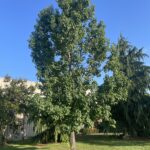
Tree Indiana Native Gleditsia aquatica [Water Locust] This native Indiana tree species is found in three southwestern counties near the lower Wabash River. It is often found in wet or ponded locations where there is standing water or high water tables. Not recommended for the landscape as it has large, multi-pronged thorns. Like its cousin, the honey locust, it has compound leaves, but can be differentiated by its location, much smaller seed pods, and flattened thorns along the branches.
Shrub Hydrangea macrophylla [Bigleaf Hydrangea] Beautiful flowers that are borne as either mopheads (hortensias), which are globular masses of mostly showy sterile flowers, or lacecaps, which are flat-topped clusters that have an outer ring of showy flowers surrounding small, less-showy fertile flowers in the center. In general, an acidic soil will produce a very blue colored flower in most cultilvar, and alkaline pink. High quality foliage. Lower flower production in cold climates, and performs poorly on hot dry sites. A…
Shrub Hydrangea macrophylla 'Mariesii Variegata' [Variegated Bigleaf Hydrangea] This cultivar has beautiful variegated foliage and lacecap flowers. An acidic soil will produce a very blue colored flower, and alkaline pink. High quality foliage. Lower flower production in cold climates, and performs poorly on hot dry sites. A few pest problems, including scale, mites, powdery mildew, and leaf spot.
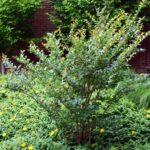
Shrub Hypericum kouytchense [Large-flowered St. John's Wort] The Large-flowered St. John's Wort is a mounded, semi-evergreen shrub with arching branches. Blooming generally begins in June and can last through September. The large, up to 2.5" diameter, bright yellow flowers are crowned by a dome of many long stamens. Some sources state that this species is synonymous with Hypericum 'Sungold'.
Shrub Ilex crenata 'Sky Pencil' [Sky Pencil Holly] 'Sky Pencil' is a nice extremely narrow, upright, fastigiate broadleaf evergreen that holds its color through winter. This species, like other hollies, is dioecious and 'Sky Pencil' is a female cultivar that will only be able to produce fruit if there is a male pollinator planted nearby. Withstands severe pruning. Winter desiccation injury to leaves in exposed sites. Spider mites can be serious. Avoid high pH soils as chlorosis may occur.
Shrub/Tree Lagerstroemia indica [Common Crapemyrtle] Can be grown as a tree or shrub. This species prefers hot sunny sites. For Zones 5 and 6, apply winter mulch to protect roots. Flower color ranges from white, pink, purple, or deep red that terminates the current year's growth. Long flowering period from July to September. Can have problems with powdery mildew.
Tree Liquidambar styraciflua 'Rotundiloba' [Rotundiloba American Sweetgum] 'Rotundiloba' has distinctly rounded leaf lobes and is fruitless. This cultivar is also narrower than the species and has variable yellow to burgundy fall color. It is difficult to establish good branching and canopy on young 'Rotundiloba' trees. Widely adapted to soils and climates. Rather difficult to transplant in large sizes. Select northern stock for use in North.
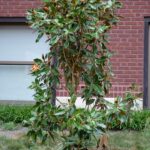
Tree Magnolia grandiflora 'Little Gem' [Little Gem Southern Magnolia] Though the straight species of Magnolia gradiflora is not hardy in Indiana, 'Little Gem' can be hardy up to zone 6(7). If planted, place in an area that is protected from winter winds and extreme temperature drops, such as an enclosed courtyard. 'Little Gem' is a dwarf cultivar of the Southern Magnolia, ranging from 15' to 20' in height and 10' in width. Typically seen as more of a shrub from, rather than the iconic…
Shrub Nandina domestica [Heavenly Bamboo] The beautiful red fruits are so prolific they can even bend down branches. Tolerates full sun or shade, even fruits well in shade. Prune by cutting canes back to ground. Develops iron chlorosis on Southwestern US due to high soil pH. 'Atropurpurea Nana' stays 2' high with reddish-green color throughout summer, turning dark red in winter.
Shrub Philadelphus inodorus [Scentless Mock Orange] This shrub only has interest when it is flowering; even then, this specific specimen is not as great as it is not fragrant, unlike its relative, P. coronarius.