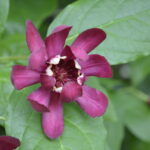
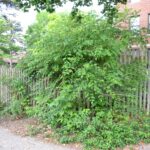
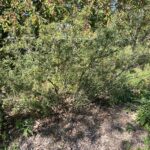
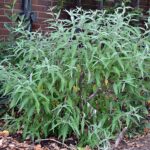
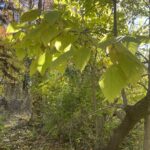
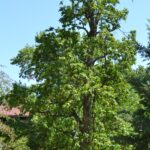
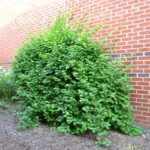
Shrub Calycanthus floridus 'Aphrodite' [Aphrodite Sweetshrub] 'Aphrodite' has an upright form with deep red flowers. The flowers are fragrant and large and bloom throughout the summer season. Large bright green leaves, can grow to be bigger than a human hand.
Liana (Climbing Vine) Campsis radicans [Common Trumpetcreeper] Very tolerant of soils and environment, except it does not tolerate shade. Can be trained as a standard. May require special support on some surfaces, especially as it becomes large and heavy (could pull down weaker structures). May also require pruning to keep size in check.
Shrub Caragana arborescens [Siberian Peashrub] The Siberian Peashrub is quite a tough and adaptable, nitrogen-fixing plant that can grow in extremely difficult conditions, but it has very limited use ornamentally. Best reserved for tough environments, such as in a windbreak, hedge, or screen.
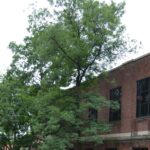
Tree Indiana Native Carya cordiformis [Bitternut Hickory] Carya cordiformis is naturally found growing in low woodlands and along rivers, streams, and ponds. This is one of the fastest growing of the hickories. The long taproot can make this species difficult to transplant. There are no serious insect or disease threats.
Shrub Caryopteris × clandonensis [Bluebeard] Is often killed to ground in winter, returning to flower in the same year. Functions much like an herbaceous perennial, primarily for flowering interest, blooming on new growth. This hybrid is much hardier than C. incana and much more showy than C. mongholica. Prefers full sun but tolerates partial shade. Attractive plant to bees, butterflies, and hummingbirds. Occasionally kills out completely at the northern edge of its useful range, with tops regularly killed back to…
Shrub Caryopteris × clandonensis 'Blue Mist' [Blue Mist Bluebeard] This cultivar blooms in clusters during late summer with vibrant blue flowers. Is often killed to ground in winter, returning to flower in the same year. Functions much like an herbaceous perennial, primarily for flowering interest, blooming on new growth. This hybrid is much hardier than C. incana and much more showy than C. mongholica. Attractive to bees, butterflies, and hummingbirds. Occasionally kills out completely at the northern edge of its useful range, with tops…
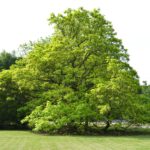
Tree Catalpa bignonioides 'Aurea' [Golden Southern Catalpa] The Golden Southern Catalpa can tolerate full sun, but does best in part sun to part shade. This species is weak wooded and should not be placed where it is open to wind and storm damage. 'Aurea' is known for its rich yellow leaf coloration and its broad form. Its flowers are trumpet shaped and white with yellow and purple spots.
Tree Catalpa ovata [Chinese Catalpa] The Chinese Catalpa is smaller than other Catalpa species, generally only reaching 30 feet. It produces attractive yellow-white flowers in the spring, but they are not as ornamental as those of other Catalpa species. Its coarse winter trunk and branches are bold and striking; picturesque, but can be too coarse for many urban landscapes. Best for difficult areas. Wood is rot resistant, but is somewhat brittle so branches can fall in wind and ice storms.…
Tree Indiana Native Catalpa speciosa [Northern Catalpa] Coarse winter trunks and branches are bold and striking; picturesque. Best for difficult areas. Wood is rot resistant, but is somewhat brittle so branches can fall in wind and ice storms. Too coarse of texture for most urban landscapes. Short-lived to about 50 years.
Liana (Climbing Vine) Indiana Native Celastrus scandens [American Bittersweet] Sun to partial shade (best flowers in full sun), and tolerant of soil conditions (except wet). Tends to be invasive. Birds are fond of fruits. Tends toward dioeciousness. Female plants need a male pollinator to produce more abundant fruits. Can girdle trees it grows on. Euonymus scale and two-marked treehoppers can cause damage.