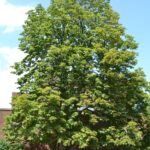
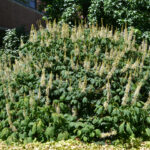
Shrub Indiana Native Audio Recording AvailablePurdue Plant Doctor Available Aesculus parviflora [Bottlebrush Buckeye] Can be kept at a smaller size for a time with careful pruning, but it will in time occupy much space. Tolerates some shade, and can even be attractive under large shade trees. Suckers quite freely. Indiana NativeAudio Recording AvailablePurdue Plant Doctor Available
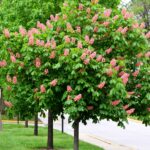
Tree Audio Recording AvailablePurdue Plant Doctor Available Aesculus × carnea 'Fort McNair' [Fort McNair Red Horsechestnut] Fort McNair Red Horsechestnut is less suscebtible to leaf scorch, leaf blotch and mildew than the straight species, although it can still contract the diseases. Does not perform well in dry sites; plant in moister soils for best growth and flowering. Flowers at an early age. Prickly fruits may be a problem underfoot. Fruits are poisonous (containing toxic saponins). Often develops branches having narrow crotch angles (branches that should be removed). Audio Recording AvailablePurdue Plant Doctor Available
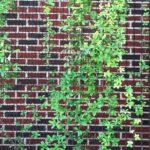
Liana (Climbing Vine) Akebia quinata [Fiveleaf Akebia] Fiveleaf Akebia is a vigorous vine that establishes quickly under many different conditions, even to the point of invading an area. Prune to keep this plant within its boundaries. Best used to climb up structures, but can also be used as a sprawling groundcover. Although generally deciduous, Akebia quinata can be evergreen in the south.
Tree Purdue Plant Doctor Available Albizia julibrissin [Albizia] Albizia julibrissin is known for its attractive, "pom-pom" like flowers that begin in late spring and last through the summer. The interesting effect of the flowers is due to the the over 1" long pink stamens. This plant is not an ideal landscape choice due to its susceptibility to many pests and diseases, including vascular wilt disease (Fusarium). Purdue Plant Doctor Available
Liana (Climbing Vine) Allamanda cathartica [Golden Trumpet] Can be grown as a small shrub if pruned regularly. Quite tolerant of many soil types. Full sun needed for maximum flower show. All Allamandas are poisonous. Caterpillars and mites can be problematic. Not salt tolerant. 'Hendersonii' is most often planted, while 'Yellow Butterflies' is compact with many large yellow flowers.
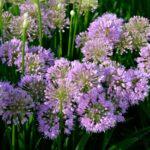
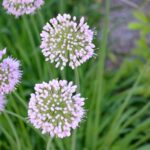
Herbaceous Audio Recording AvailablePurdue Plant Doctor Available Allium 'Millenium' [Ornamental Onion] Tolerates a wide range of soils but it performs well in sandy soils. It is wasily grown in average moisture, well drained soils in full sun or partial shade. The bulbs are best planted in the fall. Audio Recording AvailablePurdue Plant Doctor Available
Herbaceous Audio Recording AvailablePurdue Plant Doctor Available Allium senescens montamun [German garlic] German garlic, also known as mountain garlic, is an ornamental onion that is grass-like with flattened, broad leaves. It usually grows in dense clumps that are between 6 and 12 inches tall. Audio Recording AvailablePurdue Plant Doctor Available
Shrub Purdue Plant Doctor Available Alnus serrulata [Hazel Alder] Closely related to Alnus rugosa, differing chiefly in its leaves, which are usually broadest above the middle and have the margins set with fine, nearly regular teeth. Multi-stemmed habit and tends to sucker. Purdue Plant Doctor Available
Shrub/Tree Indiana Native Audio Recording AvailablePurdue Plant Doctor Available Amelanchier canadensis [Shadblow Serviceberry] Amelanchier canadensis, the Shadblow Serviceberry, tends to be confused with Amelanchier arborea, the Downy Serviceberry, and Amelanchier laevis, the Allegheny Serviceberry. However, A. canadensis, compared to A. arborea and A. laevis, is generally much more shrub-like (often forming thickets), flowers a week later, and produces upright flower clusters (as opposed to the pendulous racemes of A. arborea and A. laevis). The Shadblow Serviceberry is excellent for woodland plantings, naturalizing, and along stream and pond banks.… Indiana NativeAudio Recording AvailablePurdue Plant Doctor Available