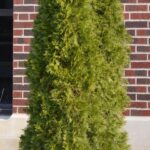
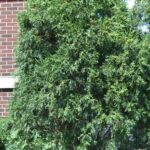
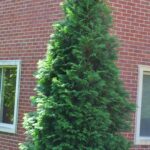
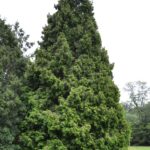
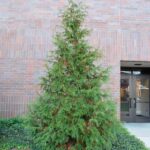
Shrub/Tree Thuja occidentalis 'Pyramidalis' [Pyramidal Eastern Arborvitae] 'Pyramidalis' has a narrow pyramidal form and brightly-colored, soft leaves. One of the best plants for screening in moist, well-aerated soils. Bagworms can be a problem. Subject to several other insect pests, all of which usually can be controlled with timely spraying. Deer may feed on foliage. Winter color can be poor (susceptible to winter burn).
Shrub/Tree Thuja occidentalis 'Smaragd' [Emerald Green Arborvitae] 'Emerald' is a very narrow, tight pyramidal cultivar that maintains excellent vertical sprays of bright, emerald green foliage throughout the year. Very heat tolerant and cold hardy. One of the best plants for screening in moist, well-aerated soils. Bagworms can be a problem. Subject to several other insect pests, all of which usually can be controlled with timely spraying. Deer may feed on foliage.
Shrub/Tree Thuja occidentalis 'Techny' [Techny Eastern Arborvitae] 'Techny' has a conical to pyramidal habit with a broad base. The deep green foliage maintains its color through winter. One of the best plants for screening in moist, well-aerated soils. Bagworms can be a problem. Subject to several other insect pests, all of which usually can be controlled with timely spraying. Deer may feed on foliage.
Shrub Thuja occidentalis 'Wareana' [Dwarf Eastern Arborvitae] 'Wareana' is a compact, pyramidal cultivar with thick, heavy, blue-green foliage that holds its color through winter. Extremely winter hardy. Bagworms can be a problem. Subject to several other insect pests, all of which usually can be controlled with timely spraying. Deer may feed on foliage.
Shrub/Tree Thuja occidentalis 'Wintergreen' [Wintergreen Eastern Arborvitae] 'Wintergreen' has a narrow pyramidal habit and maintains excellent color all year round. Slightly faster growing and more shade tolerant than other variants of T. occidentalis. One of the best plants for screening in moist, well-aerated soils. Bagworms can be a problem. Subject to several other insect pests, all of which usually can be controlled with timely spraying. Deer may feed on foliage.
Tree Thuja plicata 'Elegantissima' [Elegant Giant Arborvitae] One of the best plants for screening when grown in wet, but not saturated soils. An important timber tree in the western US. Subject to several pests (especially bagworms), all of which usually can be controlled with timely spraying.
Tree Thuja plicata 'Green Giant' [Green Giant Arborvitae] Green Giant Arborvitae is one of the best plants for screening when grown in wet, but not in saturated soils. The straight species was an important timber tree in the western US. Subject to several pests (especially bagworms), all of which usually can be controlled with timely spraying.
Shrub/Tree Thuja sp. [Arborvitae] The Arborvitae genus, Thuja, is comprised of six species of monoecious, evergreen coniferous trees or shrubs and numerous cultivars. The common name, Arborvitae, means "tree of life" and originated when Native Americans showed early French settlers how to use the foliage to treat scurvy.
Shrub Viburnum burejaeticum [Manchurian Viburnum] The Manchurian Viburnum is an uncommon species similar to Viburnum lantana (Wayfaringtree). A very adaptable shrub with good flower production, fruit set, and fall color. Grows remarkably fast in the spring.
Shrub Viburnum carlesii 'Compactum' [Compact Koreanspice Viburnum] 'Compactum' is a drawf cultivar, maxing the height around 3-4 feet in height. Flowers are similar in size to straight species. Very fragrant when in bloom. Bacterial leaf spot can be a problem in some settings. Prune immediately after flowering for best flower show the next year.