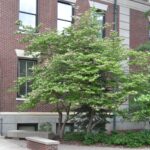
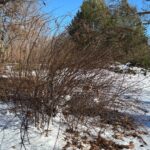
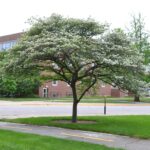
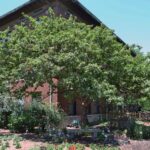
Tree Diospyros virginiana 'Meader' [Meader Persimmon] Most usually dioecious. Flowers attract bees. Fruit attracts birds and many mammals. The fruit is astringent when green, sweet and edible when ripe. Fruits, twigs, and leaves can be a littler problem. Deep tap root makes large plants difficult to transplant. Can be poisonous to horses. ‘Meader’ is a self-fertile cultivar usually producing fruit after 2-3 years.
Shrub Indiana Native Audio Recording AvailableID That Tree Video Available Dirca palustris [Leatherwood] Dirca palustris is a small, dense, quite rounded, Indiana native shrub with excellent yellow fall coloration. Although it is generally uncommon in the wild, Leatherwood can be found growing naturally and thriving along the ravines of Turkey Run State Park in Marshall, IN. This plant requires rich, moist, acidic soils and should be protected from intense sun. Leatherwood fruits, bark, and roots are poisonous. Indiana NativeAudio Recording AvailableID That Tree Video Available
Shrub Indiana Native Audio Recording AvailablePurdue Plant Doctor Available Euonymus americanus [American Euonymus] The American Euonymus is a small, suckering shrub that is native to the eastern portions of the United States, west to Texas. Normally, the American Euonymus can be found in woodlands and can tolerate deep shade and a wide range of soil types. Its flowers are unusual for Euonymus because of its five-petaled flowers instead of the usual four for most other Euonymus species. Other common names, such as Strawberry-bush or Hearts-a-Burstin, are derived from… Indiana NativeAudio Recording AvailablePurdue Plant Doctor Available
Shrub/Tree Indiana Native Audio Recording AvailableID That Tree Video AvailablePurdue Plant Doctor Available Euonymus atropurpureus [Eastern Wahoo] The Easter Wahoo is an Indiana native shrub/small tree that can be found in open woods or along forest edges and is grown for its attractive red fruits and great fall color. Due to its irregular habit, the Eastern Wahoo can be an issue in the formal landscape, but regular pruning can fix this issue. Far less invasive than the infamous Euonymus alatus (Winged Euonymus or Burning Bush). Flowers are small, rich purple that bloom… Indiana NativeAudio Recording AvailableID That Tree Video AvailablePurdue Plant Doctor Available
Tree Indiana Native Audio Recording AvailableID That Tree Video AvailablePurdue Plant Doctor Available Fagus grandifolia [American Beech] In a proper site, an excellent trouble-free shade tree with year-round interest. Less adaptable to hot, dry conditions than the exotic F. sylvatica, but somewhat more cold hardy. F. grandifolia is preferred in Zone 4. Like F. sylvatica, this tree is so shallow rooted and casts such heavy shade that grass does not grow well beneath it. Low branching habit is a concern for use in the tree lawn as a street tree (may require… Indiana NativeAudio Recording AvailableID That Tree Video AvailablePurdue Plant Doctor Available
Shrub/Tree Indiana Native Audio Recording Available Forestiera acuminata [Swamp Privet] The Swamp Privet is a large shrub typically found near swamps, floodplains, wet woods and marshes. Purple-black fruits (drupes) ripen during late summer and is a food source for water fowl, such as ducks. Forestiera acumunata is dioecious, so one would need a male and female for the shrub to produce its fruit. Leaves are a dark green and looks evergreen from a glance, yet turns a golden yellow in fall. Indiana NativeAudio Recording Available
Shrub/Tree Indiana Native Audio Recording AvailableID That Tree Video Available Frangula caroliniana [Carolina Buckthorn] Handsome shrub or small tree with dark green, 8 to 10 vein-paired leaves. Fruits are 1/3" diameter, globose and has a sweet taste to it. Changes from red to black as it matures. Fruit ripes (Red) in August and remain on the plant until October or later, by which time it turns black. Indiana NativeAudio Recording AvailableID That Tree Video Available
Tree Indiana Native Audio Recording AvailableID That Tree Video AvailablePurdue Plant Doctor Available Fraxinus americana [White Ash] Not as adaptable as Green Ash but has better esthetics. Heavy crops of seeds on female trees cause litter, and these germinate freely making the tree slightly weedy. An unattractive ash flower gall (caused by mites) can develop on male flowers and persist into winter. Subject to storm damage, so plant in areas that shelter the tree from strong winds. Emerald Ash Borer is severely affecting all species of this genus. Damage can be prevented… Indiana NativeAudio Recording AvailableID That Tree Video AvailablePurdue Plant Doctor Available
Tree Audio Recording AvailablePurdue Plant Doctor Available Fraxinus americana 'Autumn Applause' [Autumn Applause White Ash] The Autumn Applause Ash has a dense and rounded form with excellent maroon fall color. Heavy crops of seeds on female trees cause litter, and these germinate freely making the tree slightly weedy. An unattractive ash flower gall (caused by mites) can develop on male flowers and persist into winter. Subject to storm damage, so plant in areas that shelter the tree from strong winds. Emerald Ash Borer is severely affecting all species of this… Audio Recording AvailablePurdue Plant Doctor Available
Tree Indiana Native ID That Tree Video AvailablePurdue Plant Doctor Available Fraxinus nigra [Black Ash] Emerald Ash Borer is severely affecting all species of this genus. Damage can be prevented with the appropriate pesticide, but the treatment cost will eventually exceed replacement cost. See the Purdue Landscape Report article: Should ash trees still be protected from emerald ash borer? for more information. Indiana NativeID That Tree Video AvailablePurdue Plant Doctor Available